
Loading, please wait...
_900x900.jpg "Bactrian Lapis Lazuli Pin-Head and Bead")
_200x200.jpg "Bactrian Lapis Lazuli Pin-Head and Bead")
.jpg "Bactrian Lapis Lazuli Pin-Head and Bead")
LOT 1191
Bactrian Lapis Lazuli Pin-Head and Bead
3RD MILLENNIUM B.C.
4 in. (50 grams, 10 cm).
Comprising: a lapis lazuli bead with high-relief figure of a snake in sinuous coils, head poised to strike, with eyes formed as turquoise annular beads; a bronze columnar handle; a tabular banded agate bead; all three bound together from the bronze corrosion products.
Provenancewith Gallery Rosen Ancient Art, Tel Aviv, 1968.
with a London, UK gallery, 1971-early 2000s.
Accompanied by a copy of the original 1968 invoice.
This lot has been checked against the Interpol Database of stolen works of art and is accompanied by a search certificate number no.12409-225344.
This lot has been cleared against the Art Loss Register database, and is accompanied by an illustrated lot declaration signed by the Head of the Antiquities Department, Dr Raffaele D'Amato.
TimeLine Auctions follows a vetting process to ensure the authenticity and legality of all items, reinforcing our commitment to integrity and responsible trading. Each antiquity, antique, and coin lot undergoes thorough examination by a vetting committee of at least ten external specialists, professional trade association members, scientists, and archaeologists: Our Vetting Process
AUCTIONS:
TimeLine is a leading auction house specialising in antiquities, ancient art, collectables, natural history, coins, medals, and books. Our auctions offer museums, collectors, historians, and enthusiasts the opportunity to acquire unique and historically significant pieces.
LOT 1191
Bactrian Lapis Lazuli Pin-Head and Bead
Estimate £1,500 - 2,000€1,740 - 2,320 (for guidance only)$2,030 - 2,700 (for guidance only)
-
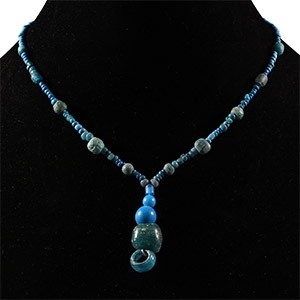
Achaemenid Pale Blue Glass Bead Necklace String
6th-4th century B.C. and laterSold for (Inc. bp): £91
A restrung designer necklace composed of alternating large and small oblate beads, central feature composed of larger beads with an annular bead below. 10.67 grams, 33.5 cm
Ex London, UK, collection, 1990s. This lot has been cleared against the Art Loss Register database, and is accompanied by an illustrated lot declaration signed by the Head of the Antiquities Department, Dr Raffaele D'Amato. -
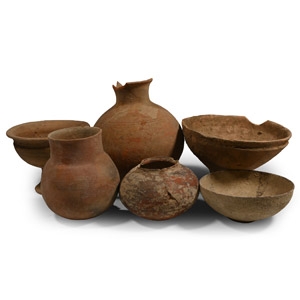
Western Asiatic and Other Pottery Collection
3rd-1st millennium B.C.Sold for (Inc. bp): £52
A mixed group comprising three bulbous jars, two footed bowls and a one squat jar; fragmentary. 2.89 kg total, 13-19.5 cm
From a West Country collection, UK, 1990s. This lot has been cleared against the Art Loss Register database, and is accompanied by an illustrated lot declaration signed by the Head of the Antiquities Department, Dr Raffaele D'Amato. -
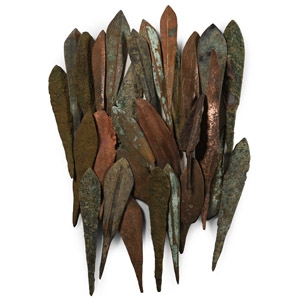
Western Asiatic Bronze Arrowhead Collection
19th - 2nd century B.C.Sold for (Inc. bp): £130
Including triangular, leaf-shaped, barbed, paddle-shaped arrowheads with a flat, comparatively wide mid-rib, and others. 271 grams total, 5.8-10.7 cm
Ex London art market, 1980-1990s. This lot has been cleared against the Art Loss Register database, and is accompanied by an illustrated lot declaration signed by the Head of the Antiquities Department, Dr Raffaele D'Amato.
Some of the represented arrowheads (paddle-shaped) were typical of the Old Babylonian Empire. The shoulders were pronounced and the arrowhead had a rectangular-section tapering tang. This simple form was popular throughout and are comparatively common finds in the Holy Land.
