
Loading, please wait...
_900x900.jpg "Bactrian Gold Wire Necklace with Pendant")
_200x200.jpg "Bactrian Gold Wire Necklace with Pendant")
.jpg "Bactrian Gold Wire Necklace with Pendant")
LOT 0250
Bactrian Gold Wire Necklace with Pendant
3RD-2ND CENTURY B.C.
26 in. (37.20 grams, 66 cm).
Tightly-coiled wire band with graduated profile, domed disc closure with repoussé central boss and pellets to the rim, pendant formed as a rectangular frame enclosing two fusiform banded agate and another fusiform bead, barrel-shaped gold collars and coiled wire finials.
Provenancewith Ancient and Islamic Art Ltd, 1993.
Private European collection, early 1990s.
This lot has been checked against the Interpol Database of stolen works of art and is accompanied by a search certificate number no.12426-218224.
TimeLine Auctions follows a vetting process to ensure the authenticity and legality of all items, reinforcing our commitment to integrity and responsible trading. Each antiquity, antique, and coin lot undergoes thorough examination by a vetting committee of at least ten external specialists, professional trade association members, scientists, and archaeologists: Our Vetting Process
AUCTIONS:
TimeLine is a leading auction house specialising in antiquities, ancient art, collectables, natural history, coins, medals, and books. Our auctions offer museums, collectors, historians, and enthusiasts the opportunity to acquire unique and historically significant pieces.
LOT 0250
Bactrian Gold Wire Necklace with Pendant
Estimate £4,000 - 6,000€4,640 - 6,960 (for guidance only)$5,400 - 8,100 (for guidance only)
-
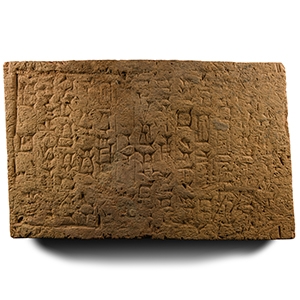
Temple Brick Section of Nebuchadnezzar II, King of Babylon
Circa 604-562 B.C.Sold for (Inc. bp): £5,200
A rectangular-section panel with fourteen columns of cuneiform text mentioning the foundation of a temple by Nebuchadnezzar II, translating as 'King of Babylon provisioner of Esagil and Ezida prime son of Nabopolassar, King of Babylon and Ebabbara, the temple of Shamash in Larsa..[...]. 1.05 kg, 21 x 13 cm
Formerly in a private collection since 1980. Acquired from the private collection of L.H., Staffordshire, UK. Previously the property of an East Sussex, UK, gentleman. From a collection acquired from various auction houses in the UK. From the estate of Mr R.W., a private Wiltshire, UK, collector; thence by descent. Accompanied by a copy of a five-page specialist report by James Brenchley. This lot has been checked against the Interpol Database of stolen works of art and is accompanied by search certificate no.12315 -215546.
The construction of the Hanging Gardens of Babylon and the destruction of Jerusalem's temple are ascribed to Nebuchadnezzar II. He is featured in the biblical Book of Daniel and is mentioned in several other books of the Bible. -
.jpg)
Mesopotamian Alabaster Disc Bead Necklace String
Circa 4th millennium B.C.Sold for (Inc. bp): £364
Composed of restrung discoid beads. 29 grams, 45 cm long
UK gallery, early 2000s. -
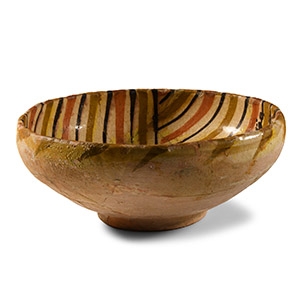
Central Asian Pottery Bowl with Kufic Inscription
Circa 10th century A.D.Estimate: £500 - 700 (+bp*)
Opening Bid: £160
Of rounded profile with painted design to inner face: quartered design of black, olive green and coral stripes on a cream field, one and a half lines of Kufic text across the centre; repaired. 384 grams, 16.5 cm wide
with a London, UK gallery 1971-early 2000s.
