
Loading, please wait...
_900x900.jpg "Bactrian Gold Coiled Wire Necklace with Pendant")
_200x200.jpg "Bactrian Gold Coiled Wire Necklace with Pendant")
.jpg "Bactrian Gold Coiled Wire Necklace with Pendant")
LOT 1227
Bactrian Gold Coiled Wire Necklace with Pendant
3RD-2ND MILLENNIUM B.C.
26 in. (37.20 grams, 66 cm).
Tightly-coiled wire band with graduated profile, domed disc closure with repoussé central boss and pellets to the rim, pendant formed as a rectangular frame enclosing two fusiform banded agate and another fusiform bead, barrel-shaped gold collars and coiled wire finials.
Provenancewith Ancient and Islamic Art Ltd, 1993.
Private European collection, early 1990s.
This lot has been checked against the Interpol Database of stolen works of art and is accompanied by a search certificate no.12597-232360.
Cf. Salvatori, S., 'Early Bactrian objects in private collections' in Ligabue, G., and Salvatori, S., Bactria. An Ancient Oasis from the Sands of Afghanistan, Venice, 1988, pp.181-7, fig.62ff, for similar style of jewellery.
FootnotesIn Old Bactria there are a number of necklaces with compartmented chlorite rosettes containing settings in lapis lazuli, cornelian, and turquoise, which seem to indicate a tradition of purely local taste; together with these should be considered other examples in twisted gold lamina, like our example, with pendants in gold or in semi-precious stones such as rock crystal.
CONDITIONTimeLine Auctions follows a vetting process to ensure the authenticity and legality of all items, reinforcing our commitment to integrity and responsible trading. Each antiquity, antique, and coin lot undergoes thorough examination by a vetting committee of at least ten external specialists, professional trade association members, scientists, and archaeologists: Our Vetting Process
AUCTIONS:
TimeLine is a leading auction house specialising in antiquities, ancient art, collectables, natural history, coins, medals, and books. Our auctions offer museums, collectors, historians, and enthusiasts the opportunity to acquire unique and historically significant pieces.
-
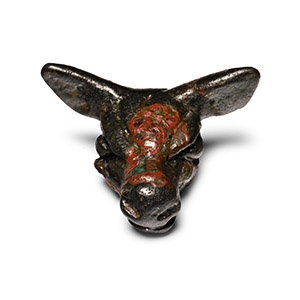
Western Asiatic Bronze Amulet of a Deer's Head
2nd-1st millennium B.C.Estimate: £180 - 240 (‡+bp*)
Opening Bid: £90
Modelled in the round with large alert ears, deeply incised facial detailing. 6.16 grams, 21 mm
Ex Dr. Leo Mildenberg, Zurich, 1990s. Acquired by Galerie Rhéa, Zurich, from the above in 1999. -
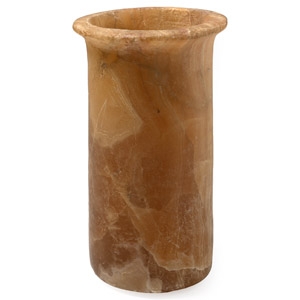
Mesopotamian Stone Vase
1st millennium B.C.Sold for (Inc. bp): £124
Slightly flared tubular body with flat everted rim. 311 grams, 10.4 cm
Ex Mayfair, London, UK, gallery, 2000s. -
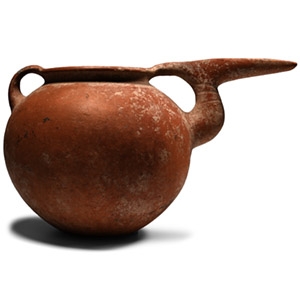
Large Amlash Terracotta Vessel
Early 1st millennium B.C.Estimate: £2,000 - 3,000 (+bp*)
Opening Bid: £864
Of zoomorphic form, with a globular body, u-section spout and loop handle to the rear. 846 grams, 30 cm wide
Acquired before 1978. Private collection, UK. Accompanied by a thermoluminescence analysis report no.N125e39 from Oxford Authentication. This lot has been checked against the Interpol Database of stolen works of art and is accompanied by a search certificate number no.12703-235149.
