
Loading, please wait...
_900x900.jpg "Bactrian Bronze Zebu Vessel with Stopper")
_200x200.jpg "Bactrian Bronze Zebu Vessel with Stopper")
_900x900.jpg "Bactrian Bronze Zebu Vessel with Stopper")
_200x200.jpg "Bactrian Bronze Zebu Vessel with Stopper")
_900x900.jpg "Bactrian Bronze Zebu Vessel with Stopper")
_200x200.jpg "Bactrian Bronze Zebu Vessel with Stopper")
.jpg "Bactrian Bronze Zebu Vessel with Stopper")
.jpg "Bactrian Bronze Zebu Vessel with Stopper")
.jpg "Bactrian Bronze Zebu Vessel with Stopper")
LOT 0222
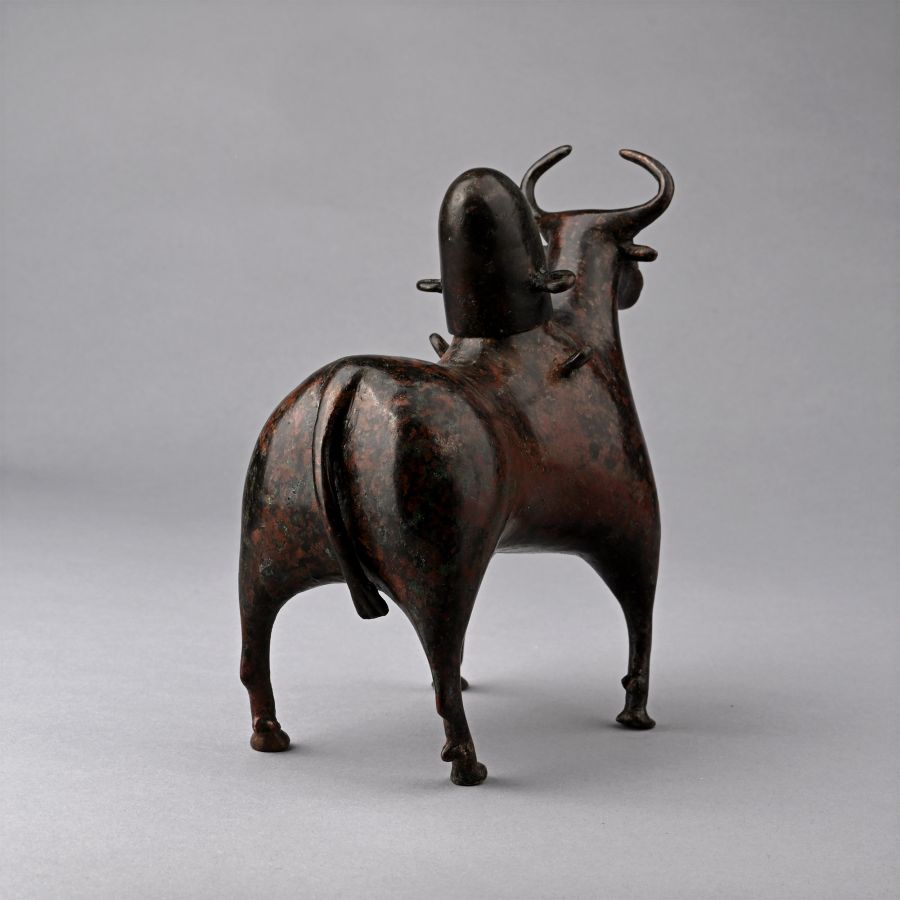
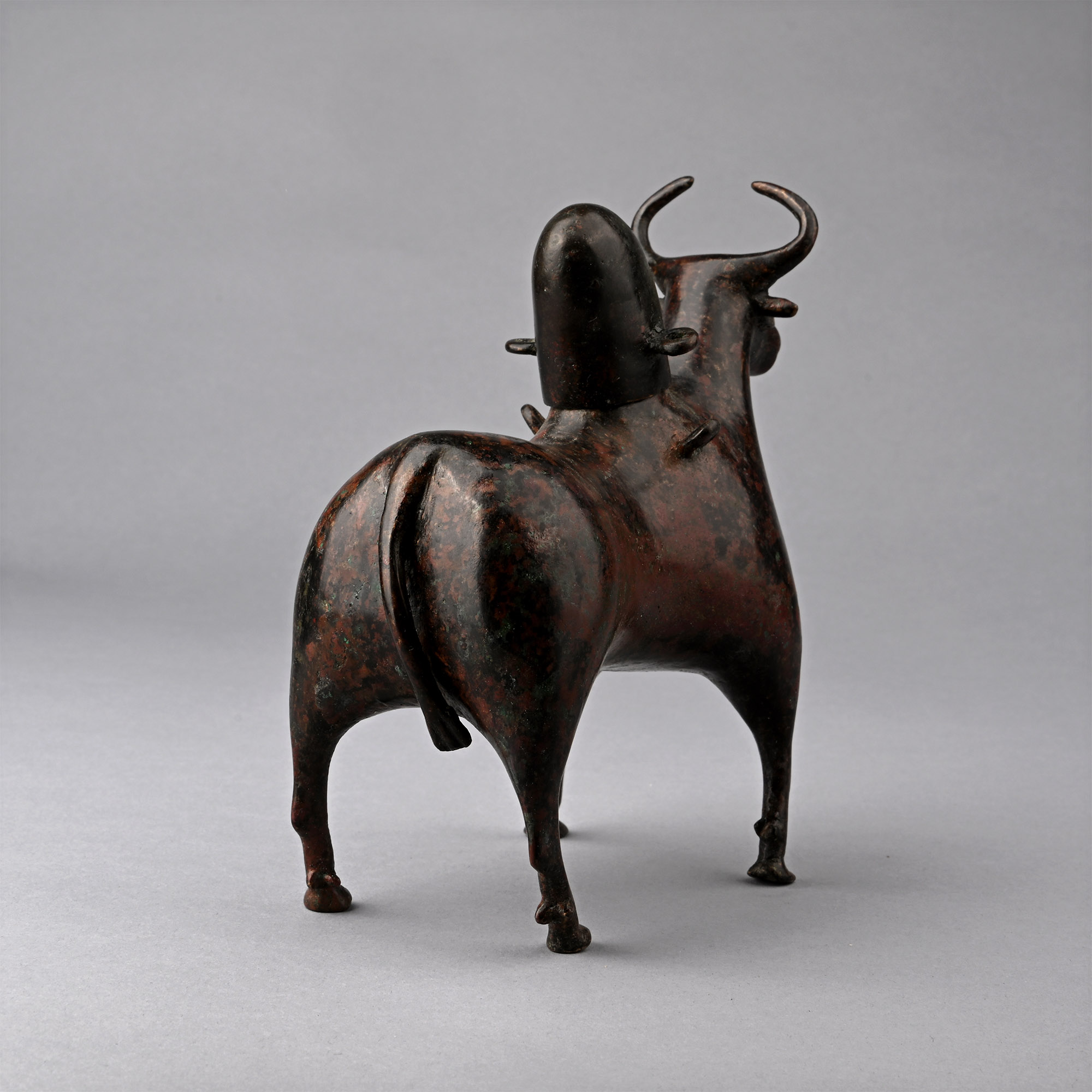
Bactrian Bronze Zebu Vessel with Stopper
1ST MILLENNIUM B.C.
6 1/2 in. (870 grams, 16.5 cm wide).
Modelled in the round as a zebu standing four-square with head raised; columnar muzzle with shallow slit mouth, discoid eye-sockets to accept and inlay; lateral loops at the shoulder and tubular filler-hole; separate hump forming a lid with corresponding loops for attachment.
ProvenancePrivate collection, New York, 1987.
with Bonhams, London, 1 May 2013, no.154.
Accompanied by a copy of the relevant Bonhams catalogue pages.
Accompanied by a copy of French passport no.119527.
Accompanied by an academic report by Dr Raffaele D’Amato.
This lot has been checked against the Interpol Database of stolen works of art and is accompanied by search certificate number no.12976-245249.
See a statuette of a zebu in the Metropolitan Museum of Art, accession number 64.7; for the iconography see Vats, M.S., Excavations at Harappā. In two volumes with plans and plates. V. II. 139 Plates, Delhi, 1940; Winkelmann, S., ‘Transformation of Near Eastern animal motifs in Murghabo-Bactrian Bronze Age art’ in Peruzzetto A. et al. Animals, Gods and Men from East to West. Papers on archaeology and history in honour of Roberta Venco Ricciardi, Eds. BAR International Series 2516, 2013, pp.47–64.
FootnotesThe majestic zebu bull, with its heavy dewlap and wide curving horns, was considered to be a symbol of majesty and power since the first civilizations of the Indus Valley. It was the leader of the herd, the strength and virility (then symbol of fecundity) of which protected the group and ensured the procreation of the species. This is the reason why it was often chosen for sacrificial rites. It probably represented the emblem of the most powerful clans or top classes of Mohenjo-Daro and Harappa and it was the most impressive motif found in these cities, appearing constantly on painted pottery and bronze or clay figurines of the Indus area.
CONDITIONTimeLine Auctions follows a vetting process to ensure the authenticity and legality of all items, reinforcing our commitment to integrity and responsible trading. Each antiquity, antique, and coin lot undergoes thorough examination by a vetting committee of at least ten external specialists, professional trade association members, scientists, and archaeologists: Our Vetting Process
AUCTIONS:
TimeLine is a leading auction house specialising in antiquities, ancient art, collectables, natural history, coins, medals, and books. Our auctions offer museums, collectors, historians, and enthusiasts the opportunity to acquire unique and historically significant pieces.
LOT 0222
Bactrian Bronze Zebu Vessel with Stopper
Estimate £15,000 - 20,000€17,400 - 23,200 (for guidance only)$20,250 - 27,000 (for guidance only)
-
Heavy Luristan Bronze Dish
13th-7th century B.C.Estimate: £150 - 200 (+bp*)
Opening Bid: £75
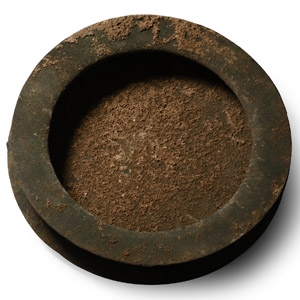
Comprising a shallow body with sharply sloping walls and wide, everted rim. 712 grams, 19.5 cm
Acquired 1980-2015. Ex Abelita family collection. This lot has been cleared against the Art Loss Register database, and is accompanied by an illustrated lot declaration signed by the Head of the Antiquities Department, Dr Raffaele D'Amato. -
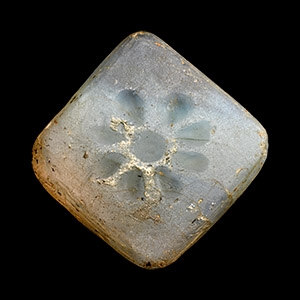
Western Asiatic Chalcedony Gaming Piece
3rd-5th century A.D.Estimate: £400 - 600 (+bp*)
Opening Bid: £222
Square in plan and plano-convex in section with tessellated triangles on the dome, horizontal grooves at the sides, incuse octofoil to the underside. 39.7 grams, 31 mm
Ex Mayfair, London, UK, collection, 1980s. -
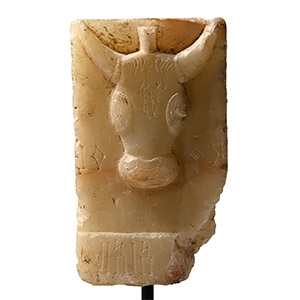
South Arabian Alabaster Plaque with Bull's Head
3rd-1st century B.C.Sold for (Inc. bp): £910
Comprising a square panel with a bull's head in low-relief, striated eyes and flaring nostrils, a thick tuft of hair arranged between the eyes, shallow acanthus leaf between curved horns, inscription on the rectangular space at the bottom of the panel; mounted on a custom-made display stand. 2.09 kg total, 19.8 cm including stand
UK collection, 1990s. Acquired on the UK art market, before 2000. Private collection, Mr M.V., a London-based businessman.
The presence of these representations in South Arabian cemeteries attests to the importance of the bull in the religious iconography of pre-Islamic Arabia.
