
Loading, please wait...
LOT 1391
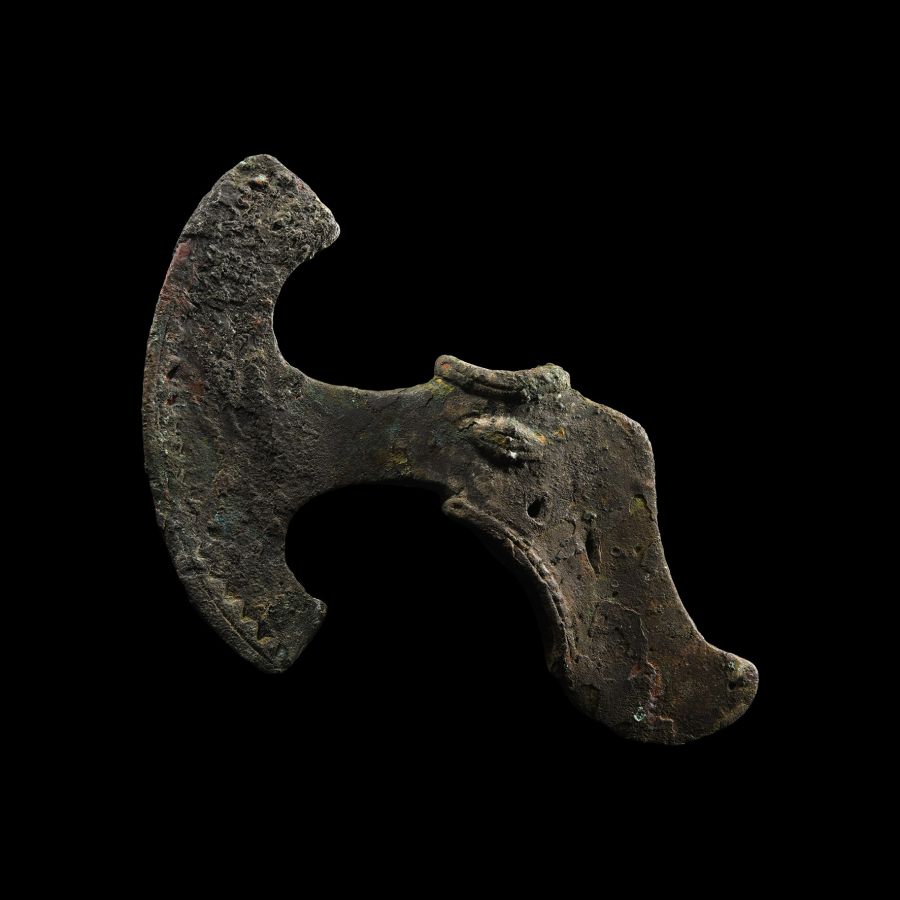
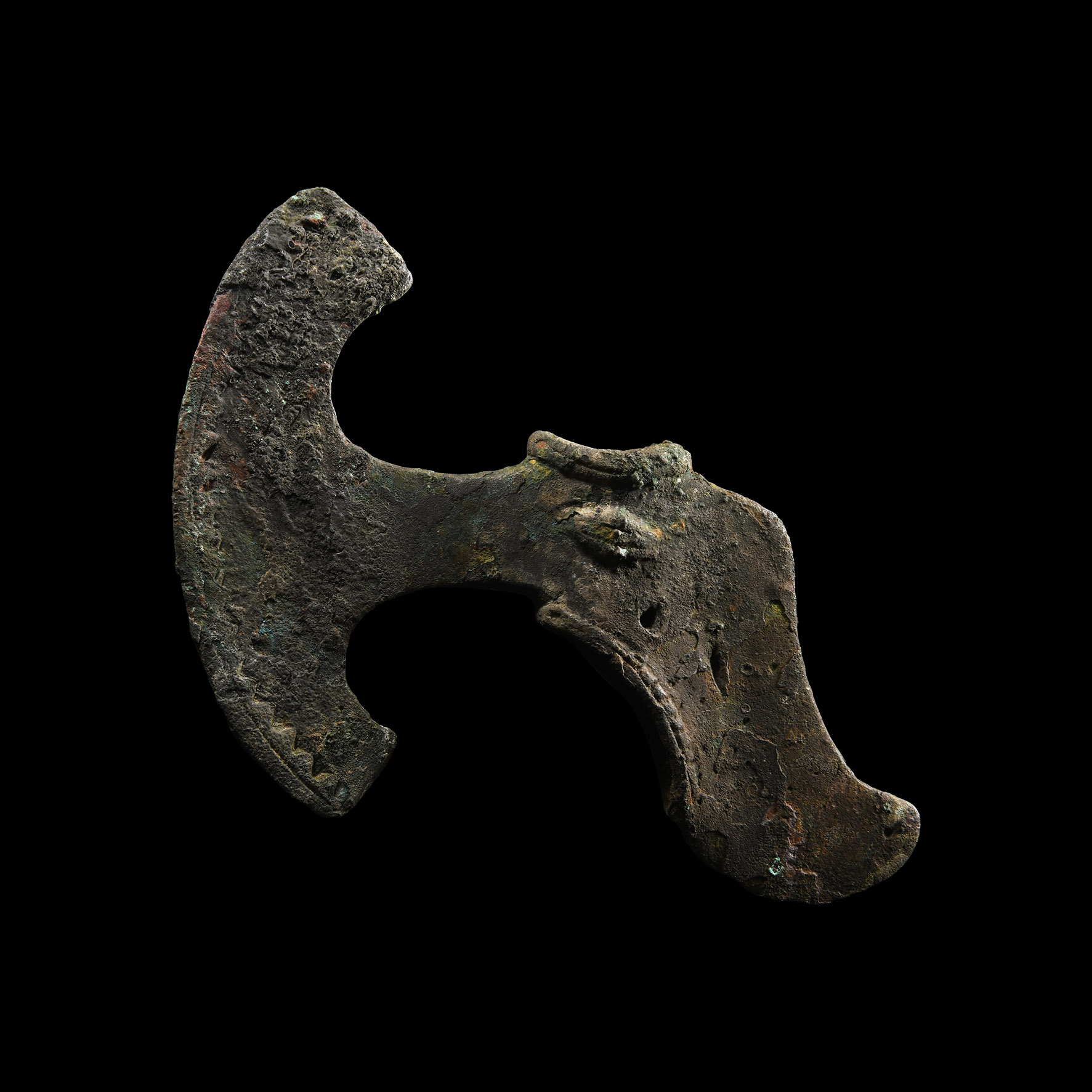
Bactrian Bronze Eye Axehead
3RD-2ND MILLENNIUM B.C.
6 1/4 in. (327 grams, 16 cm).
Fan-shaped blade; an apotropaic eye in relief to each side of the socket; wing-shaped extension to the rear.
ProvenanceFrom an old London, UK, collection.
Ex London, UK, gallery.
Cf. Gernez, G., L’armament en métal au Proche et Moyen-Orient: des origines a 1750 av. J.C., Paris, 2007, fig.2.15, subtype H 2.I.b
FootnotesMost of these axes are believed to have originated in Bactria, but some objects come from well documented contexts in Margiane (Gonur), Lut (Shahdad) and Kermanshah (Khinaman). According to Gernez they were made for ceremonial use.
CONDITIONTimeLine Auctions follows a vetting process to ensure the authenticity and legality of all items, reinforcing our commitment to integrity and responsible trading. Each antiquity, antique, and coin lot undergoes thorough examination by a vetting committee of at least ten external specialists, professional trade association members, scientists, and archaeologists: Our Vetting Process
AUCTIONS:
TimeLine is a leading auction house specialising in antiquities, ancient art, collectables, natural history, coins, medals, and books. Our auctions offer museums, collectors, historians, and enthusiasts the opportunity to acquire unique and historically significant pieces.
LOT 1391
Bactrian Bronze Eye Axehead
Estimate £300 - 400€350 - 460 (for guidance only)$410 - 540 (for guidance only)
-
Luristan Bronze Dagger
13th-7th century B.C.Sold for (Inc. bp): £338
Triangular blade with rib below the shoulder connected to the grip with lateral flanges and integral pommel, recessed to accept an organic insert 228 grams, 34 cm
Ex Abelita family collection, 1988. -
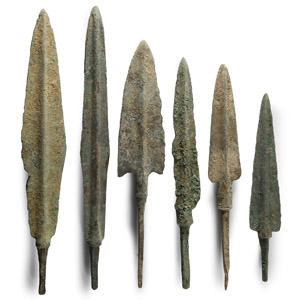
Luristan Bronze Arrowhead Group
12th-9th century B.C.Sold for (Inc. bp): £195
Comprising arrowheads of various types, mainly leaf-shaped and barbed types, with midribs. 216 grams total, 12.2 - 18 cm
Acquired 1990s. From the collection of a late Japanese weaponry collector.
The barbed arrowhead seems to belong to the type V, subcategory type C, according to the classification of Khorasani and Negahban. In the four categories of triangular bronze arrowheads from Luristan, Marlik and Northern Iran individuated by Negahban, subtypes C and D of type V are larger arrow or javelin heads, C large triangular arrowheads with barbed shoulders and D with lanceolate shape and rounded midrib. The straight shoulders recalls a Marlik typology (see Khorasani, 2006, p.307, fig.379). -
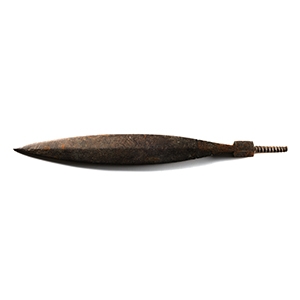
Maasai Leaf-Shaped Iron Spear
20th century A.D.Sold for (Inc. bp): £91
Lenticular in section, leaf-shaped in plan with rectangular block to the shoulder and threaded tang. 447 grams, 37 cm
From an old English collection formed in the 1980s. Property of an Essex gentleman; acquired on the UK art market.
