
Loading, please wait...
LOT 1491
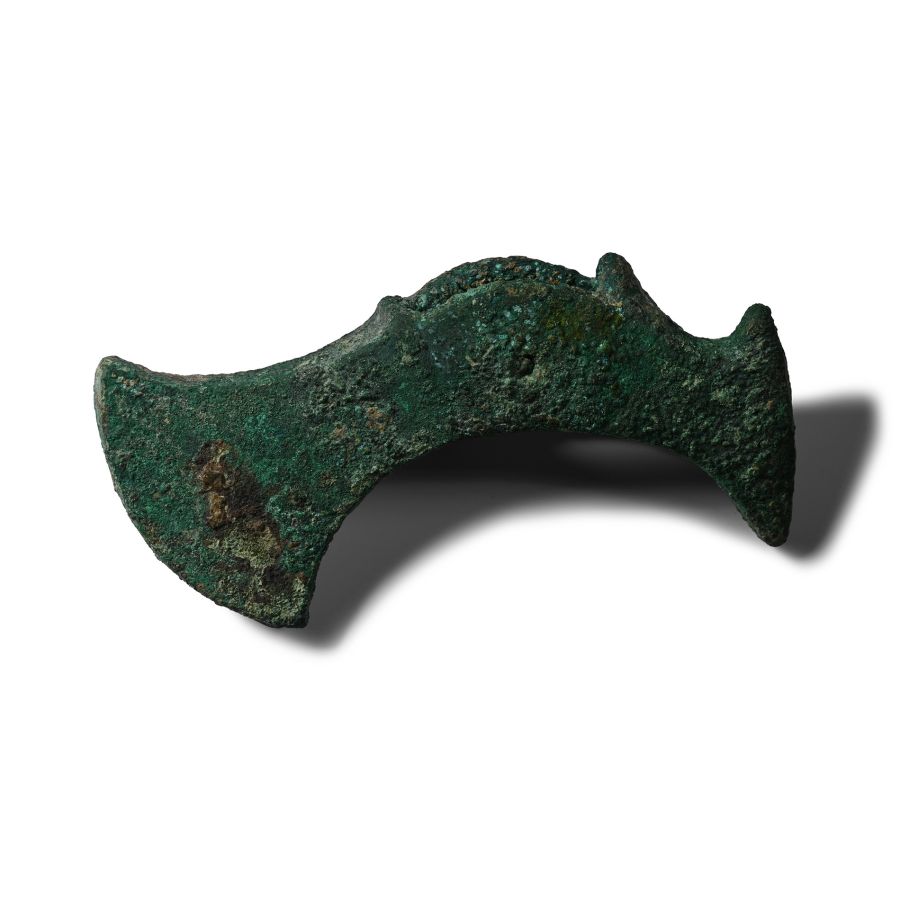
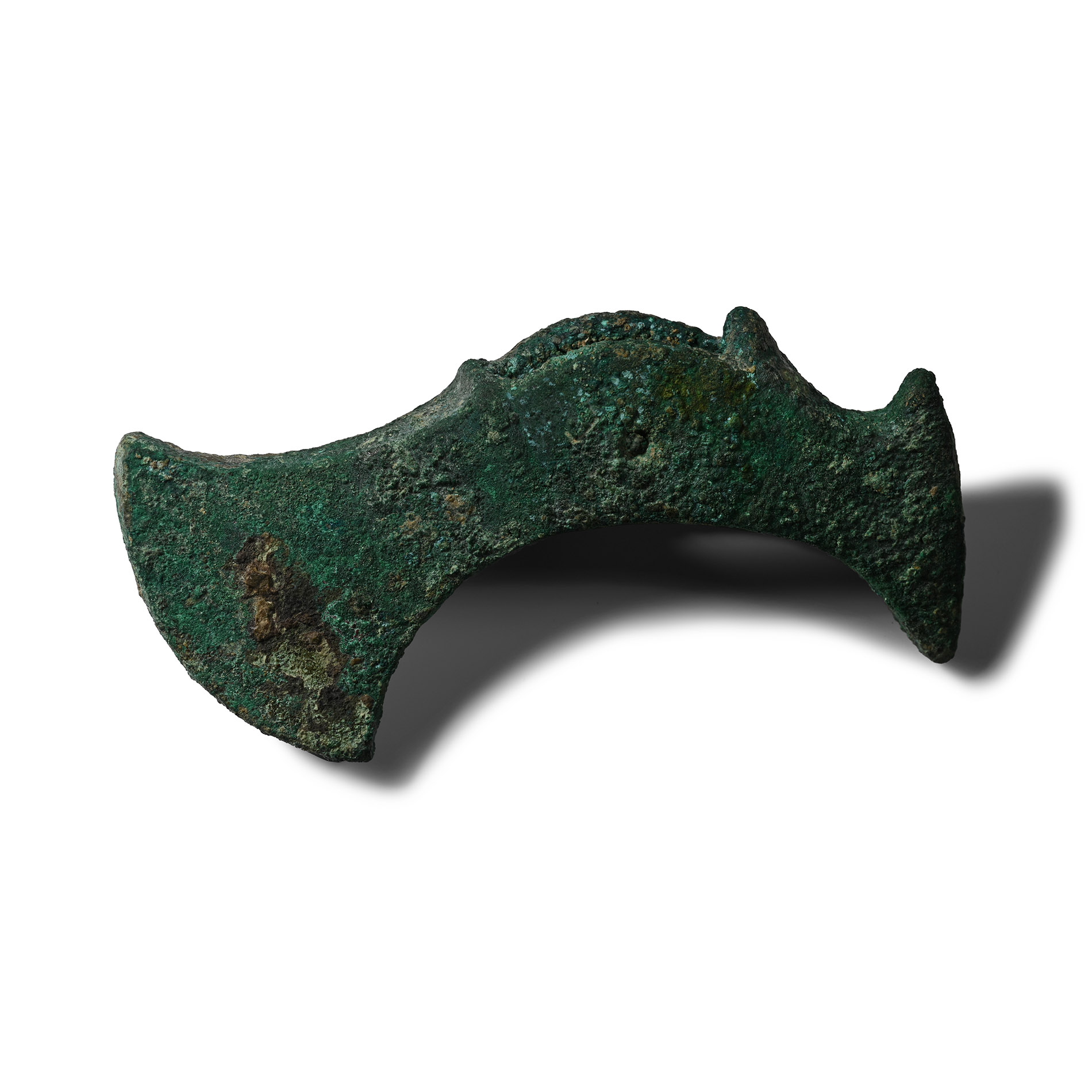
Bactrian Bronze Axehead
3RD-2ND MILLENNIUM B.C.
4 1/8 in. (227 grams, 10.6 cm).
With curved flaring cutting edge, characteristic curving shape and narrow socket, blade end squaring off, shaft hole pierced on both sides.
ProvenanceAcquired in the mid 1980s-1990s.
Private collection, Switzerland, thence by descent.
Private collection, since the late 1990s.
This lot is accompanied by an illustrated lot declaration signed by the Head of the Antiquities Department, Dr Raffaele D'Amato.
Cf. Gernez, G., L’armament en métal au Proche et Moyen-Orient: des origines a 1750 av. J.C., Paris, 2007, fig.2.15, type H2.Ia1, for the type.
FootnotesThese collared axes have the specific feature of being equipped with variously shaped rear extensions. The provenance of this typology is clearer than others: these axes came from Margiana and southern Bactria. Gonur Depe and Susa yielded a rather atypical and probably imported example. P. Amiet suggests that they were an adoption of Elamite material, from conceptual and institutional models. They would have developed from the end of the 3rd and the beginning of the 2nd millennium B.C.
CONDITIONTimeLine Auctions follows a vetting process to ensure the authenticity and legality of all items, reinforcing our commitment to integrity and responsible trading. Each antiquity, antique, and coin lot undergoes thorough examination by a vetting committee of at least ten external specialists, professional trade association members, scientists, and archaeologists: Our Vetting Process
AUCTIONS:
TimeLine is a leading auction house specialising in antiquities, ancient art, collectables, natural history, coins, medals, and books. Our auctions offer museums, collectors, historians, and enthusiasts the opportunity to acquire unique and historically significant pieces.
LOT 1491
Bactrian Bronze Axehead
Estimate £400 - 600€460 - 700 (for guidance only)$540 - 810 (for guidance only)
-
Canaanite 'Window' Bronze Axehead
2100-1800 B.C.Sold for (Inc. bp): £737
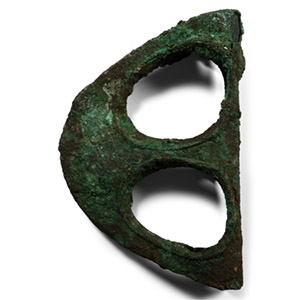
Curving blade with two large 'eye-shaped' openings, cylindrical socket. 142 grams, 11 cm
Acquired in the mid 1980s. Private collection, Switzerland, thence by descent. Private collection, since the late 1990s This lot is accompanied by an illustrated lot declaration signed by the Head of the Antiquities Department, Dr Raffaele D'Amato.
The ‘window’ axes have several morphological characteristics. The blade, semi-circular or elongated in shape, always ended in a rounded edge. In this type the blade was flat in section. It included two openings at its base—windows—of varying width, circular or oval. The haft consisted of a collar as wide as the blade. The weapon was threaded into an elongated wooden handle, often curved at its base, of oval section, with a differential width promoting the strength of the haft. It was thus wedged, and a rivet passed through the handle, just above the axe, serving as a stop. -
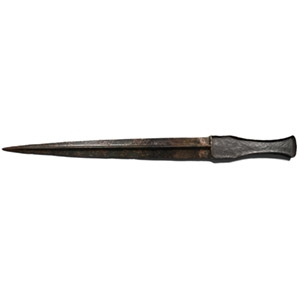
Large Luristan Bronze Dirk
12th century B.C.Sold for (Inc. bp): £294
With raised flanges to the grip, possibly to accept organic inserts, tapering triangular blade with a strong mid-rib. 216 grams, 39.5 cm
Acquired in the 1990s. Ex Abelita family collection. This lot is accompanied by an illustrated lot declaration signed by the Head of the Antiquities Department, Dr Raffaele D'Amato.
The dirk belongs to Type IIIa bronze dirks of the Medveskaya classification. It was cast in one piece (hilt and blade). The presence of the mid-rib however represents an exception to the general typology. -
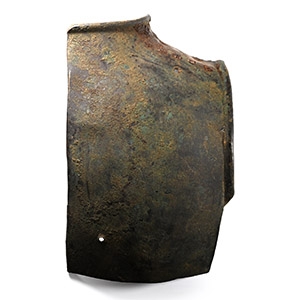
Hellenistic Bronze Cuirass Section
3rd-1st century B.C.Sold for (Inc. bp): £520
Possibly the upper right back element of a composite cuirass for a cataphract (armoured horseman), part of the edge around the neck and shoulders preserved, iron rivets and holes for attaching the shoulder straps still visible. 220 grams, 23 cm
UK private collection, acquired in 1996. This lot is accompanied by an illustrated lot declaration signed by the Head of the Antiquities Department, Dr Raffaele D'Amato.
A near complete armour for cataphract was found in the French excavations in Al-Khanoum, a Hellenistic city in Afghanistan. The cavalry of Seleucid, Ptolemaic and other Hellenistic Kingdoms formed regiments of heavy armoured horsemen, who in the west, employed a combination of lamellar and segmented armour together with muscled armour of Greek type. Cataphract armour in the West had more Greek element, for example more plate armour and less scale and lamellar.
