
Loading, please wait...
LOT 0208
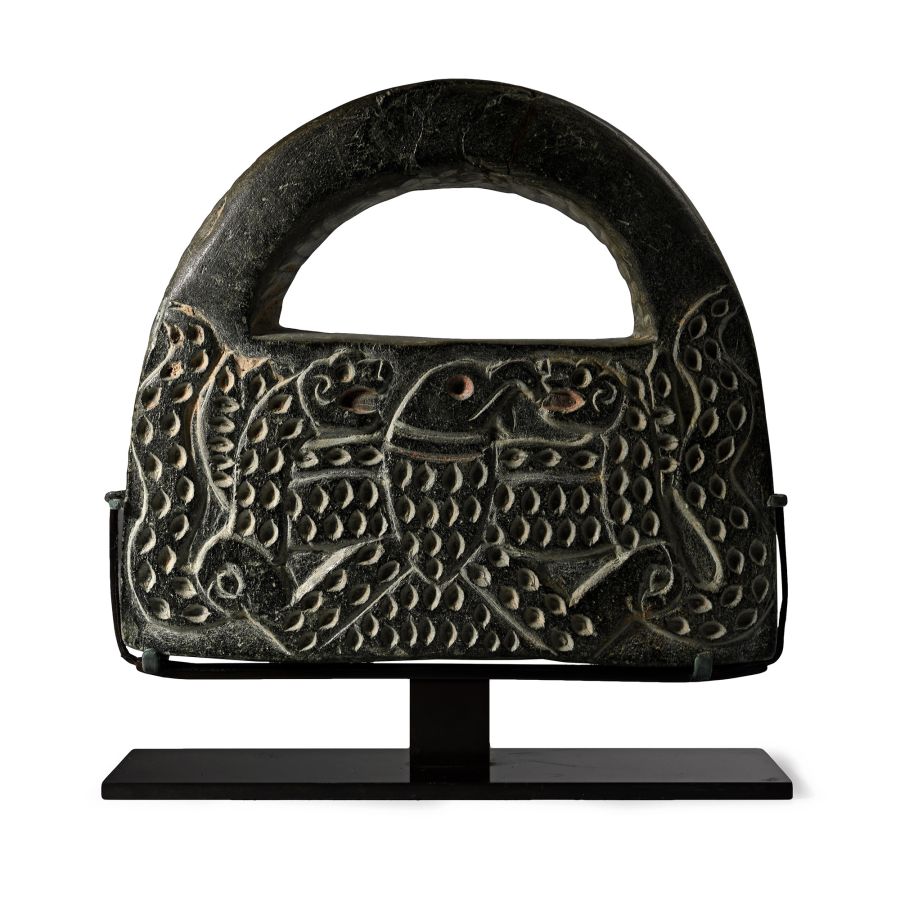
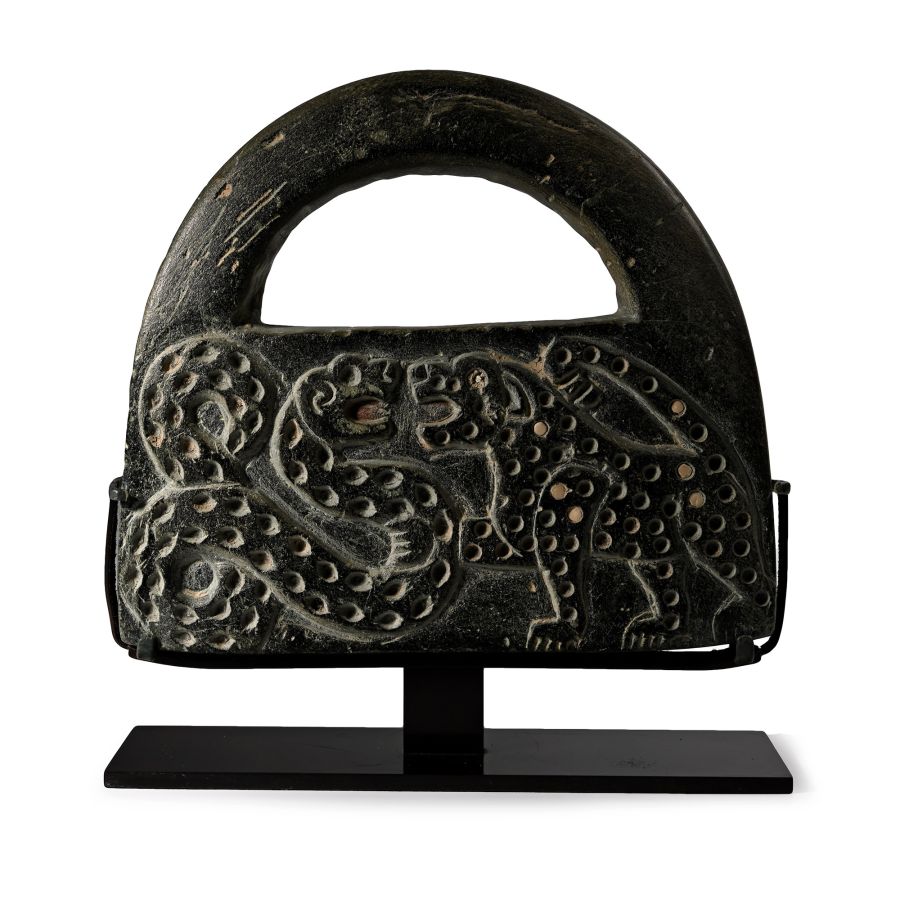
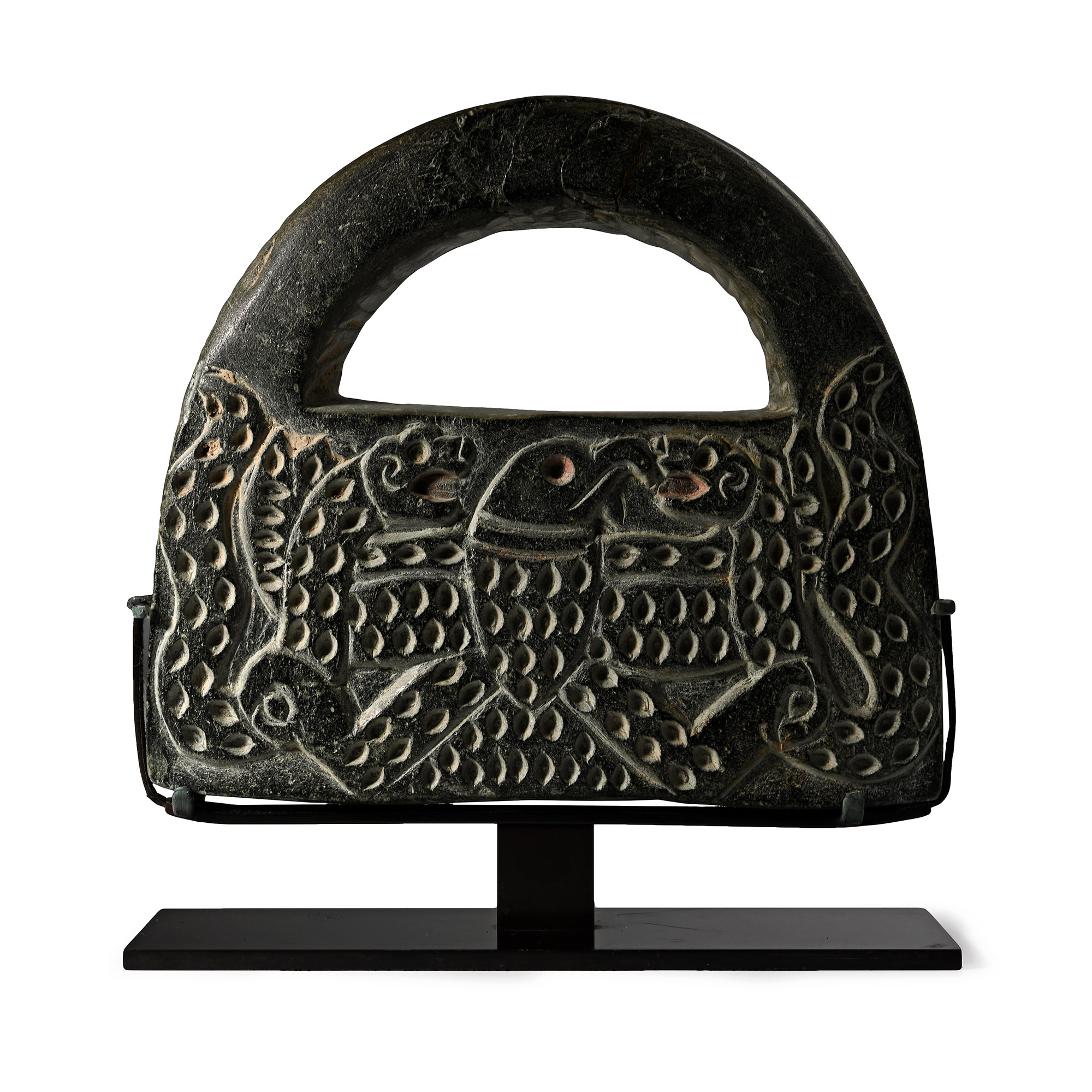
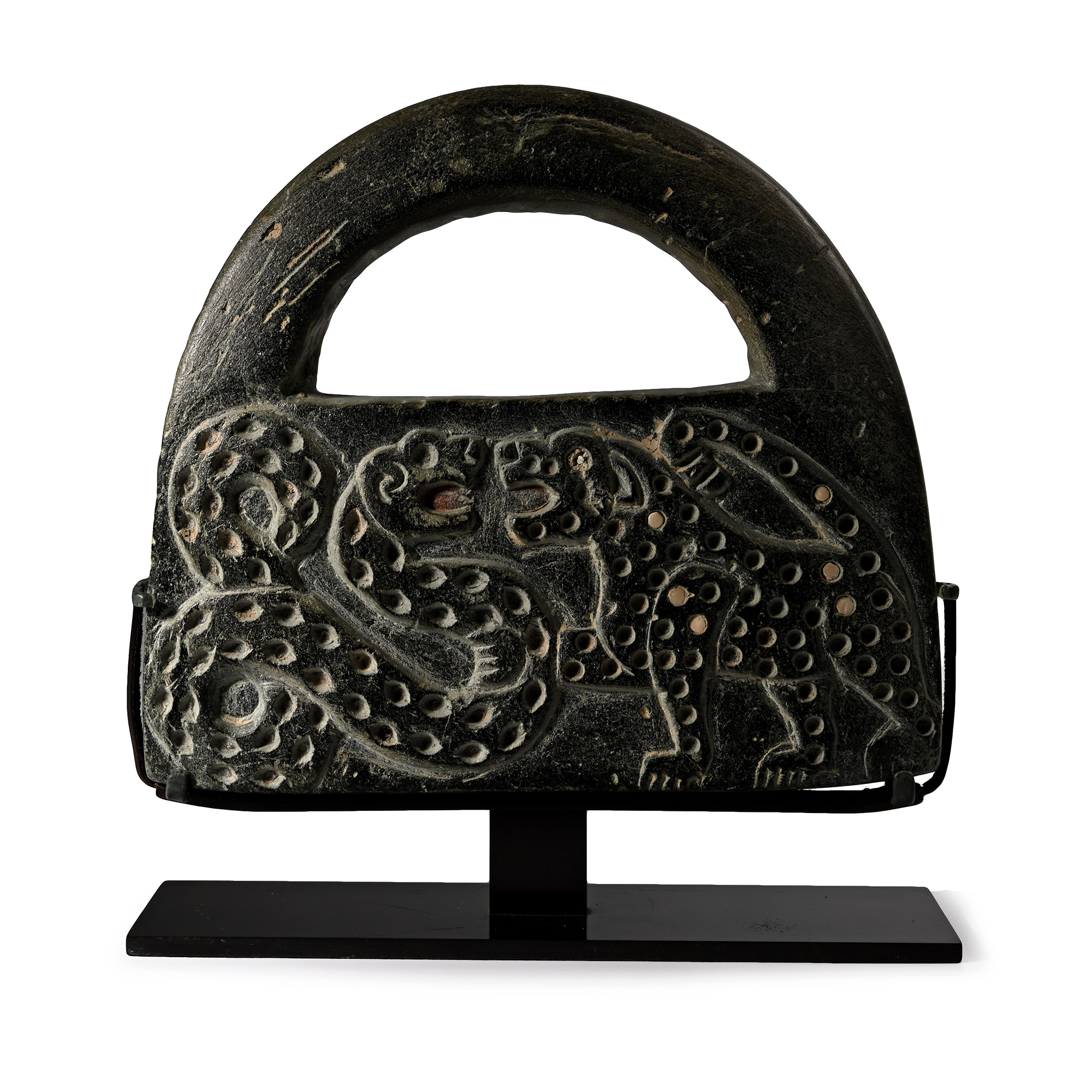
Bactrian Black Chlorite 'Hand Bag' Ceremonial Weight
3RD MILLENNIUM B.C.
7 1/4 in. (8 3/8 in.) (2.95 kg total,18.5 cm (22.5 cm including stand)).
D-shaped in profile with void below the curved edge, obverse with reserved serpent and lion opposed, the lion's claw grasping the serpent; reverse with spread eagle flanked by rearing serpents; all bodies with sockets to accept coloured inserts; mounted on a custom-made stand. [No Reserve]
Provenancewith Gallery Rosen Ancient Art, Tel Aviv, 1960s.
Ex London, UK, gallery, 1971-early 2000s.
London, UK, collection.
This lot has been checked against the Interpol Database of stolen works of art and is accompanied by a search certificate no.12774-237878.
Cf. 7000 years of Iranian Art, Exhibition catalogue, Smithsonian Institute, 1964, p.54 & p.118, illustration no.11; and see Vidale, M., Treasures from the Oxus: The Art and Civilisation of Central Asia, London, 2017, pp.44-51, figs.41-45, for a variety of stones and shapes.
FootnotesThe object could have been carried or swung in ceremonies or processions. On one side is a bird of prey, with its claws surrounded by the writhing bodies of two serpents, whose heads flank the bird's head. This symmetrical scheme probably renders a version of the enmity of eagle and serpent, which must have been an important theme of ancient Iranian art; the motif was later diffused throughout the world.
CONDITIONTimeLine Auctions follows a vetting process to ensure the authenticity and legality of all items, reinforcing our commitment to integrity and responsible trading. Each antiquity, antique, and coin lot undergoes thorough examination by a vetting committee of at least ten external specialists, professional trade association members, scientists, and archaeologists: Our Vetting Process
AUCTIONS:
TimeLine is a leading auction house specialising in antiquities, ancient art, collectables, natural history, coins, medals, and books. Our auctions offer museums, collectors, historians, and enthusiasts the opportunity to acquire unique and historically significant pieces.
-
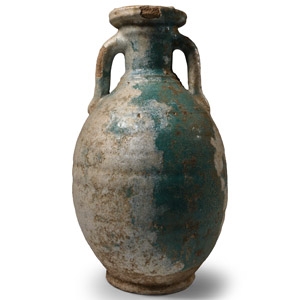
Parthian Lead-Glazed Amphora
1st-3rd century A.D.Estimate: £250 - 350 (+bp*)
Opening Bid: £125
Barrel-shaped in profile with basal ring, short neck with rolled rim and two lateral strap handles. 1.5 kg, 28.5 cm
Ex West London, UK, collection, 1990s. This lot has been cleared against the Art Loss Register database, and is accompanied by an illustrated lot declaration signed by the Head of the Antiquities Department, Dr Raffaele D'Amato. -
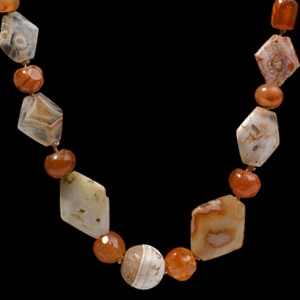
Bactrian Carnelian and Agate Bead Necklace
Late 1st millennium B.C. and laterEstimate: £500 - 700 (+bp*)
Opening Bid: £225
Restrung group of tabular lozenge beads, spherical and other spacer beads. 88 grams, 85.5 cm
Acquired in London, 1974. Ex K.M., London, UK. with Gorny and Mosch, Auction 252, 13 December 2017, no.357. with Gorny and Mosch, Auction 256, 26 June 2018, no.273. Private collection, London, UK. -
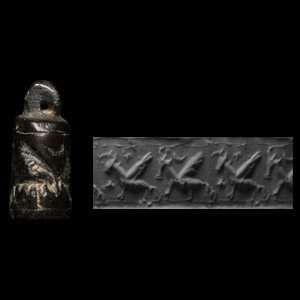
Urartu Black Stone Stamp-Cylinder Seal with Winged Quadruped
Circa 900-700 B.C.Sold for (Inc. bp): £910
With two winged monsters, accompanied by museum quality impressions and a copy of an old scholarly note, typed and signed by W.G. Lambert, late Professor of Assyriology, University of Birmingham, 1970-1993, which states: 'Description of Stamp-Cylinder Seal of black stone, 31 x 14 mm. Sides: two winged monsters of slightly differing type; lunar crescent and other fillers, the design between rules. Base: winged quadruped. The stamp-cylinder is from the ancient Urartu, the area around lake Van, and dates c. 900-700 B.C. It has a pierced lug at the top which allows the base to be used as a stamp seal. Such monsters as are depicted are typical of Urartian art, not only of their seals. Condition very good.' 7.88 grams, 30 mm
UK private collection, acquired 1990-1993. Accompanied by a copy of a scholarly note, typed and signed by Professor Wilfrid George Lambert in 1987.
