
Loading, please wait...
LOT 1174
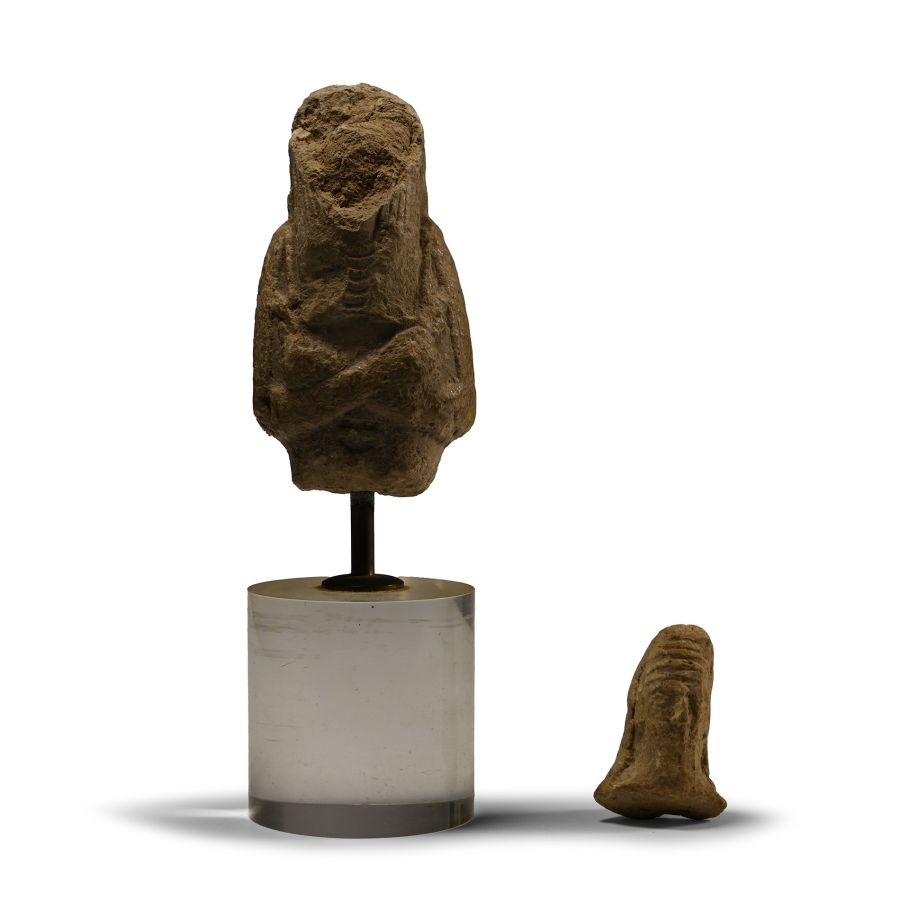
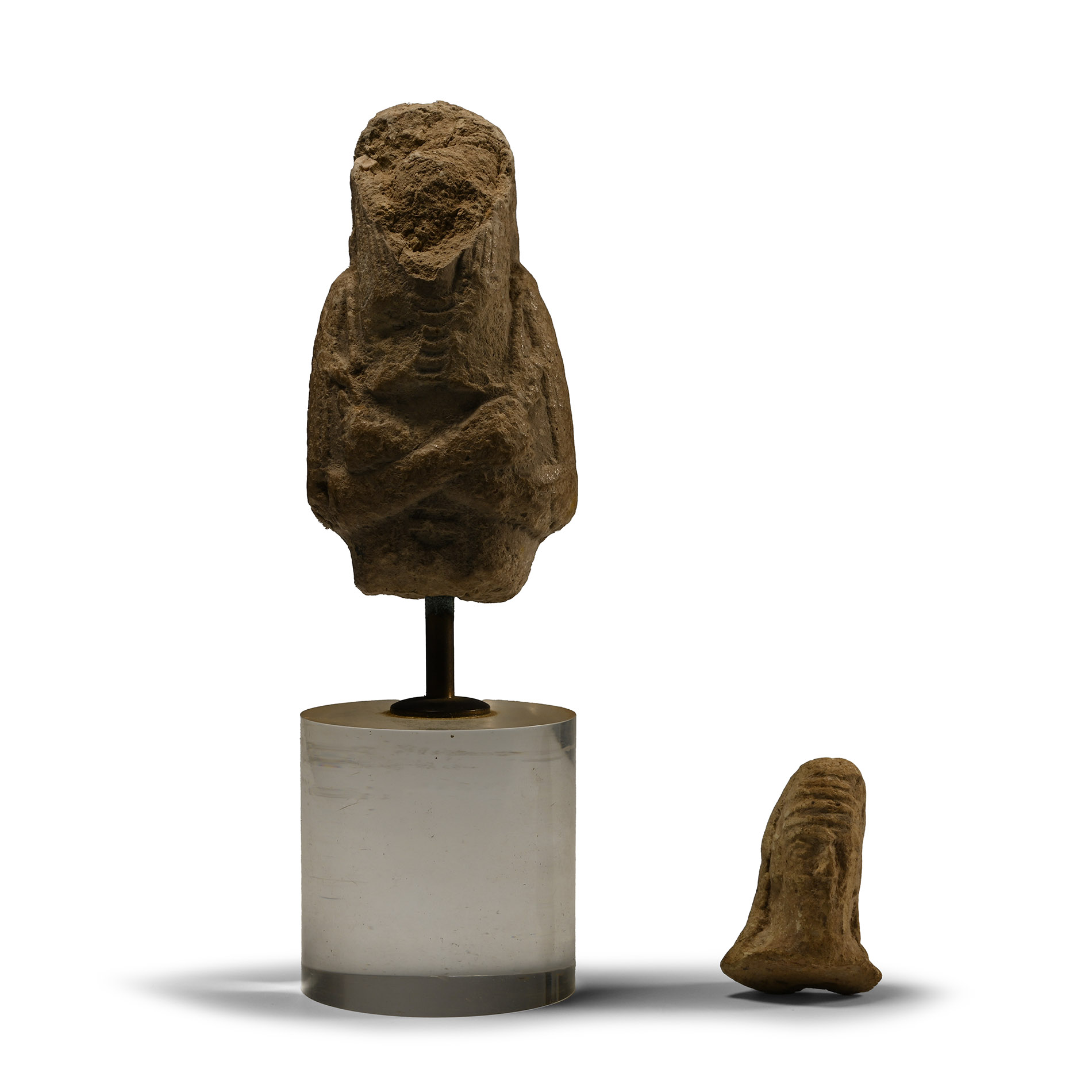
Babylonian Head and Egyptian Shabti Group
MID 1ST MILLENNIUM B.C. AND LATER
1 3/4 - 6 1/2 in. (268 grams total, 4.3-16.5 cm including stand).
Comprising of a male head from a figurine, and a possible Grand Tour fragment of a shabti with tripartite wig and arms crossed at the chest, mounted on a custom-made stand. [2, No Reserve]
ProvenanceFrom an old English deceased estate.
Property of a London, UK, collector.
This lot has been cleared against the Art Loss Register database, and is accompanied by an illustrated lot declaration signed by the Head of the Antiquities Department, Dr Raffaele D'Amato.
TimeLine Auctions follows a vetting process to ensure the authenticity and legality of all items, reinforcing our commitment to integrity and responsible trading. Each antiquity, antique, and coin lot undergoes thorough examination by a vetting committee of at least ten external specialists, professional trade association members, scientists, and archaeologists: Our Vetting Process
AUCTIONS:
TimeLine is a leading auction house specialising in antiquities, ancient art, collectables, natural history, coins, medals, and books. Our auctions offer museums, collectors, historians, and enthusiasts the opportunity to acquire unique and historically significant pieces.
-

Urartu Bull-Headed Bronze Cauldron Applique Pair
8th century B.C.Estimate: £18,000 - 24,000 (‡+bp*)
Opening Bid: £9,000
Matched pair of bovine-head mounts, each formed as a pair of D-shaped wings and a tail with low-relief feather detailing and holes to accept rivets; central head and neck of a bull with prominent horns, bands of curly hair to the pate and throat, large scaphoid eyes, incised contour detailing to muzzle, socket to reverse. 790 grams total, 8-13 cm wide
From the warehouse of Lane Hope Ltd, London, UK, 1980s (company dissolved December 1991). Private collection, UK; anonymous sale, Gorny & Mosch, Munich, Auction 206, 20 June 2012, no.85. European private collection, acquired at Gorny & Mosch, 2012. Accompanied by a copy of an Art Loss Register certificate, no.6210.AM. Accompanied by a copy of the relevant Gorny & Mosch catalogue pages. This lot has been checked against the Interpol Database of stolen works of art and is accompanied by a search certificate number no.12696-234610. This lot has been cleared against the Art Loss Register database, and is accompanied by an illustrated lot declaration signed by the Head of the Antiquities Department, Dr Raffaele D'Amato. -
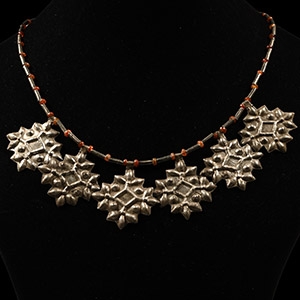
Elamite Carnelian Necklace with Silver Pendants
Late 2nd-early 1st millennium B.C.Estimate: £400 - 600 (+bp*)
Opening Bid: £200
Restrung necklace of sheet-silver tubular beads with interstitial carnelian spacers, six sheet-silver cruciform pendants each with repoussé cross fleury motif. 29.2 grams, 50 cm long
Acquired before 1983. Ex London gallery, 1990s. This lot has been cleared against the Art Loss Register database, and is accompanied by an illustrated lot declaration signed by the Head of the Antiquities Department, Dr Raffaele D'Amato. -
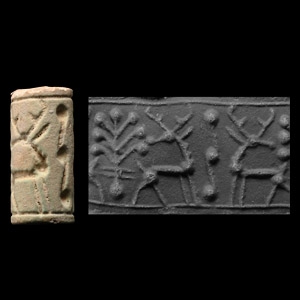
Mitanni Faience Cylinder Seal with Worship Scenes
Circa 1500-1200 B.C.Sold for (Inc. bp): £364
Accompanied by a copy of an old scholarly note, typed and signed by W.G. Lambert, late Professor of Assyriology, University of Birmingham, 1970-1993, which states: ' Cylinder Seal of Faience with Turquoise Glaze 30.5 x 14.5 mm. The design consists of a stylized sacred tree and either side of it a standing stag with rump next to the tree, but head turned back. The end of the scene is marked by a simple guilloche in vertical position. The design is framed by a line above and another beneath. This seal is Mitanni, c. 1500-1200 B.C., and from anywhere between Syria and Western Kurdistan. It is a product of the Hurrian civilisation of the area, and the stylized tree is a symbol of the storm god, Hurrian Teshub, Babylonian Adad, Hebrew Hadad or Baal. The tree has a central trunk terminating in a bud, and three branches off each side similarly terminating in buds.The stags occur commonly on Mitanni seals, but while they may well be symbolic, it is not known of what they may be the symbol. The guilloche is a standard decorative filler of the period. Faience is a manufactured substance, comparable to the modern porcelain. In the ground it often deteriorates over the centuries and has a powdery surface. This one, however, is in exceptionally fine condition, the only mark of its age being that the glaze has lost something of its original colour. In this excellent condition, such seals are rare.'; supplied with a museum-quality impression. 6.51 grams, 30 mm
From the private collection of a North American lady, formed 1970s-early 1990s, with collection reference no.P30. Accompanied by a copy of a scholarly note, typed and signed by Professor Wilfrid George Lambert dated September 1990. This lot has been cleared against the Art Loss Register database, and is accompanied by an illustrated lot declaration signed by the Head of the Antiquities Department, Dr Raffaele D'Amato.
