
Loading, please wait...
LOT 0206
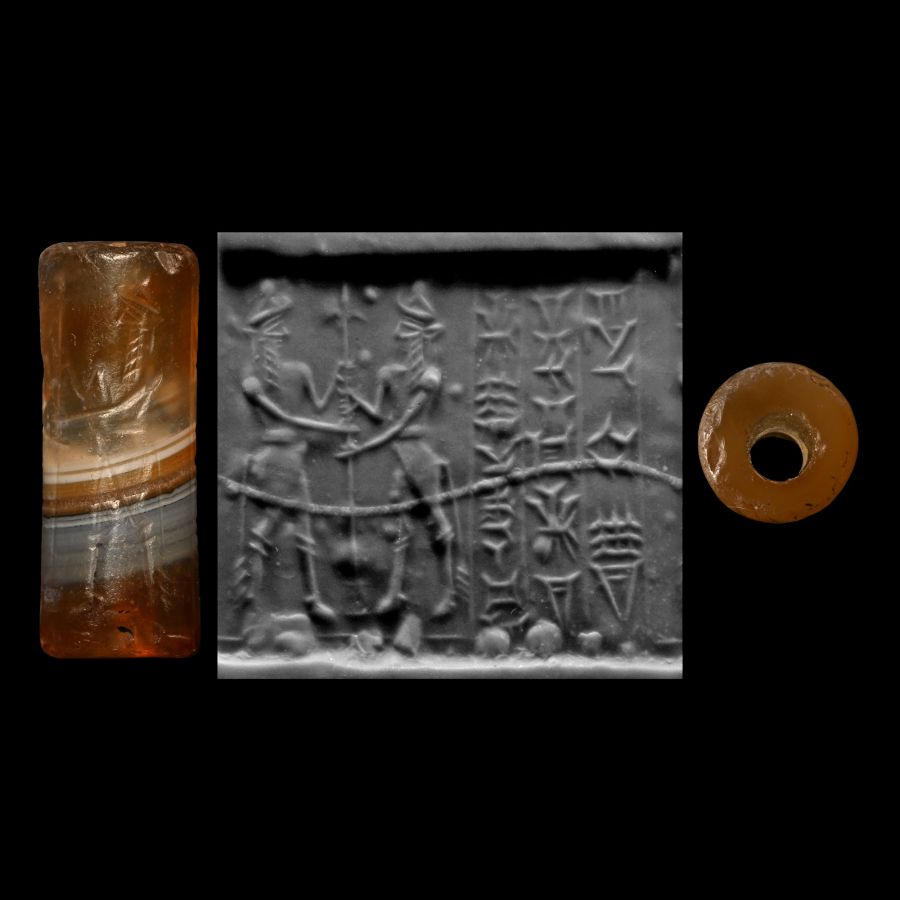
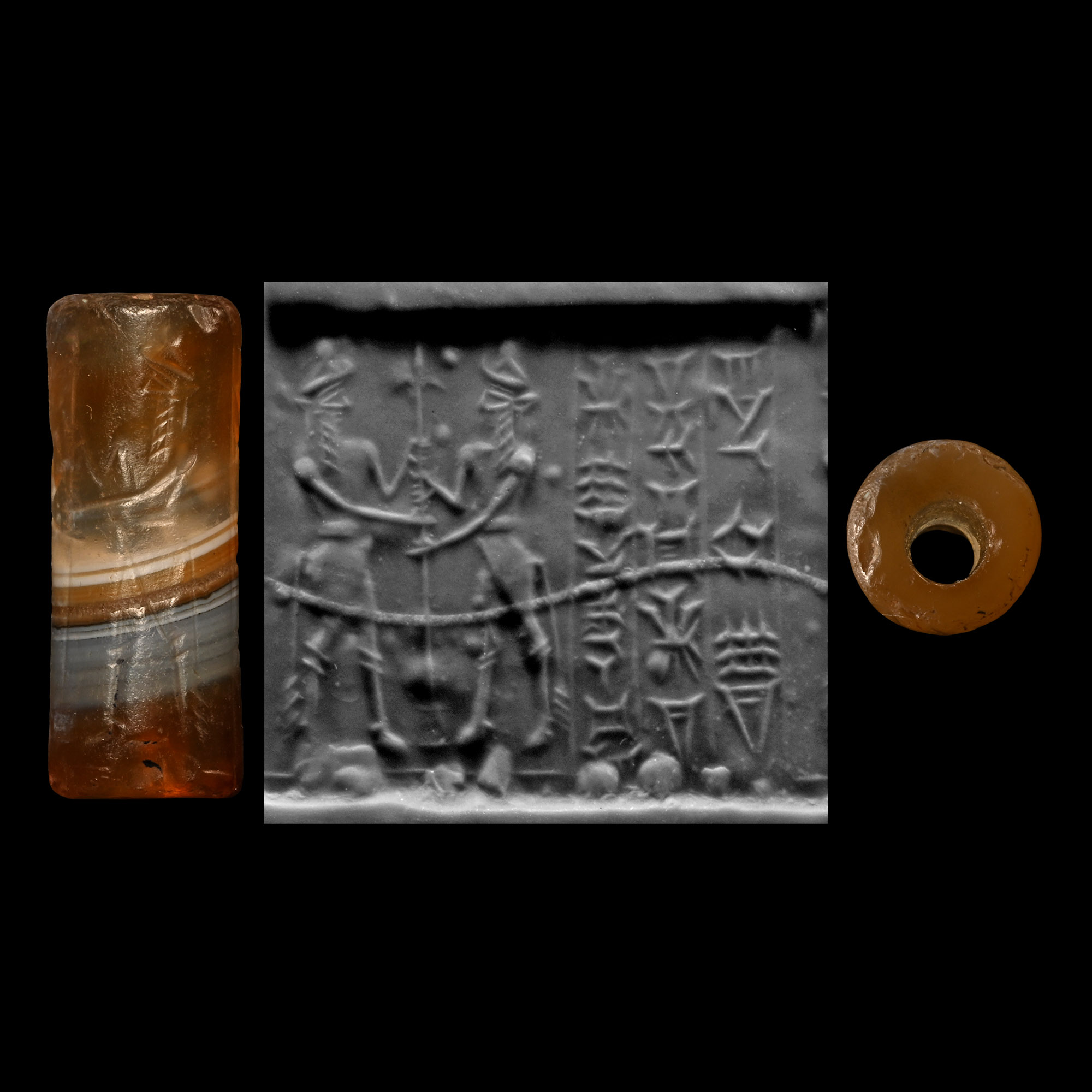
Babylonian Cylinder Seal with King and Bull-Men
CASSITE PERIOD, CIRCA 1400-1100 B.C.
7/8 in. (2.8 grams, 22 mm).
With three standing figures; accompanied by an old scholarly note, typed and signed by W.G. Lambert, late Professor of Assyriology, University of Birmingham, 1970-1993, which states: 'Cylinder Seal of Fawn, Colourless and Whitish Agate, 22.5 x 9 mm. The design shows two standing bull-men holding between them a pole-standard with a kind of fleur-de-lis on top. There is a cuneiform inscription in Babylonian language: sa-ki-in (May god be merciful) / na4kisib an-ni (to the one equipped) / ilum li-re-en-s[u] (with this seal. This is a Cassite-period Babylonian seal, c. 1400-1100 B.C. It is a rare design for the period and the inscription may be unique. The seal is chipped at the edges, and is joined from two pieces with no loss of surface, and is in an attractive stone.' [No Reserve]
ProvenanceAcademically researched and catalogued by the late Professor Lambert in the early 1990s.
From a collection acquired from various auction houses in the UK.
From the estate of Mr R.W., a private Wiltshire, UK, collector; thence by descent.
Accompanied by an original typed and signed scholarly note by the late W.G. Lambert, Professor of Assyriology at the University of Birmingham, 1970-1993.
TimeLine Auctions follows a vetting process to ensure the authenticity and legality of all items, reinforcing our commitment to integrity and responsible trading. Each antiquity, antique, and coin lot undergoes thorough examination by a vetting committee of at least ten external specialists, professional trade association members, scientists, and archaeologists: Our Vetting Process
AUCTIONS:
TimeLine is a leading auction house specialising in antiquities, ancient art, collectables, natural history, coins, medals, and books. Our auctions offer museums, collectors, historians, and enthusiasts the opportunity to acquire unique and historically significant pieces.
-
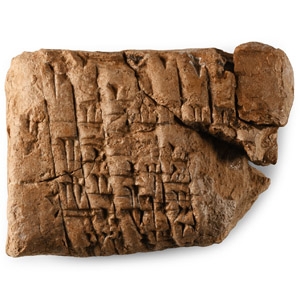
Mesopotamian Cuneiform Tablet
2nd millennium B.C.Sold for (Inc. bp): £390
Pillow-shaped clay tablet with cuneiform text to both broad faces and one edge; chipped, repaired. 70.5 grams, 57 mm
Specialised collection of cuneiform texts, the property of a London gentleman and housed in London before 1992. Thence by descent to family members. Examined by Professor Wilfrid George Lambert FBA (1926-2011), historian, archaeologist, and specialist in Assyriology and Near Eastern archaeology, in the late 1980s and early 1990s. This small collection is exceptional for the variety of types, including some very rare and well preserved examples. -
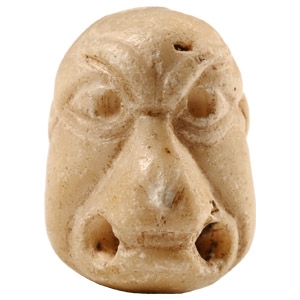
Neo-Assyrian Stone Grotesque Face Pendant
800-600 B.C.Estimate: £300 - 400 (+bp*)
Opening Bid: £150
Carved in the round with animal-like features and grimacing expression, drilled eyes and strong eyebrows; pierced through the top of the head and through the mouth; possibly depicting Huwawa. 6.43 grams, 19 mm
From the property of late Mr SM, London, UK, 1970-1990s, thence by descent. Examined by Professor Wilfrid George Lambert FBA (1926-2011), historian, archaeologist, and specialist in Assyriology and Near Eastern archaeology, in the late 1980s and early 1990s. -
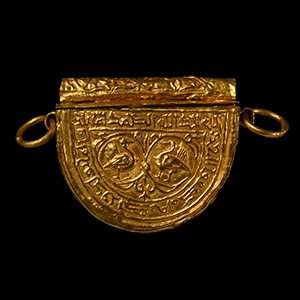
Seljuk Gold Pendant with Two Birds
12th-13th century A.D.Estimate: £2,000 - 3,000 (+bp*)
Opening Bid: £1,000
D-shaped in plan hollow-formed sheet gold pendant with lateral attachment loops; repoussé design to each broad face of two opposed birds within a circle formed by the branches of a tree, band of calligraphic text to the border; lid with rolled tubular panel, repoussé quatrefoil design, rim with running vinescroll; repaired. 11.18 grams, 41 mm
UK private collection before 2000. On the UK art market. Property of a London gentleman.
