
Loading, please wait...
LOT 1190
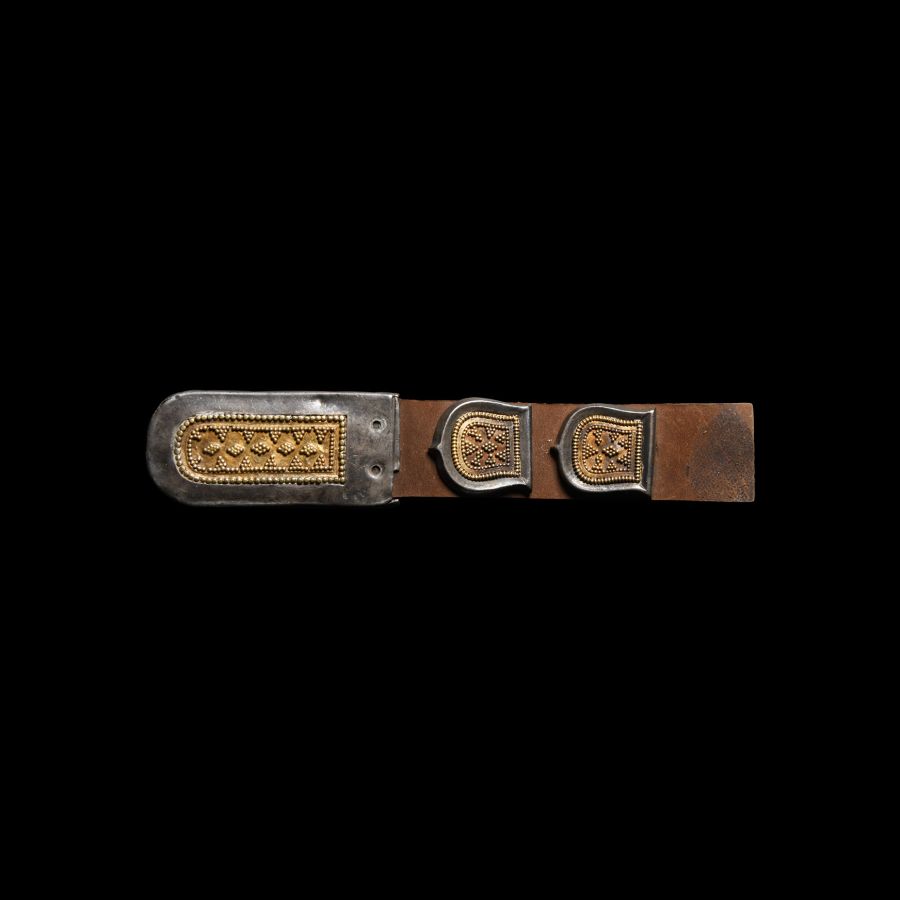
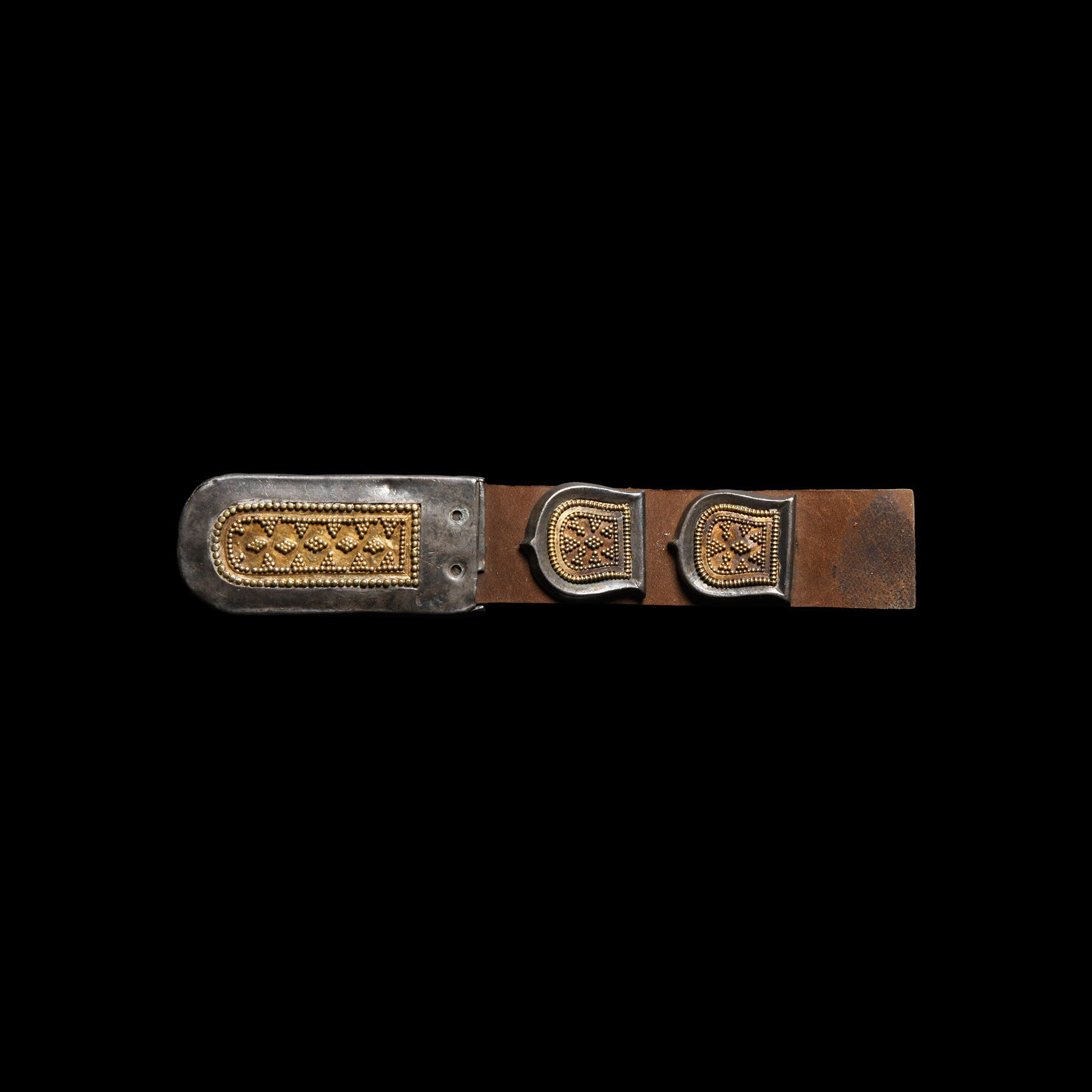
Avar-Byzantine Silver-Gilt Sword Belt Mount Group
7TH-9TH CENTURY A.D.
4 3/4 in. (26.5 grams, 12.2 cm long).
Comprising three belt mounts later remounted onto brown leather comprising: a rectangular strap end with rounded terminal, decorated with granulated borders, lozenges and chevrons; two roughly D-shaped mounts with apex flourish and waisted sides, also decorated with granulated lozenges and chevrons.
ProvenanceAcquired in the 1980s-1990s.
Ex an important central London gallery, London W1.
Cf. Daim, F., Hunnen + Awaren, Reitervölker aus dem Osten, Burgenländische Landesausstellung 1996, Schloß Halbturn, 26 April - 31 Oktober 1996, Eisenstadt, 1996, p.398, nos.5.365-5.367, for similar belt fittings.
FootnotesThis type of belt element decorated with granulation, is present in the Avar graves of the second half of the 7th century, and was most likely produced in the workshops of the Eastern Roman Empire, from where they reached the Avar lands as imperial gifts (tomb of Kunbàboni) or spoils of war. They were part of multiple belts, to which sabers and knives were attached, commonly used among Avars, Bulgars and Romans during the 7th and 8th centuries AD.
CONDITIONTimeLine Auctions follows a vetting process to ensure the authenticity and legality of all items, reinforcing our commitment to integrity and responsible trading. Each antiquity, antique, and coin lot undergoes thorough examination by a vetting committee of at least ten external specialists, professional trade association members, scientists, and archaeologists: Our Vetting Process
AUCTIONS:
TimeLine is a leading auction house specialising in antiquities, ancient art, collectables, natural history, coins, medals, and books. Our auctions offer museums, collectors, historians, and enthusiasts the opportunity to acquire unique and historically significant pieces.
LOT 1190
Avar-Byzantine Silver-Gilt Sword Belt Mount Group
Estimate £200 - 300€230 - 350 (for guidance only)$270 - 410 (for guidance only)
-
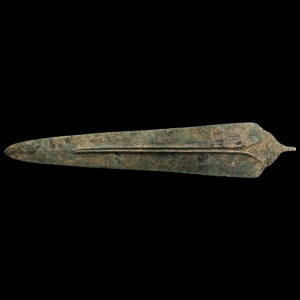
Luristan Bronze Short Sword Blade
1st millennium B.C.Sold for (Inc. bp): £130
Triangular profile with two parallel fullers tapering to a rounded tip, the tang forming an extension of the midrib. 194 grams, 30.7 cm
Ex German collection, Cologne, 1980-1990s.
The metalworking techniques used in making bronze weapons in Luristan were very complex. Surfaces were often finished in repoussé work, and some of the weapons were chased, others engraved. -
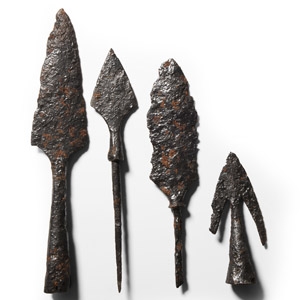
Medieval Iron Arrowhead Group
12th-15th century A.D.Sold for (Inc. bp): £117
Comprising tanged and socketted arrowheads with triangular, leaf-shaped and barbed examples. 40 grams total, 5-10.7 cm
From a private European collection, formed in the 1980s. Acquired from TimeLine Auctions, 2016, lot 72. The Kusmirek Collection, UK. -
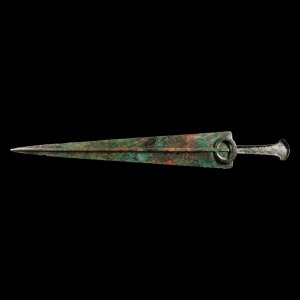
Luristan Bronze Hilted Dirk
Circa 1000 B.C.Sold for (Inc. bp): £715
The blade with a tapering profile, triangular in overall form, with square shoulders, penannular guard with strong midrib, flanged hilt with straight grip, widening slightly into a fan-shaped pommel. 363 grams, 47.5 cm
Acquired from Alan Cherry, Bournemouth, UK. Ex Alexander Cotton collection, Hampshire, UK 1980s.
These types of short sword or dirks were usually cast in one piece, and the penannular rib in relief was cast on at the same time with the handle of the blade. In some cases, however, the penannular rib was later cast on the dagger, possibly to strengthen a weak point at the junction of hilt and blade. The flanged hilt was originally filled with organic material like bone.
