
Loading, please wait...
_900x900.jpg "Assyrian Bronze Arm and Hand Type Brooch")
_200x200.jpg "Assyrian Bronze Arm and Hand Type Brooch")
.jpg "Assyrian Bronze Arm and Hand Type Brooch")
LOT 1095
Assyrian Bronze Arm and Hand Type Brooch
CIRCA 7TH-5TH CENTURY B.C.
4 x 4 in. (186 grams total, 10 x 10.3 cm including frame).
The bow decorated with circumferential grooves, one arm ending with the partially preserved wire coil; the catchplate in the form of a hand engraved with an X; accompanied by a display frame with information ticket. [No Reserve]
ProvenanceEx Robin Symes Gallery, London, UK, 1990s.
From a Leicestershire, UK, collection.
Cf. Curtis, J., An examination of late Assyrian Metalwork with special reference to Nimrud, Oxford-Oakville, 2013, pl.LXXXVIII.
FootnotesFibulae with triangular bows (type 3 of Curtis classification) were the most common in Assyria. At least 66 bronze examples have been found at Nimrud, 32 in the graves and tombs at Ashur, 14 at Kouyunjik (some of them represented only by fragments), three at Nebbi Yunus, six at Khorsabad, three at Sharif Khan, all fragmentary, and single examples at Tell Billa and Tell al Rimah.
CONDITIONTimeLine Auctions follows a vetting process to ensure the authenticity and legality of all items, reinforcing our commitment to integrity and responsible trading. Each antiquity, antique, and coin lot undergoes thorough examination by a vetting committee of at least ten external specialists, professional trade association members, scientists, and archaeologists: Our Vetting Process
AUCTIONS:
TimeLine is a leading auction house specialising in antiquities, ancient art, collectables, natural history, coins, medals, and books. Our auctions offer museums, collectors, historians, and enthusiasts the opportunity to acquire unique and historically significant pieces.
-
.jpg)
Western Asiatic Alabaster Cylinder Seal
Circa 3rd millennium B.C.Sold for (Inc. bp): £104
With incised design of interlaced parallel bands. 506 grams, 33 mm
Acquired 1970s-1996. Property of a North American collector; collection no.071. London collection, 2016. -
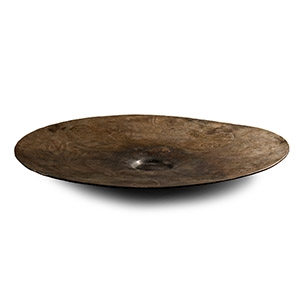
Large Silver Dish with Ibexes
3rd-6th century A.D. or earlierEstimate: £2,000 - 3,000 (+bp*)
Opening Bid: £500
A finely hammered bowl, the surface punched with vegetal and zoomorphic decoration comprising standing rams or mouflons enclosed within a circle, spear-shaped leaves separating the figures, low foot; the engraving possibly later. 800 grams, 37 cm wide
UK private collection before 2000. Acquired on the UK art market. Property of a London gentleman. Accompanied by an academic report by Dr Raffaele D’Amato. This lot has been checked against the Interpol Database of stolen works of art and is accompanied by search certificate number no.12169-220737.
The plate exhibits a typical hammered form, and was probably reinforced with an organic base. The subject of the decoration, rams or mouflons with the head facing right or left, is a theme found on Sassanid art and is also visible on a decorated silver and gilt vessel of the Sackler Gallery collection (Gunter, Jett, no.21). Decoration in the form of such animal enclosed in a medallion appears in the central exterior roundel of a silver bowl in the Detroit Institute of Arts (Grabar, 1967, p.125, no.41). -
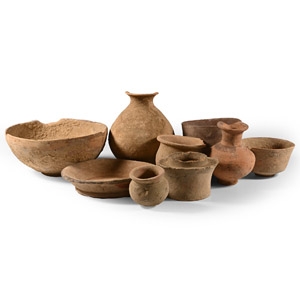
Western Asiatic Pottery Group
2nd-1st millennium B.C.Sold for (Inc. bp): £117
Comprising vessels and bowls of various shapes; some with painted detailing. 1.9 kg total, 5.5-16.5 cm
From a London, UK, collection, 1980-1990.
