
Loading, please wait...
_900x900.jpg "Archaic Greek Modified Bronze Corinthian Helmet")
_200x200.jpg "Archaic Greek Modified Bronze Corinthian Helmet")
_900x900.jpg "Archaic Greek Modified Bronze Corinthian Helmet")
_200x200.jpg "Archaic Greek Modified Bronze Corinthian Helmet")
_900x900.jpg "Archaic Greek Modified Bronze Corinthian Helmet")
_200x200.jpg "Archaic Greek Modified Bronze Corinthian Helmet")
_900x900.jpg "Archaic Greek Modified Bronze Corinthian Helmet")
_200x200.jpg "Archaic Greek Modified Bronze Corinthian Helmet")
.jpg "Archaic Greek Modified Bronze Corinthian Helmet")
.jpg "Archaic Greek Modified Bronze Corinthian Helmet")
.jpg "Archaic Greek Modified Bronze Corinthian Helmet")
.jpg "Archaic Greek Modified Bronze Corinthian Helmet")
LOT 0252
Archaic Greek Modified Bronze Corinthian Helmet
LATE 7TH-EARLY 6TH CENTURY B.C.
12 1/4 in. (2.2 kg total, 31.5 cm high including stand).
Consisting of two sections joined with bronze rivets; above a domed section with row of rivets; below, a folded band with rolled rim, with rivets to the rear holding two halves; line of holes to the base for securing an inner lining.
ProvenanceAcquired in the 1970s.
Ex private Austrian collection.
The Kusmirek Collection, UK.
Accompanied by an academic report by Dr Raffaele D'Amato.
Accompanied by a metal analysis and appraisal by Dr Brian Gilmour.
This lot has been checked against the Interpol Database of stolen works of art and is accompanied by search certificate number no.11764-203980.
Cf. Hixenbaugh, R., Ancient Greek Helmets, New York, 2019, nos.C245 and C248; for a similar helmet skull from Torre di Satriano e Benevento (Bottini, Egg, Von Hase, Pflug, Schaaf, Schauer, Waurick, 1988, p.72, fig.7, cat.14, p.392) and Melfi (Museo Nazionale del Melfese, 1996, p.4).
FootnotesThe upper part of the helmet was probably modified in antiquity, the lower part of the eye holes and the cheek pieces have been cut away, and replacement cheek pieces, now lacking, were once crudely rivetted to the sides.
CONDITIONTimeLine Auctions follows a vetting process to ensure the authenticity and legality of all items, reinforcing our commitment to integrity and responsible trading. Each antiquity, antique, and coin lot undergoes thorough examination by a vetting committee of at least ten external specialists, professional trade association members, scientists, and archaeologists: Our Vetting Process
AUCTIONS:
TimeLine is a leading auction house specialising in antiquities, ancient art, collectables, natural history, coins, medals, and books. Our auctions offer museums, collectors, historians, and enthusiasts the opportunity to acquire unique and historically significant pieces.
LOT 0252
Archaic Greek Modified Bronze Corinthian Helmet
Estimate £4,000 - 6,000€4,640 - 6,960 (for guidance only)$5,400 - 8,100 (for guidance only)
-
.jpg)
Roman Bronze Military Mask Helmet Section
3rd century A.D.Sold for (Inc. bp): £975
From the upper part of the right side of the face mask, the upper edge with a band of embossed curved lines, probably representing stylised hairs, intertwined with laurel crown; embossed image of advancing Mars, the god of war, to the centre, depicted nude with military sagum, a pseudo-Corinthian helmet to the head and carrying a circular shield. 55 grams, 17 cm wide
Acquired 1960s-1990s. Late Alison Barker collection, a retired London barrister.
In the decorative patterns of Roman helmets, Mars was among the most revered deities in the Imperial army. After Jupiter, he was the most aristocratic god of the old Italic religion, master of armament, who governed military service (militiae potens) and oversaw the training ground, for which he was named Campester. The emperor Augustus named him Ultor (‘Avenger’) and dedicated to him a luxurious temple in the centre of the forum in gratitude for his victory over the murderers of Caesar and, in addition, granted to him the privileges of the Capitoline Jupiter. -
.jpg)
WWII 'RAF' Bomber (Mosquito) Helmet, Map and Whistle Group
1941 A.D. or laterSold for (Inc. bp): £1,170
Comprising: a type C leather open face helmet wired for type B communication, oxygen mask with hose and alloy-framed flying goggles with padded leather and rubber band, the frames stamped 'Stadium Made in England Patent Reg Design'; the helmet with webbing chin strap, buckles and stud fasteners, chamois leather lining bearing ink stamp and handwritten 'Adams Progressive' 'No.75-78', plug holder with paper label, tubular oxygen mask inlet marked 'MLD 18' 'MC253D', microphone plug and hose with brass connector stamped 'D/156'; together with an RAF flight map and an RAF 'ditching' whistle of classic snail type with Air Ministry's crown markings and reference numbers '23/230' and '293/14/L1795'; the helmet mounted on a wooden 'mannequin' head. 6.1 kg, 31 cm
Acquired from J C Militaria and Historic Flying Clothing Company. The Kusmirek Collection, UK. Accompanied by copies of listings for each item.
This type of helmet and system was introduced in 1941 A.D. -
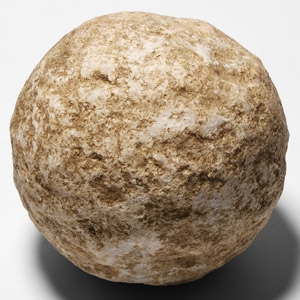
Roman Marble Ballista Catapult Shot
1st-3rd century A.D.Sold for (Inc. bp): £1,430
Suitable for use with an onager or other small catapult-type siege weapon; with roughened, abrasive surface. 682 grams, 79 mm
Acquired 1971-1972. From the collection of the vendor's father. Property of a London, UK, collector.
The operation of the onager (Latin for 'wild ass') is first mentioned in 353 A.D. by Ammianus Marcellinus in his Res Gestae and more fully in Vegetius's Epitoma Rei Militaris probably written in the reign of Emperor Theodosius I (378-395 A.D.).
