
Loading, please wait...
LOT 1077
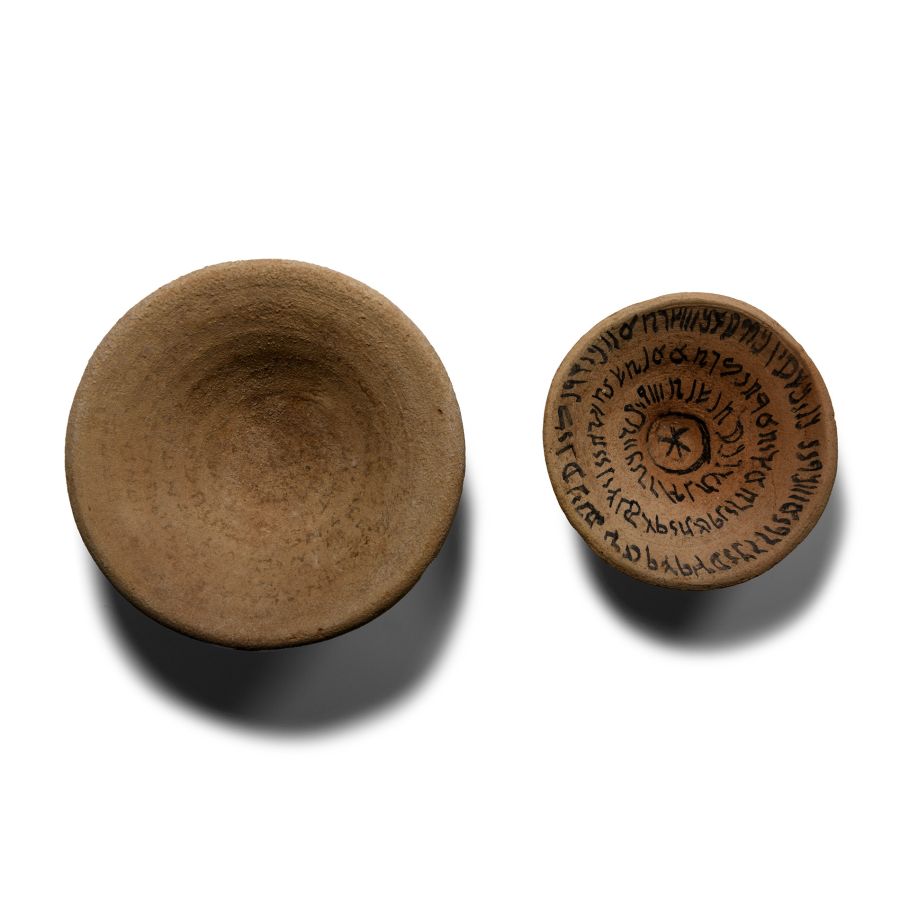
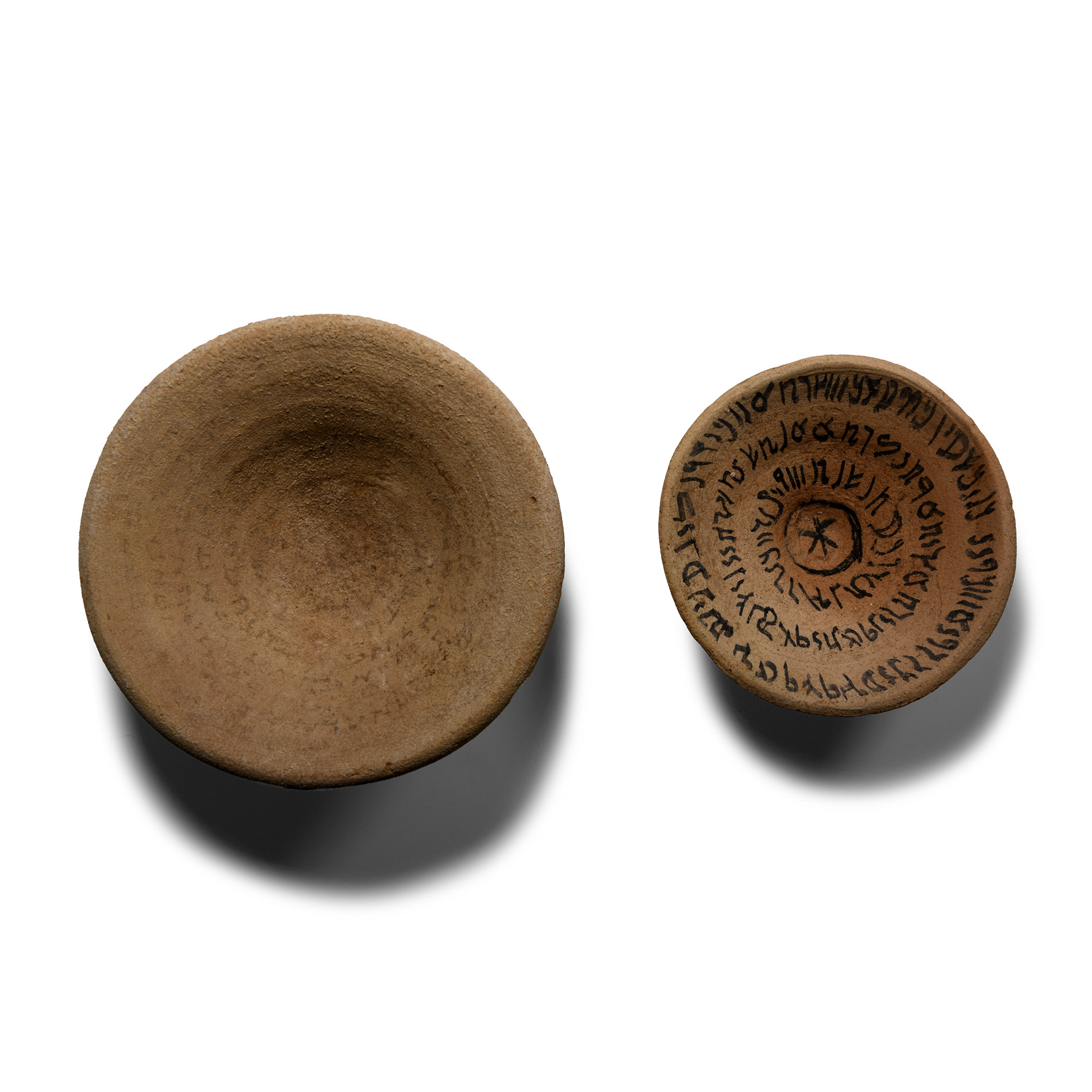
Aramaic Terracotta Magic Bowl with Cursive Script
4TH-8TH CENTURY A.D.
3 3/4 - 4 7/8 in. (277 grams total, 9.5-12.4 cm).
An unglazed terracotta trumpet-shaped bowl with the faint remains of Aramaic-script to the inside; accompanied by a smaller bowl with three concentric rings of recently overpainted pseudo Aramaic-script to the upper face. [2]
ProvenanceAcquired on the German art market, 1989-1995.
with The Museum Gallery, 19 Bury Place, London, WC1, UK, 1998-2003.
Property of a London based academic, 2003-present.
Aramaic incantation bowls are particular to the Sassanian period and have been found in regions of modern Iraq. These simple ceramic bowls, also known as magic bowls, each contain an Aramaic inscription, written in ink, which spirals from the centre. The bowls seem to have played an important part in domestic life. For example, during excavation in Nippur in 1889, one or more incantation bowls were found in each house together with domestic artefacts, most often in doorways or under floorboards in the corner of rooms. The bowls are predominantly apotropaic, and the inscriptions tend to protect their owners from misfortunes such as those faced in child-birth, illness and evil spirits.
CONDITIONTimeLine Auctions follows a vetting process to ensure the authenticity and legality of all items, reinforcing our commitment to integrity and responsible trading. Each antiquity, antique, and coin lot undergoes thorough examination by a vetting committee of at least ten external specialists, professional trade association members, scientists, and archaeologists: Our Vetting Process
AUCTIONS:
TimeLine is a leading auction house specialising in antiquities, ancient art, collectables, natural history, coins, medals, and books. Our auctions offer museums, collectors, historians, and enthusiasts the opportunity to acquire unique and historically significant pieces.
-

Western Asiatic and Other Stone Bead Group
1st millennium B.C. and laterSold for (Inc. bp): £52
Including tabular, oblate, tubular, square-section and other types in lapis lazuli, carnelian, terracotta and other materials. 122 grams total, 2-21 mm
From the private collection of the late Mrs Belinda Ellison, a long time member of the Egyptian Exploration Society, c.1940-2020. -
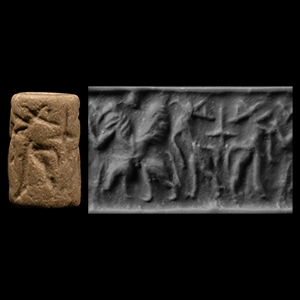
Akkadian Cylinder Seal with Combat Scene
2300-2200 B.C.Sold for (Inc. bp): £156
Limestone with lions and quadrupeds; accompanied by an old scholarly note, typed and signed by W.G. Lambert, late Professor of Assyriology, University of Birmingham, 1970-1993, which states: 'Cylinder Seal of Fawn Stone, 17 x 10.5 mm. The design shows two crossed lions in the middle, each attacking a domestic horned animal on the outside of the scene. There is a simple linear device as a terminal. This is an Akkadian seal, c. 2300-2200 B.C., from Mesopotamia or an adjacent area. It is in [sic] good state of preservation.' 2.8 grams, 16 mm
Property of a London gentleman; part of his family collection since the 1970s. From a collection acquired from various auction houses in the UK. From the estate of Mr R.W., a private Wiltshire, UK, collector; thence by descent. Accompanied by a original typed and signed scholarly note by the late W.G. Lambert, Professor of Assyriology at the University of Birmingham, 1970-1993. -
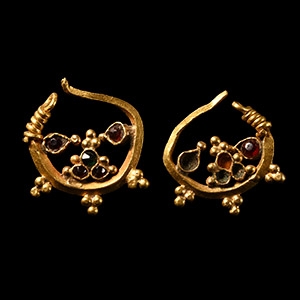
Western Asiatic Gold Gem-Set Earrings
2nd-4th century A.D.Estimate: £400 - 600 (+bp*)
Opening Bid: £200
Comprising two diamond-section penannular hoops with loops; each with three granulated pyramids to the lower edge; the centre of the hoop with a triple-cell set with one green and two red glass (?) gems with granulated outer edges, flanked by two teardrop-shaped cells set with a red glass (?) gem. 2.76 grams total, 19-21 mm
From a late Japanese specialist collector, 1970-2000s.
