
Loading, please wait...
_900x900.jpg "Aramaic Lead Magical Text Scroll Fragment")
_200x200.jpg "Aramaic Lead Magical Text Scroll Fragment")
_900x900.jpg "Aramaic Lead Magical Text Scroll Fragment")
_200x200.jpg "Aramaic Lead Magical Text Scroll Fragment")
.jpg "Aramaic Lead Magical Text Scroll Fragment")
.jpg "Aramaic Lead Magical Text Scroll Fragment")
LOT 1192
Aramaic Lead Magical Text Scroll Fragment
2ND-8TH CENTURY A.D.
2 7/8 in. (8.13 grams, 73 mm).
The remains of a bifacial magical lead scroll with letters written in a form of Aramaic and Greek, incised on a lead tablet preserved in a sub-rectangular fragment.
ProvenanceAcquired 1979-1999.
London collection of the late Mr S.M., thence by descent.
TimeLine Auctions follows a vetting process to ensure the authenticity and legality of all items, reinforcing our commitment to integrity and responsible trading. Each antiquity, antique, and coin lot undergoes thorough examination by a vetting committee of at least ten external specialists, professional trade association members, scientists, and archaeologists: Our Vetting Process
AUCTIONS:
TimeLine is a leading auction house specialising in antiquities, ancient art, collectables, natural history, coins, medals, and books. Our auctions offer museums, collectors, historians, and enthusiasts the opportunity to acquire unique and historically significant pieces.
LOT 1192
Aramaic Lead Magical Text Scroll Fragment
Estimate £300 - 400€350 - 460 (for guidance only)$410 - 540 (for guidance only)
-
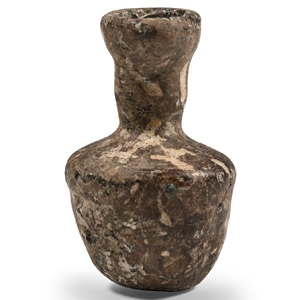
Western Asiatic Miniature Glass Vessel
12th-14th century A.D.Sold for (Inc. bp): £20
Iridescent ewer with tapering body and sharply carinated shoulder, balustered neck and funicular mouth. 11.4 grams, 46 mm
Collected from 1970-1999. From the collection of the late Mr S.M., London, UK. -
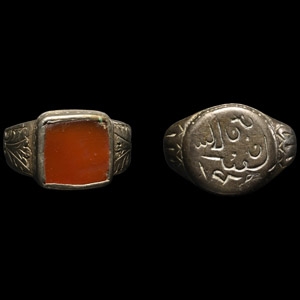
Ottoman Silver Ring Pair
18th-19th century A.D.Sold for (Inc. bp): £117
Comprising: one with a flat-section hoop with incised decoration to the expanding shoulders, square bezel set with carnelian; one with a D-section hoop with expanding shoulders, discoid bezel with inscription. 13.74 grams total, 22-24 mm
Ex German art market, 2000s. Acquired from an EU collector living in London. From the collection of Surrey, UK, gentleman. -
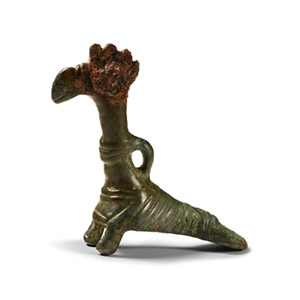
Luristan Bronze Peacock Pendant
13th-7th century B.C.Sold for (Inc. bp): £46
Modelled in the round with hollow to the underside, long neck with collar and loop to the rear. 25.5 grams, 59 mm
From a North Yorkshire, UK, private collection. Acquired from Adam Partridge Auctioneers, Macclesfield, UK. Property of Mr A.B., an American collector.
