
Loading, please wait...
LOT 1451
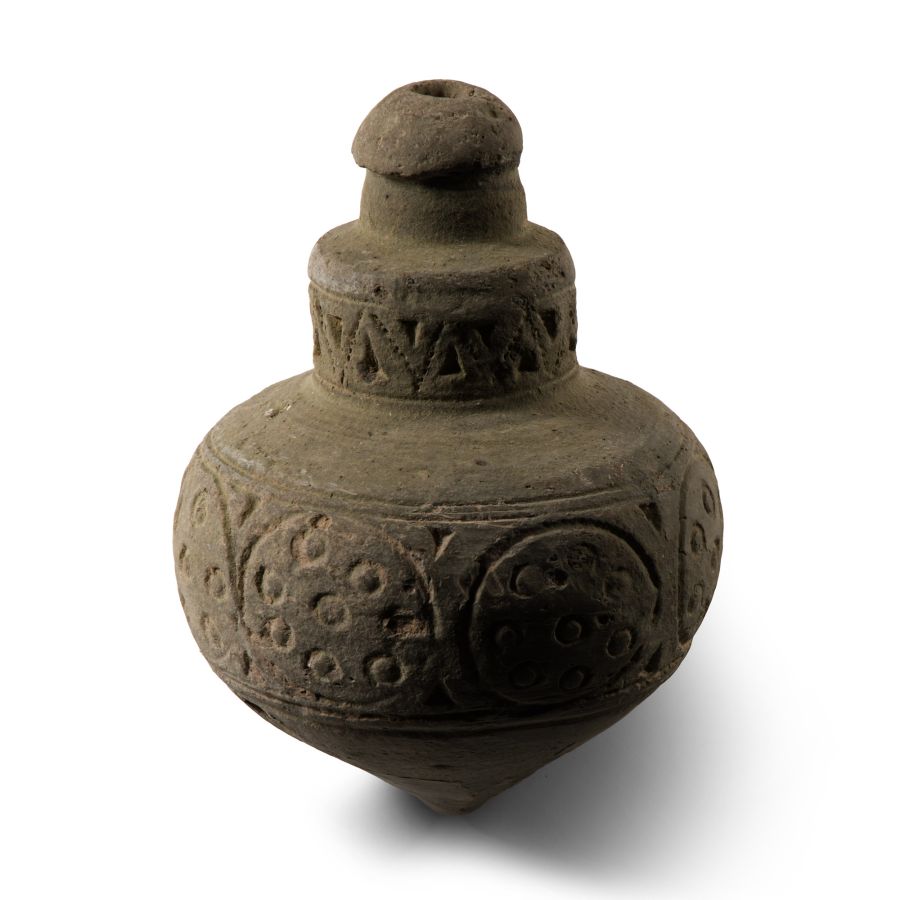
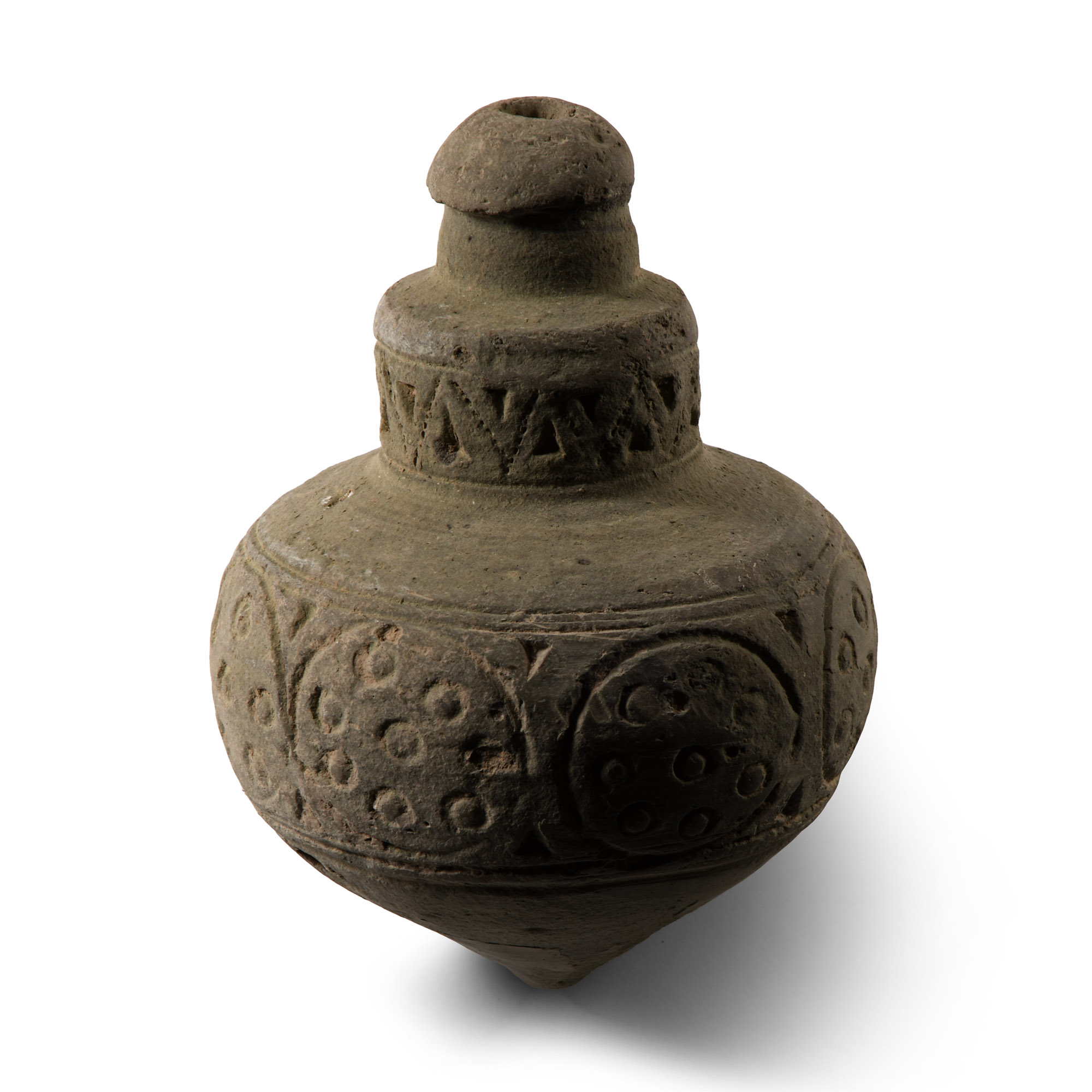
Arab 'Greek Fire' Ceramic Fire Bomb or Hand Grenade
13TH CENTURY A.D.
4 3/4 in. (430 grams, 12 cm).
Piriform body decorated with concentric circles inside a horizontal band, raised ornamental neck, with domed filler-hole, intended to be filled with explosive liquid and wick, used as a hand grenade. [No Reserve]
ProvenanceFrom a military inspired collection formed from the 1990s.
LiteratureCf. Arendt, W. I., Granaten des 13-14. Jahrhunderts, die an der Wolga gefunden sind, Zeitschrift fur Historische Waffen-und Kostumkunde, 11 (1926-8), p.42; cf. Arendt, W., Die Spharisch-konischen Gefasse aus Gebranntem Ton, ibid; cf. Ayalon, D., Gunpowder and Firearms in the Mamluk Kingdom, London, 1956, p.16.
FootnotesThe Arabs made good use of these weapons. Their efficiency was described in the account of the siege of Akka in 1189, given by the contemporary historian Ibn al-Athir. He tells how the Christians exercised their engineering skills and built mighty siege towers. The situation was hopeless for the defending Arabs until a man from Damascus showed up, because he knew how to produce Greek Fire: ‘To trick the Christians he first threw some vessels with naphtha and other things, which were not set on fire, upon one of the siege towers, and it was without power. The Christians...climbed the top of the siege tower...the man from Damascus waited until the contents of the vessels were spread all over. When the moment came, he threw a new pot, which was set on fire. In a few moments the fire was spread all over, and the siege tower was eaten up by the flames. The fire was spread in such a hurry that the Christians could not manage to climb down from the siege tower. Men, weapons, everything was eaten up by the flames.’
CONDITIONTimeLine Auctions follows a vetting process to ensure the authenticity and legality of all items, reinforcing our commitment to integrity and responsible trading. Each antiquity, antique, and coin lot undergoes thorough examination by a vetting committee of at least ten external specialists, professional trade association members, scientists, and archaeologists: Our Vetting Process
AUCTIONS:
TimeLine is a leading auction house specialising in antiquities, ancient art, collectables, natural history, coins, medals, and books. Our auctions offer museums, collectors, historians, and enthusiasts the opportunity to acquire unique and historically significant pieces.
-
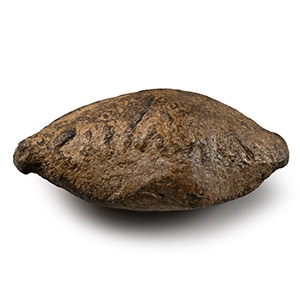
Roman 'Pompey the Great' Lead Slingshot
1st century B.C.Sold for (Inc. bp): £182
Biconical lead slingshot (glans) with inscription in Latin letters 'CN' (Cneius) 'MAG' (Magnus) on one side, and 'IMP' for 'IMPERATOR' (victorious general) to the other side, i.e Gnaeus Pompeius Magnus Imperator (Pompey the Great the victorious general). 59.6 grams, 40 mm
Ex German art market, 2000s. Acquired from an EU collector living in London. From the collection of Surrey, UK, gentleman. Accompanied by an academic paper by military specialist Dr Raffaele D'Amato, dated 4th May 2022 and titled 'Roman Res Publica - Lead Slingshots (glandes) of Caesarian Age - 45 B.C circa'.
The shot (Völling type 1C) is marked with the abbreviated name of Gnaeus Pompey; it was used in quantity at the Battle of Monda (or Munda) against Julius Caesar, 17th March 45 BC. The projectiles were made of different materials: lead (glandes) or in pottery or stone (lapides missiles). Sometimes they were signed with the name of the general, like our specimen. -
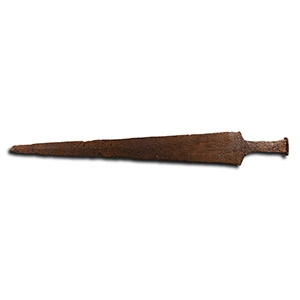
Scythian Iron Akinakes Sword with Decorations
4th century B.C.Estimate: £1,500 - 2,000 (+bp*)
Opening Bid: £750
Of Central Asian typology, strong hilt and narrow ogival guard with Steppe style ornamentation, tipped hilt, triangular tapering blade fitted with a central triangular blood channel with sixteen grooves. 481 grams, 58.5 cm
Ex private collection of Mr M.B., Mainz, Germany, since the 1980s. Acquired from the above, 2004. This lot has been checked against the Interpol Database of stolen works of art and is accompanied by a search certificate number no.12283-214520.
The akinakes was a characteristic Scythian type of weaponry, which was used throughout their history (7th-3rd centuries B.C.). With the departure of the Scythians from the steppe in the 3rd century B.C., and the appearance of the Sarmatian tribes in the Northern Black Sea region in the 2nd-1st centuries B.C., Sarmatian types of bladed weapons spread in the region. This particular shape of akinakes belongs to the nomadic cultures of Central Asia. -
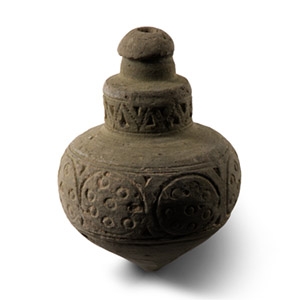
Arab 'Greek Fire' Ceramic Fire Bomb or Hand Grenade
13th century A.D.Sold for (Inc. bp): £598
Piriform body decorated with concentric circles inside a horizontal band, raised ornamental neck, with domed filler-hole, intended to be filled with explosive liquid and wick, used as a hand grenade. 430 grams, 12 cm
From a military inspired collection formed from the 1990s.
The Arabs made good use of these weapons. Their efficiency was described in the account of the siege of Akka in 1189, given by the contemporary historian Ibn al-Athir. He tells how the Christians exercised their engineering skills and built mighty siege towers. The situation was hopeless for the defending Arabs until a man from Damascus showed up, because he knew how to produce Greek Fire: ‘To trick the Christians he first threw some vessels with naphtha and other things, which were not set on fire, upon one of the siege towers, and it was without power. The Christians...climbed the top of the siege tower...the man from Damascus waited until the contents of the vessels were spread all over. When the moment came, he threw a new pot, which was set on fire. In a few moments the fire was spread all over, and the siege tower was eaten up by the flames. The fire was spread in such a hurry that the Christians could not manage to climb down from the siege tower. Men, weapons, everything was eaten up by the flames.’
