
Loading, please wait...
_900x900.jpg "Arab 'Greek Fire' Ceramic Fire Bomb or Hand Grenade")
_200x200.jpg "Arab 'Greek Fire' Ceramic Fire Bomb or Hand Grenade")
.jpg "Arab 'Greek Fire' Ceramic Fire Bomb or Hand Grenade")
LOT 1350
Arab 'Greek Fire' Ceramic Fire Bomb or Hand Grenade
13TH CENTURY A.D.
4 1/2 in. (610 grams, 11.5 cm).
Piriform body decorated with concentric circles inside a pointed star pattern, with domed filler-hole, intended to be filled with explosive liquid and wick, used as a hand grenade. [No Reserve]
ProvenanceAcquired 1980-2015.
Ex Abelita family collection.
Cf. Arendt, W. I., Granaten des 13-14. Jahrhunderts, die an der Wolga gefunden sind, Zeitschrift fur Historische Waffen-und Kostumkunde, 11 (1926-8), p.42; cf. Arendt, W., Die Spharisch-konischen Gefasse aus Gebranntem Ton, ibid; cf. Ayalon, D., Gunpowder and Firearms in the Mamluk Kingdom, London, 1956, p.16; the shape finds correspondence with a fire grenade from Hama, today in the BM, inv.no.1893,1009.38; cf. Pentz, P., 'A medieval workshop for producing 'Greek fire' grenades' in Antiquity, Volume 62, Issue 234, March 1988, pp. 89 - 93.
FootnotesThe Arabs, following the Roman examples, made great use of these weapons. The efficiency of the weapon appears, for example, from the account of the siege of Akka in 1189, given by the contemporary historian Ibn al-Athir. He tells how the Christians exercised their engineering skill and built mighty beffroys. The situation was hopeless for the defending Arabs until a man from Damascus showed up, because he knew how to produce Greek Fire: ‘To trick the Christians he first threw some vesseIs with naptha and other things, which were not set on fire, upon one of the beffroy’s, and it was without power. The Christians...climbed the top of the beffroy...the man from Damascus waited until the contents of the vessels were spread all over. When the moment came, he threw a new pot, which was set on fire. In a few moments the fire was spread all over, and the beffroy was eaten up by the flames. The fire was spread in such a hurry that the Christians could not manage to climb down from the beffroy. Men, weapons, everything was eaten up by the flames.’
CONDITIONTimeLine Auctions follows a vetting process to ensure the authenticity and legality of all items, reinforcing our commitment to integrity and responsible trading. Each antiquity, antique, and coin lot undergoes thorough examination by a vetting committee of at least ten external specialists, professional trade association members, scientists, and archaeologists: Our Vetting Process
AUCTIONS:
TimeLine is a leading auction house specialising in antiquities, ancient art, collectables, natural history, coins, medals, and books. Our auctions offer museums, collectors, historians, and enthusiasts the opportunity to acquire unique and historically significant pieces.
-
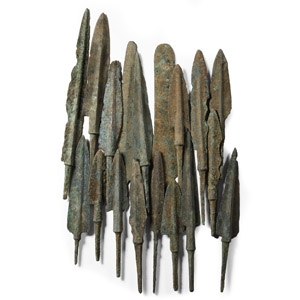
Luristan Bronze Arrowhead Collection
Circa 2nd millennium B.C.-9th century B.C.Sold for (Inc. bp): £234
Including triangular, leaf-shaped, barbed, square-section, and other types. 446 grams total, 10-17.5 cm
Ex London, UK, collection, 1990s.
It is significant to remember that the use of winged and barbed heads in Anatolia was common since the second millennium B.C., but apparently their employment began earlier in this area, where types like these occur alongside the non-barbed, predominantly ribbed and tanged types. -
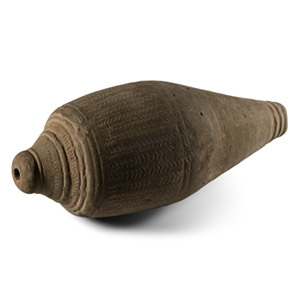
Turco-Mongol Ceramic Fire Bomb or Hand Grenade
13th-15th century A.D.Sold for (Inc. bp): £124
A hollow vessel with cylindrical body, carinated shoulder, short neck and domed mouth, bands of impressed herringbone patterns to the shoulder and waist, piriform lower body; intended to be filled with explosive liquid and a wick, and used as a hand grenade. 463 grams, 17 cm
From a military inspired collection formed from the 1990s.
This piece was a type of ceramic fire grenade, similar to the ones used by the Eastern Romans but of Turco-Mongol type. Apart from the use of manual flame-throwers, special corps of soldiers employed terracotta grenades, in the form of small jars, abundantly evidenced in archaeological excavations. -
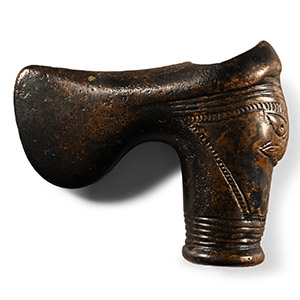
Elamite Copper Axehead with 'Animal' Face
Late 3rd millennium B.C.Sold for (Inc. bp): £715
Plain cylindrical shaft, bulbous towards the top with an incised animal face to the rear of the shaft, the blade with a convex cutting edge. 206 grams, 78 mm
with a London, UK gallery, 1971-early 2000s.
The type belongs to the Gernez classification of collared axes, with trapezoidal blade and cylindrical sleeve. This set of fairly standardised axes is characterised by a trapezoidal blade, a cylindrical collar with a clear moulding at its base and a marked angular moulding at its top, extending onto the top of the blade. This basic model is exclusively from Susa.
