
Loading, please wait...
LOT 1446
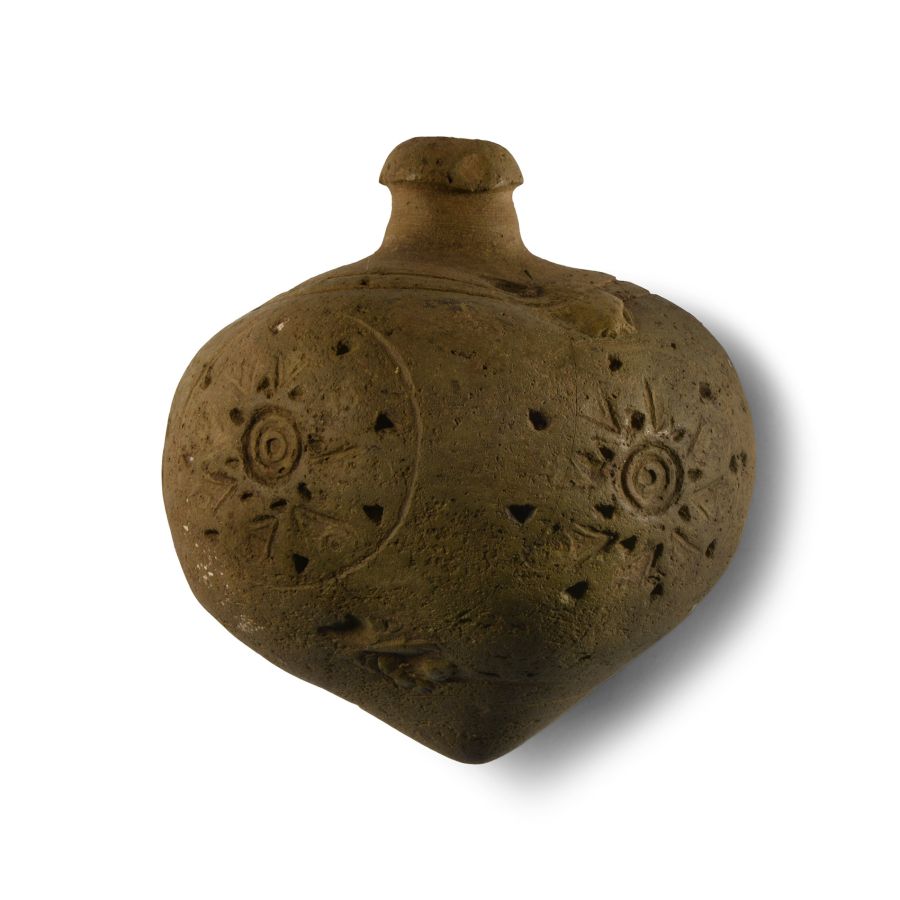
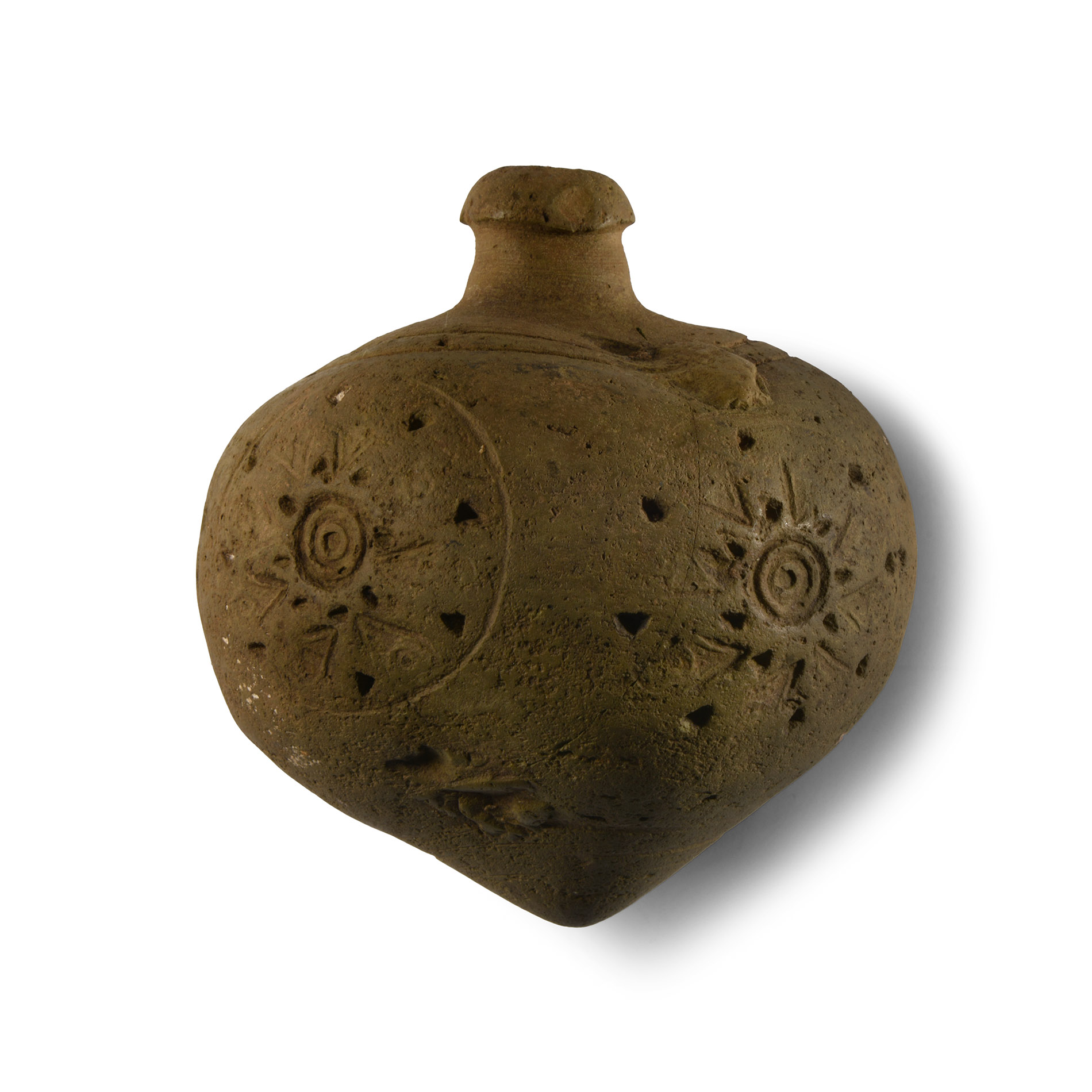
Arab 'Greek Fire' Ceramic Fire Bomb or Hand Grenade
13TH CENTURY A.D.
4 1/2 in. (610 grams, 11.5 cm).
Piriform body decorated with concentric circles inside a eight rays pointed star pattern, with domed filler-hole, intended to be filled with explosive liquid and wick, used as a hand grenade. [No Reserve]
ProvenanceAcquired 1980-2015.
Ex Abelita family collection.
Accompanied by an academic paper by military specialist Dr Raffaele D'Amato, dated 15 July 2019 and titled 'Eastern Roman Empire - Greek Fire Bomb or Hand Grenade (μεσαίον kακάβιον) 9th-11th century AD'.
Cf. Arendt, W. I., Granaten des 13-14. Jahrhunderts, die an der Wolga gefunden sind, Zeitschrift fur Historische Waffen-und Kostumkunde, 11 (1926-8), p.42; cf. Arendt, W., Die Spharisch-konischen Gefasse aus Gebranntem Ton, ibid; cf. Ayalon, D., Gunpowder and Firearms in the Mamluk Kingdom, London, 1956, p.16; the shape finds correspondence with a fire grenade from Hama, today in the BM, inv.no.1893,1009.38; cf. Pentz, P., 'A medieval workshop for producing 'Greek fire' grenades' in Antiquity, Volume 62, Issue 234, March 1988, pp. 89 - 93.
FootnotesThe Arabs, following the Roman examples, made great use of these weapons. The efficiency of the weapon appears, for example, from the account of the siege of Akka in 1189, given by the contemporary historian Ibn al-Athir. He tells how the Christians exercised their engineering skill and built mighty beffroys. The situation was hopeless for the defending Arabs until a man from Damascus showed up, because he knew how to produce Greek Fire: ‘To trick the Christians he first threw some vesseIs with naptha and other things, which were not set on fire, upon one of the beffroy’s, and it was without power. The Christians...climbed the top of the beffroy...the man from Damascus waited until the contents of the vessels were spread all over. When the moment came,he threw a new pot, which was set on fire. In a few moments the fire was spread all over, and the beffroy was eaten up by the flames. The fire was spread in such a hurry that the Christians could not manage to climb down from the beffroy. Men, weapons, everything was eaten up by the flames.’
CONDITIONTimeLine Auctions follows a vetting process to ensure the authenticity and legality of all items, reinforcing our commitment to integrity and responsible trading. Each antiquity, antique, and coin lot undergoes thorough examination by a vetting committee of at least ten external specialists, professional trade association members, scientists, and archaeologists: Our Vetting Process
AUCTIONS:
TimeLine is a leading auction house specialising in antiquities, ancient art, collectables, natural history, coins, medals, and books. Our auctions offer museums, collectors, historians, and enthusiasts the opportunity to acquire unique and historically significant pieces.
-
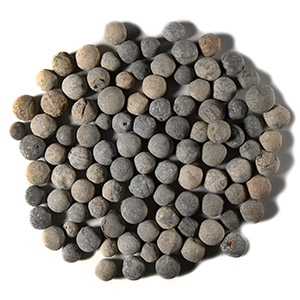
Lead Musket Ball Collection
17th-18th century A.D.Sold for (Inc. bp): £39
Group of ninty-nine lead musket and pistol balls. 2.08 kg total, 12-18 mm
UK gallery, early 2000s. -
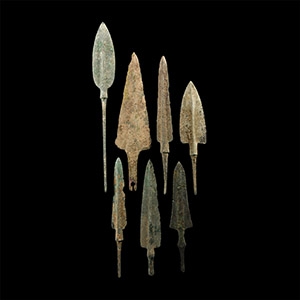
Luristan Bronze Arrowhead Group
13th-7th century B.C.Sold for (Inc. bp): £156
Comprising mainly tanged arrowheads including various types of leaf-shaped heads with midribs. 200 grams total, 12-15.3 cm
Acquired 1990s. From the collection of a late Japanese weaponry collector.
The barbed arrowhead seems to belong to the type V, subcategory type C, according to the classification of Khorasani and Negahban. In the four categories of triangular bronze arrowheads from Luristan, Marlik and Northern Iran individuated by Negahban, subtypes C and D of type V are larger arrow or javelin heads, C large triangular arrowheads with barbed shoulders and D with lanceolate shape and rounded midrib. The straight shoulders recalls a Marlik typology (see Khorasani, 2006, p.307, fig.379). -
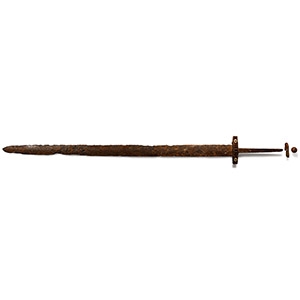
Migration Period Iron Sword with Garnet and Shell Cross Guard with Gold and Amber Sword Bead
5th-6th century A.D.Sold for (Inc. bp): £6,240
Eastern Roman or Germanic cavalry spatha with a parallel-sided blade and broad pointed tip, long tang; the trapezoidal lower guard with a gilt chip-carved plate divided in segments set with garnets to one side, each end with a shell disc set with a central garnet cabochon; accompanied by a strap from the scabbard and an amber sword bead with a beaded gold setting with a garnet cabochon. 970 grams total, 2-100 cm
From the private collection of a London gentleman, from his grandfather's collection formed before the early 1970s. Accompanied by an academic report by Dr Raffaele D’Amato. This lot has been checked against the Interpol Database of stolen works of art and is accompanied by search certificate number no.12012-213600.
The western spatha of the 4th-6th centuries was developed in a context that one can qualify as Romano-Germanic. Certain characteristics of the future Merovingian sword were already present in late Roman swords. It is quite natural that Type IV swords have been found in the countries conquered or settled by the Goths in southern, central and western Europe.
