
Loading, please wait...
LOT 0558
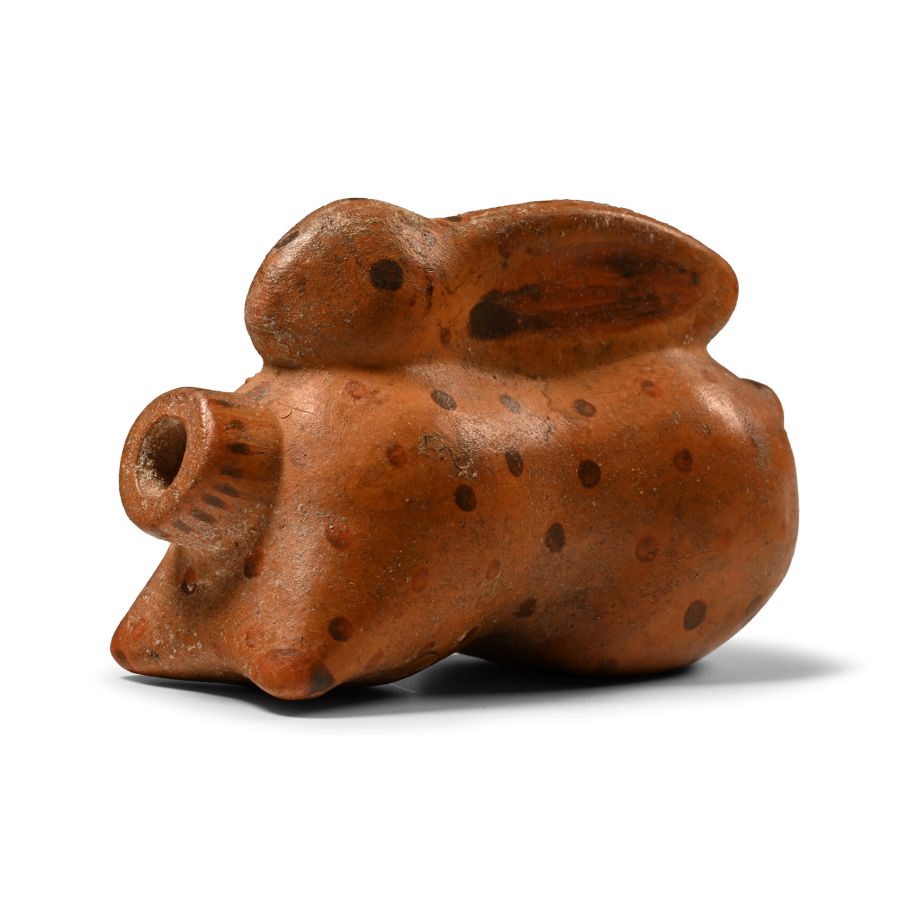
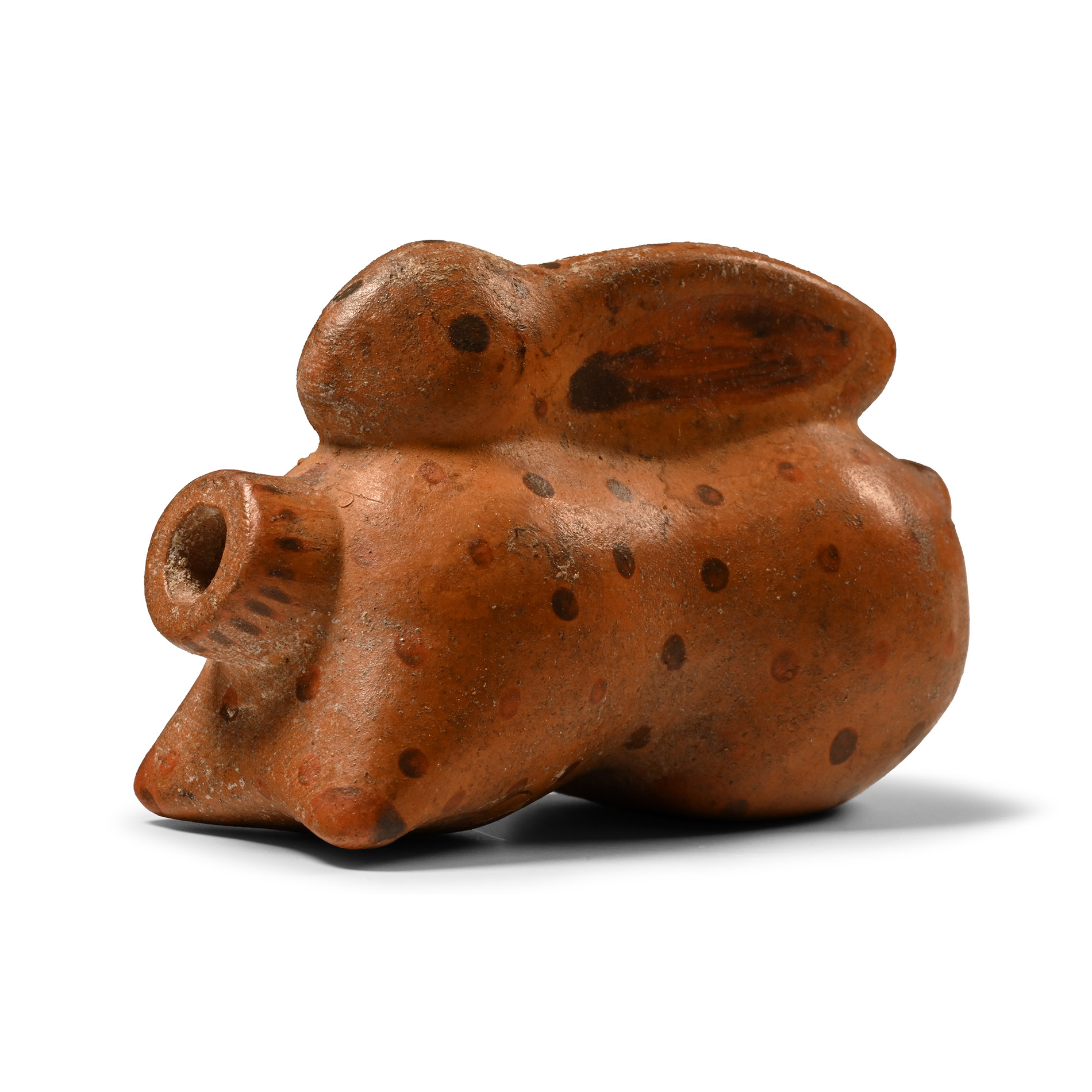
Apulian Terracotta Hare Oil Flask
7TH CENTURY B.C.
3 3/8 in. (82 grams, 86 mm).
Hollow-formed in the shape of a hare at rest with long ears parallel to the spine, vent to the chest; with spot markings to the flanks.
ProvenanceAcquired on the German art market, 1989-1995.
with The Museum Gallery, 19 Bury Place, London, WC1A 2JB, 1998-2003.
Property of a London based academic, 2003-present.
Cf. similar item in Harvard University Art Museums, accession no.2002.283, in Harvard University Art Museums, Annual Report 2002-2003, Cambridge, MA, 2004, p.12.
FootnotesMould-made aryballoi (perfume flasks) in the shapes of animals were popular in Greece in the 7th and 6th centuries B.C. Aristocratic men gave real hares as gifts to younger male lovers; this vessel might have performed a similar function.
CONDITIONTimeLine Auctions follows a vetting process to ensure the authenticity and legality of all items, reinforcing our commitment to integrity and responsible trading. Each antiquity, antique, and coin lot undergoes thorough examination by a vetting committee of at least ten external specialists, professional trade association members, scientists, and archaeologists: Our Vetting Process
AUCTIONS:
TimeLine is a leading auction house specialising in antiquities, ancient art, collectables, natural history, coins, medals, and books. Our auctions offer museums, collectors, historians, and enthusiasts the opportunity to acquire unique and historically significant pieces.
-
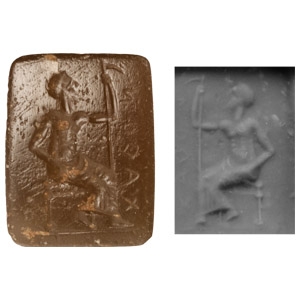
Greek Pyramid Seal with Inscription
Circa 5th century B.C.Sold for (Inc. bp): £208
With incuse Zeus seated on a stool, holding the shaft of a sceptre topped by an eagle, legend to the side 'XAΡOΝ'; supplied with a museum-quality impression. 5.02 grams, 20 mm
From the property of late Mr SM, London, UK, 1969-1999.
The seal bears a classical representation of seated Zeus with his eagle-headed sceptre. The inscribed name (Charon) is probably the one of the owner, according to the interpretation of Boardman. The parallel of the image on this seal can be seen on a blue chalcedony scaraboid, type A.L.17 preserved in the Getty Museum (inventory 84.AN.I.12). -
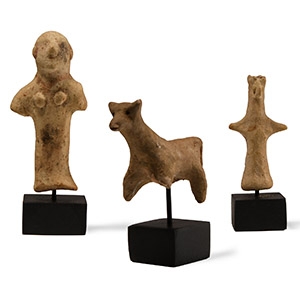
Cypriot Terracotta Figure Group
Early 1st millennium B.C.Sold for (Inc. bp): £208
Including standing female with painted collar, and other types; each mounted on a custom-made display stand. 91 grams total, 63-94 mm including stand
From a collection acquired on the UK art market from various auction houses and collections mostly before 2000. From an important Cambridgeshire estate; thence by descent. -
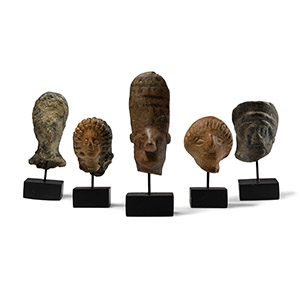
Phoenician Terracotta Head Collection
4th-2nd century B.C.Sold for (Inc. bp): £143
Including one with tongue-shaped headdress and painted detailing, one with radiating hair and chignon to the rear, and other types; each mounted on a custom-made display stand. 308 grams total, 7.3-10.7 cm including stand
From a collection acquired on the UK art market from various auction houses and collections mostly before 2000. From an important Cambridgeshire estate; thence by descent.
