
Loading, please wait...
_900x900.jpg "Apulian Red-Figure Askos with Panthers")
_200x200.jpg "Apulian Red-Figure Askos with Panthers")
_900x900.jpg "Apulian Red-Figure Askos with Panthers")
_200x200.jpg "Apulian Red-Figure Askos with Panthers")
.jpg "Apulian Red-Figure Askos with Panthers")
.jpg "Apulian Red-Figure Askos with Panthers")
LOT 0086
Apulian Red-Figure Askos with Panthers
4TH CENTURY B.C.
4 3/4 in. (149 grams, 12 cm).
With an arching strap handle and a wide spout; either side of the body painted with a crouching panther, one playing with a ball and the other depicted facing; repaired.
ProvenanceAcquired from Gallery Gryphos, Munich, 1992.
European private collection.
Accompanied by an academic report by Dr Raffaele D’Amato.
This lot has been checked against the Interpol Database of stolen works of art and is accompanied by a search certificate number no.12001-211879.
Cf. Tugusheva, O., Corpus Vasorum Antiquorum Russia, Pushkin State Museum of Fine Arts, Moscow: Attic Red-Figured Vases, Fascicule 6, Roma, 2003, pl.57, nos.4-5 and 6-7, a similar askos with two panthers, one facing, the other in profile; see also a similar Apulian red-figure askos depicting a dog and a hare, of the end of 4th century B.C. in Antikensammlung Kiel, Inventory B 730; similar askoi but of Attic production in painting style in HeiBmeyer H.H., Vasen und Figurliche Gefasse aus der Griechischen Antike – Katalog einer suddeuutschen Sammlung, Dettelbach, 2008, figs.24-25-26; Papuci-Władka, E., Corpus Vasorum Antiquorum, Poland, Cracow, Fascicule I, Cracow, 2012, pl.80; Trinkl, E., Corpus Vasorum Antiquorum Österreich Beiheft 1, Interdisziplinäre Dokumentations – und visualisierungsmethoden, Wien, 2013, fig.39, p.67, for a restored specimen of the same typology.
FootnotesPainted askoi in different forms have been produced and been in use in Athens since the middle and second quarter of the 5th century B.C., but they were also made in southern Italy. The askoi painted with a pair of animal figures were realised in Magna Graecia after the Attic continental production of similar models, with the representation of griffins, sphinxes and laconic hounds. The function of the askos as a vessel was clearly linked to wine, and therefore it is not anomalous to see it decorated with panther motifs, an animal connected with Dionysus, the god of wine and drinking.
CONDITIONTimeLine Auctions follows a vetting process to ensure the authenticity and legality of all items, reinforcing our commitment to integrity and responsible trading. Each antiquity, antique, and coin lot undergoes thorough examination by a vetting committee of at least ten external specialists, professional trade association members, scientists, and archaeologists: Our Vetting Process
AUCTIONS:
TimeLine is a leading auction house specialising in antiquities, ancient art, collectables, natural history, coins, medals, and books. Our auctions offer museums, collectors, historians, and enthusiasts the opportunity to acquire unique and historically significant pieces.
LOT 0086
Apulian Red-Figure Askos with Panthers
Estimate £3,000 - 4,000€3,480 - 4,640 (for guidance only)$4,050 - 5,400 (for guidance only)
-
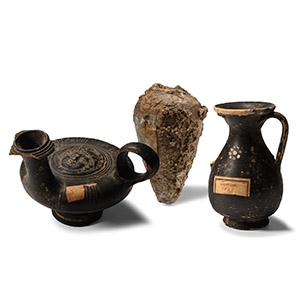
Greek Terracotta Vessel Collection
Circa 4th century B.C.Estimate: £800 - 1,000 (+bp*)
Opening Bid: £400
Mixed group comprising: blackware footed jug with loop handle, high-relief mask of Apollo, old collector's label inside the foot 'Carnac 1846'; blackware amphora with strap handles (one absent), band of rosettes to the neck, old collector's labels 'Carnac 1846' to base and body; amphora with marine encrustation, old collector's label (illegible). 526 grams total, 98-120 mm
Collected circa 1846. From a 19th century collection. Acquired by a previous vendor's father in the 1930s-1940s. Ex property of a North London, UK, gallery. -
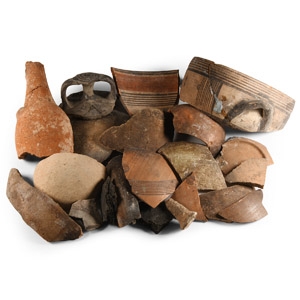
Greek and Other Pottery Sherd Group
Circa 1st millennium B.C.Sold for (Inc. bp): £91
Including fragments of amphora, lekythos, kylix and other types. 1 kg total, 3.6-15.5 cm
From a collection acquired on the UK art market from various auction houses and collections mostly before 2000. From an important Cambridgeshire estate; thence by descent. -
.jpg)
Etruscan Bronze Figure of Warring Mars
6th century B.C.Estimate: £6,000 - 8,000 (‡+bp*)
Opening Bid: £3,000
The Etrusco-Italic warrior Laran (Roman Mars) modelled in the round, representing a young muscular hero with long torso and rounded shoulders, wearing a high-crested Illyrian helmet with grooved perimeter, a hole above each ear for attaching an ornament; mounted on a custom-made display stand. 326 grams total, 16.2 cm high including stand
Ex Koutoulakis collection. Ex Gorny & Mosch, Munich, 17 June 1999, no.2051. with Sotheby's, New York, 12 June 2001, no.16. Accompanied by an academic report by Dr Raffaele D'Amato. This lot has been checked against the Interpol Database of stolen works of art and is accompanied by search certificate number no.11803-206793.
The statuette assumes the position of the 'warring Mars', which characterises the numerous Etruscan and Italic statues of the god produced as votive offerings to the temples or for private lararia. The god is depicted as taking part in a military march with his left leg advancing, his raised right would have held a spear and the left hand a shield.
