
Loading, please wait...
LOT 0785
Antiquarian Research and Photograph Albums of Various Roman Sites in Britain
1960S-1980S A.D.
10 1/2 x 11 1/4 - 13 1/4 x 11 3/8 in. (12.9 kg total, 26.5 x 28.5 - 33.5 x 29 cm).
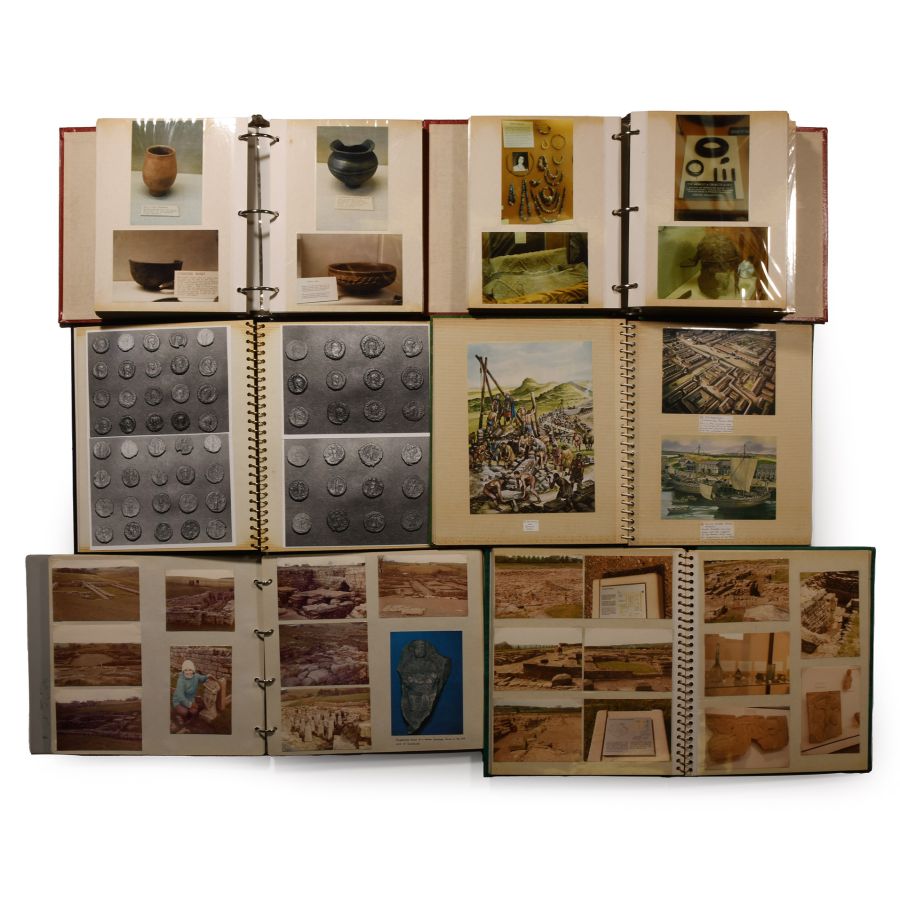
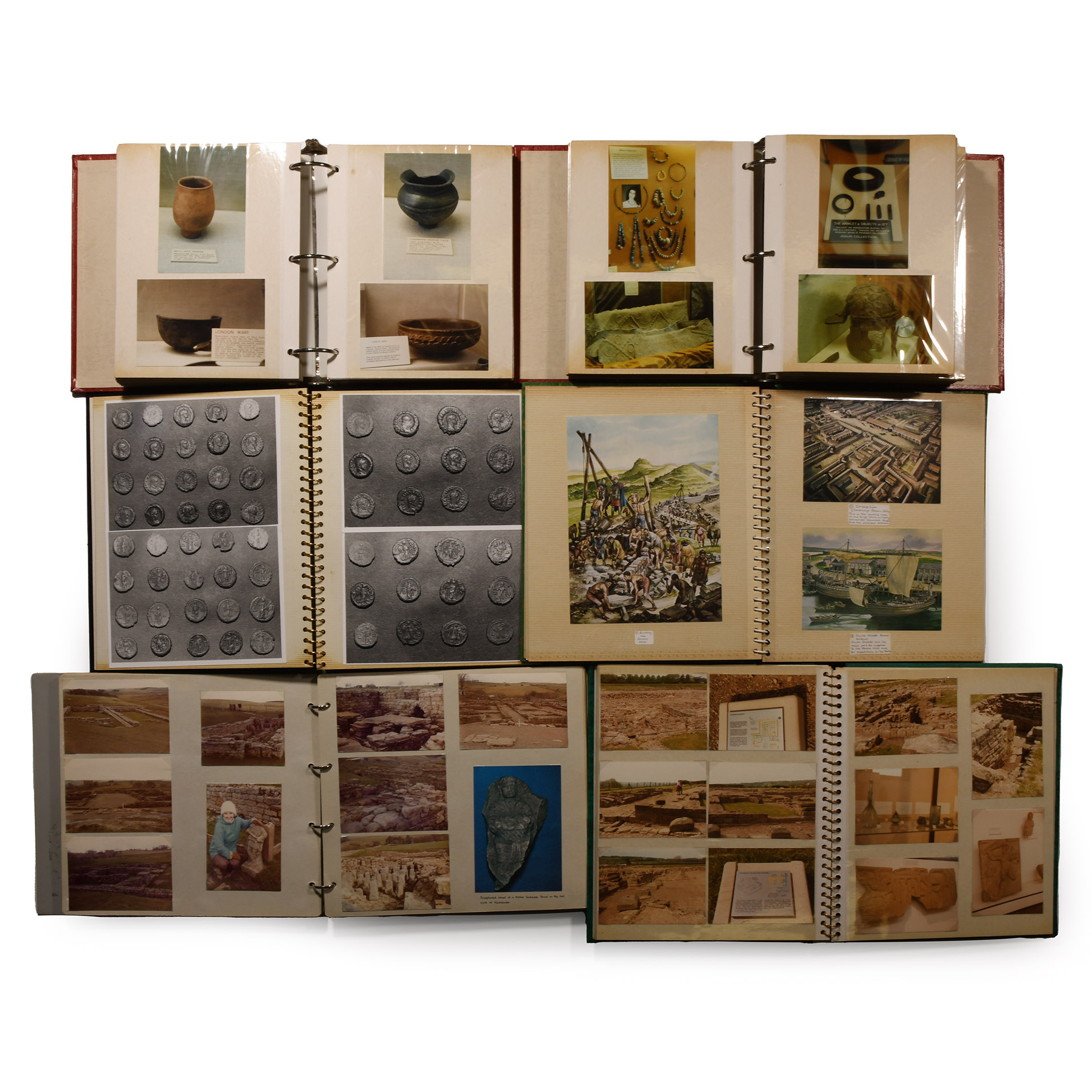
Comprising six albums: a photo album with pictures from Calleva Atrebatum, Roman Silchester in Hampshire, England, showing categorised images of artefacts and displays from Reading museum with handwritten information labels, including mosaics, jewellery, beads, pottery, tiles and other artefacts; a photo album with images from Tullie House Museum showing pictures of oil lamps, oil lamps, pottery, some with handwritten information labels, also containing images from Colchester Castle Museum comprising images of pottery, Samian ware moulds, and other artefacts, and images from Wroxeter Roman city, pictures of six stones from the Roman camp at Old Penrith, pictures from Newcastle Museum, and from Great Witcombe villa in Gloucestershire; an album with postcards and printed information cards from Vindolanda, a Roman auxiliary fort south of Hadrian's Wall showing life and costumes during Roman occupation; another album with photographs from Corbridge, a Roman town south of Hadrian's Wall, pictures taken at Aldborough Roman town, and pictures from Yorkshire Museum in York; an album containing black-and-white images of mainly Roman and Byzantine coins; a scrap book with labelled pictures and postcards from Chedworth Roman Villa, Chesters Roman Fort in Northumberland, Housesteads Roman Fort, antiquities in Chesters Museum, Hadrian's Wall area, Aesica (Great Chesters), Vindolanda, and miscellaneous pictures of historic places and artefacts. [6, No Reserve]
ProvenanceFrom the collection of a late East Anglian teacher and antiquarian who retired to the Isle of Wight in Hampshire, UK.
He amassed a large collection of objects between the 1960s-1980s.
TimeLine Auctions follows a vetting process to ensure the authenticity and legality of all items, reinforcing our commitment to integrity and responsible trading. Each antiquity, antique, and coin lot undergoes thorough examination by a vetting committee of at least ten external specialists, professional trade association members, scientists, and archaeologists: Our Vetting Process
AUCTIONS:
TimeLine is a leading auction house specialising in antiquities, ancient art, collectables, natural history, coins, medals, and books. Our auctions offer museums, collectors, historians, and enthusiasts the opportunity to acquire unique and historically significant pieces.
LOT 0785
Antiquarian Research and Photograph Albums of Various Roman Sites in Britain
Sold for (Inc. bp): £124
-
Roman and Later Artefact Group
3rd-17th century A.D.Sold for (Inc. bp): £39
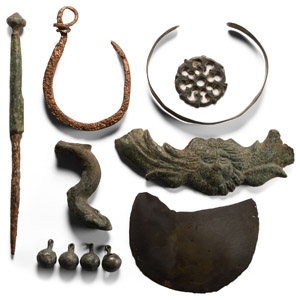
Comprising: an annular bracelet with linear decoration; four spherical buttons; an openwork mount; a large mount with a central face mask; a polished mirror insert fragment; a casket leg formed as lion's paw; a pin with iron stem; and a hook. 179 grams total, 1.3-12 cm
Property of the vendor's grandfather, thence by family descent, circa 1985. From the private collection of a New York, USA gentleman. -
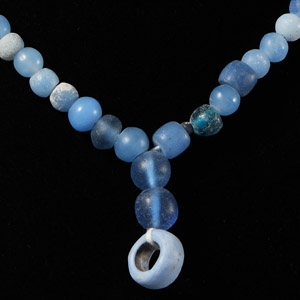
Roman and Other Bead Necklace
1st-4th century A.D. and laterSold for (Inc. bp): £117
Restrung designer necklace with polyhedral, oblate, tubular and other beads, centrepiece an annular bead. 23.4 grams, 37 cm
Acquired on the London, UK, art market in the 1990s. Ex London, UK, gallery. -
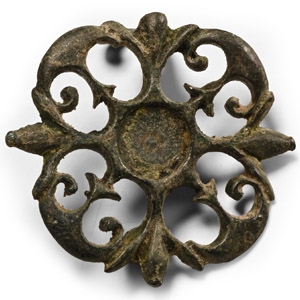
Roman Bronze Plate Brooch
2nd-3rd century A.D.Sold for (Inc. bp): £104
Openwork body composed of four pelta-shaped motifs separated by floral motifs, radiating from a central recessed disc; catch and pin-lugs to the reverse. 6.63 grams, 33 mm
Ex German art market, 2000s. Acquired from an EU collector living in London. From the collection of Surrey, UK, gentleman.
