
Loading, please wait...
LOT 1393
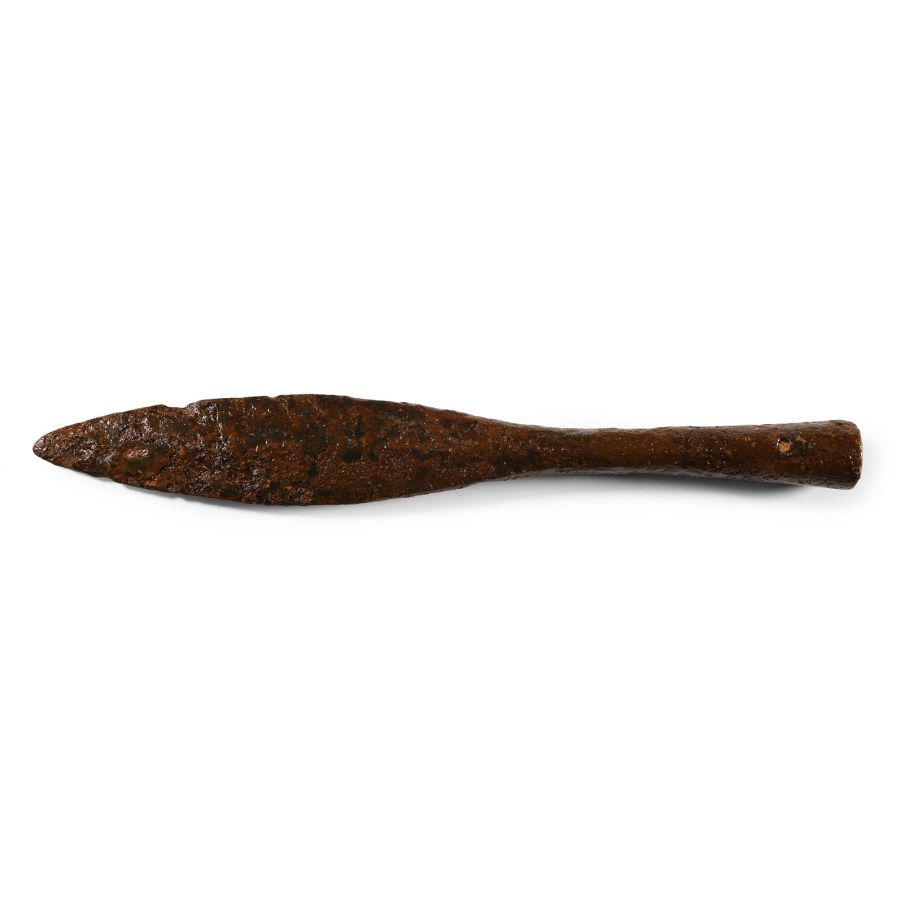
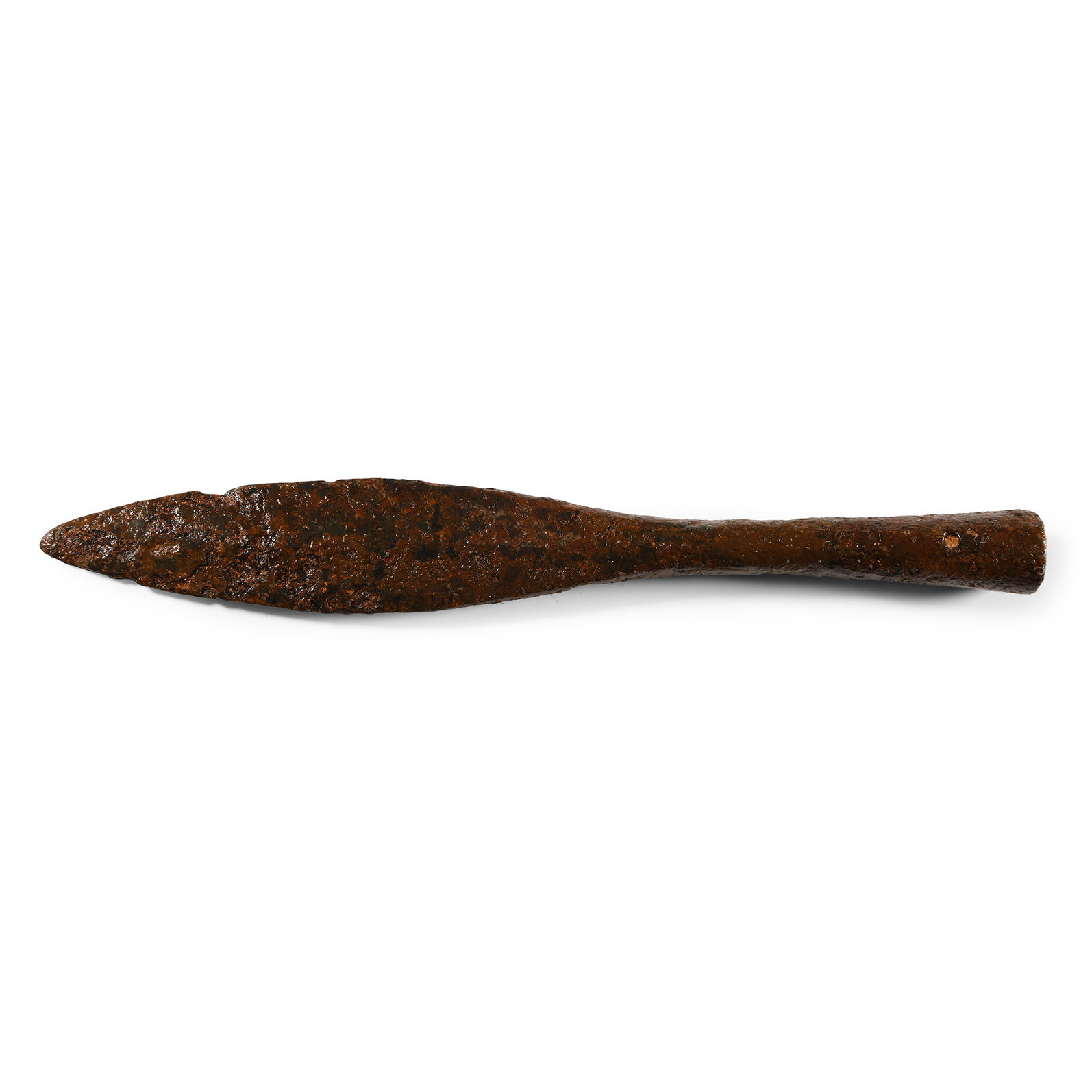
Anglo-Saxon Socketted Iron Spearhead
5TH-6TH CENTURY A.D.
9 5/8 in. (215 grams, 24.4 cm).
Lentoid-section broad leaf-shaped blade with thick neck and split socket; Swanton's Group D1. [No Reserve]
ProvenanceFound near Wetwang, East Yorkshire, UK.
Acquired circa 2005.
Ian Wilkinson collection, Nottinghamshire, UK.
Exhibited at Harwich Museum, Harwich, Essex, UK, 14th March-9th June 2024; accompanied by a copy of a photograph of the artefact on display.
LiteratureCf. Swanton, M.J., Spearheads of the Anglo-Saxon Settlements, London, 1973, fig.18(c).
FootnotesThe chronological range of the type D1 extends over the entire Pagan period. With the group C1, of which Swanton believed this might simply be a long-socketted variant, the typology did not survive the 7th century A.D.
CONDITIONTimeLine Auctions follows a vetting process to ensure the authenticity and legality of all items, reinforcing our commitment to integrity and responsible trading. Each antiquity, antique, and coin lot undergoes thorough examination by a vetting committee of at least ten external specialists, professional trade association members, scientists, and archaeologists: Our Vetting Process
AUCTIONS:
TimeLine is a leading auction house specialising in antiquities, ancient art, collectables, natural history, coins, medals, and books. Our auctions offer museums, collectors, historians, and enthusiasts the opportunity to acquire unique and historically significant pieces.
-
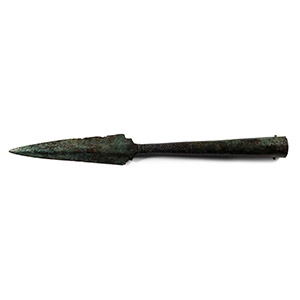
Elamite Socketted Spearhead
1st millennium B.C.Estimate: £300 - 400 (+bp*)
Opening Bid: £167
With tapering split socket, stepped shoulders and two-edged triangular head; pronounced midrib, bands of low-relief chevron and braid detailing, attachment pin. 180 grams, 28 cm
From a Mayfair, London, gallery, 1990s. -
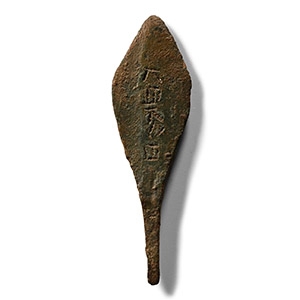
Phoenician Bronze Arrowhead with Inscription
Circa 12th-11th century B.C.Sold for (Inc. bp): £3,640
With incised text to the midrib on one face, less well-defined characters to the reverse. 9.2 grams, 63 mm
From the collection of a gentleman, acquired on the London art market in the 1990s.
The arrowhead seems to carry a Proto-Aramaic or Phoenician inscription like many arrows found in the Levant and Israel. They are usually reporting proper names like ‘Suwar, retainer of Abday’. As far as the function of these arrowheads is concerned, we know that the name inscribed on them was the owner's because successive owner's names were incised on two palimpsest examples. The letters engraved upon our arrow seem to be in the Phoenician alphabet and read ḤŞ’Ḥ’ (arrow of…) on the reverse, and ’Š I Š Q (?) (man of…) on the obverse. -
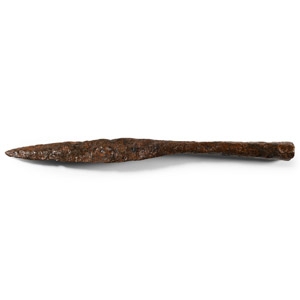
Anglo-Saxon Iron Socketted Spearhead
6th-8th century A.D.Sold for (Inc. bp): £163
Lentoid-section narrow blade with thick shoulder, closed socket; Swanton's Group I2. 159 grams, 26 cm
Found near Wetwang, East Yorkshire, UK. Acquired circa 2005. Ian Wilkinson collection, Nottinghamshire, UK.
The spear-heads of group I2 belong to a larger number of blades with more slender and regularly curved leaf-shapes than previous types. The majority present profiles more regularly curved from junction to tip, the broader part of the blade near the middle, with the fuller comformably longer. All of the group are much of the length varying between some 25 and 35 cm.
