Loading, please wait...
Details
LOT 1589
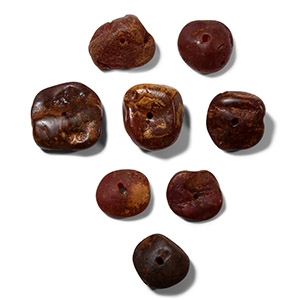
Anglo-Saxon Glass Bead Group
6TH-8TH CENTURY A.D.
2 3/8 in. (14 grams, 59 mm).
Restrung, comprising melon and biconvex types and a pierced Roman bronze coin used as a pendant. [No Reserve]
Provenance
Found on an Anglo-Saxon site in Suffolk, UK.
Acquired from Den of Antiquity, 2009.
Ian Wilkinson collection, Nottinghamshire, UK.
VETTING:
TimeLine Auctions follows a vetting process to ensure the authenticity and legality of all items, reinforcing our commitment to integrity and responsible trading. Each antiquity, antique, and coin lot undergoes thorough examination by a vetting committee of at least ten external specialists, professional trade association members, scientists, and archaeologists: Our Vetting Process
AUCTIONS:
TimeLine is a leading auction house specialising in antiquities, ancient art, collectables, natural history, coins, medals, and books. Our auctions offer museums, collectors, historians, and enthusiasts the opportunity to acquire unique and historically significant pieces.
RELATED LOTS
-
'The Hoxne Priory' Anglo-Saxon Bronze Anthropomorphic Figurine
600-700 A.D. or laterEstimate: £2,000 - 3,000 (+bp*)
Opening Bid: £1,000
Modelled in the round standing naked with both feet on a drum-shaped base; the head bulbous with small lentoid eyes placed high on the face, wedge-shaped nose and slit mouth; the arms poorly defined but apparently extending to the hips (and perhaps bent flat across the body); the legs separated by a rotary device with small feet, the genital area blank with a shallow socket in the shape of a phallus and testes. 43.6 grams, 75 mm
Found whilst searching with a metal detector approximately 100 yards from the ruins of Hoxne Priory, Suffolk, UK, on 27th August 2023 by Richard Hudson. Accompanied by a report by Anglo-Saxon and Viking specialist Stephen Pollington. Accompanied by a copy of the British Museum's Portable Antiquities Scheme (PAS) report no.SF-F804CE. Accompanied by a copy of the Suffolk County Council archaeological finds recording service receipt dated 27th August 2023. Accompanied by a handwritten signed letter from the finder explaining the circumstances of finding including copies of photographs taken shortly after finding. This lot has been checked against the Interpol Database of stolen works of art and is accompanied by a search certificate number no.12134-217182.
The piece is unusual in that the arms are poorly defined and the lower arms and hands not easily discernible, the columnar base is not normally present, and the legs were apparently connected by metal which needed to be drilled out, possibly due to a poorly-prepared mould allowing leakage across from one leg to the other. Metal analysis by X-ray fluorescence (XRF), and the trace elements found therein, seems to support an early Anglo-Saxon date: Cu 59.8, Sn 20.7, Pb 8.1, Fe 7.0, Zn 2.1, As 1.2, Bi 0.8, Ti 0.2. The find spot is near Hoxne, Suffolk, which has a long and interesting history. In 1992, a huge hoard of Roman silverware was discovered in the vicinity, with the largest collection of gold and silver coins of the 4th-5th century found anywhere within the Roman Empire. This suggests that the area was always important economically and socially. The local Priory dates from the mid-tenth century (i.e. mid-Saxon period) but the site was already associated with the kings of East Anglia, who held land here; it is usually said to be the spot where King Edmund defied the Danish leader Hinguar (Ivarr) and met his death. It is probable that the priory's location was chosen because it was already a site of religious worship: Pope Gregory's instruction to the missionaries attempting to convert the Anglo-Saxons was to preserve their festivals and sites of religious worship, but to alter the religious content (Chaney, 1967). It is thus likely that the location of the Priory was already a (pre-Christian) holy place with a temple. -
Saxon Gold Pendant with Cabochon Garnet
Circa 6th-7th century A.D.Sold for (Inc. bp): £1,560
Tongue-shaped gold cell with applied bands of braided filigree, inset cabochon garnet; integral loop. 5.38 grams, 24 mm
From the private collection of a London gentleman, from his grandfather's collection formed before the early 1970s. -
Anglo-Saxon Gilt Bronze Horse Harness Pelta Mount
6th-7th century A.D.Sold for (Inc. bp): £975
Comprising a pelta-shaped panel pierced in three places to accept a rivet (one absent); obverse with low-relief Style II knotwork. 18.2 grams, 56 mm
Found Peterborough, Cambridgeshire, UK. From an East Anglian private collection.