
Loading, please wait...
LOT 1534
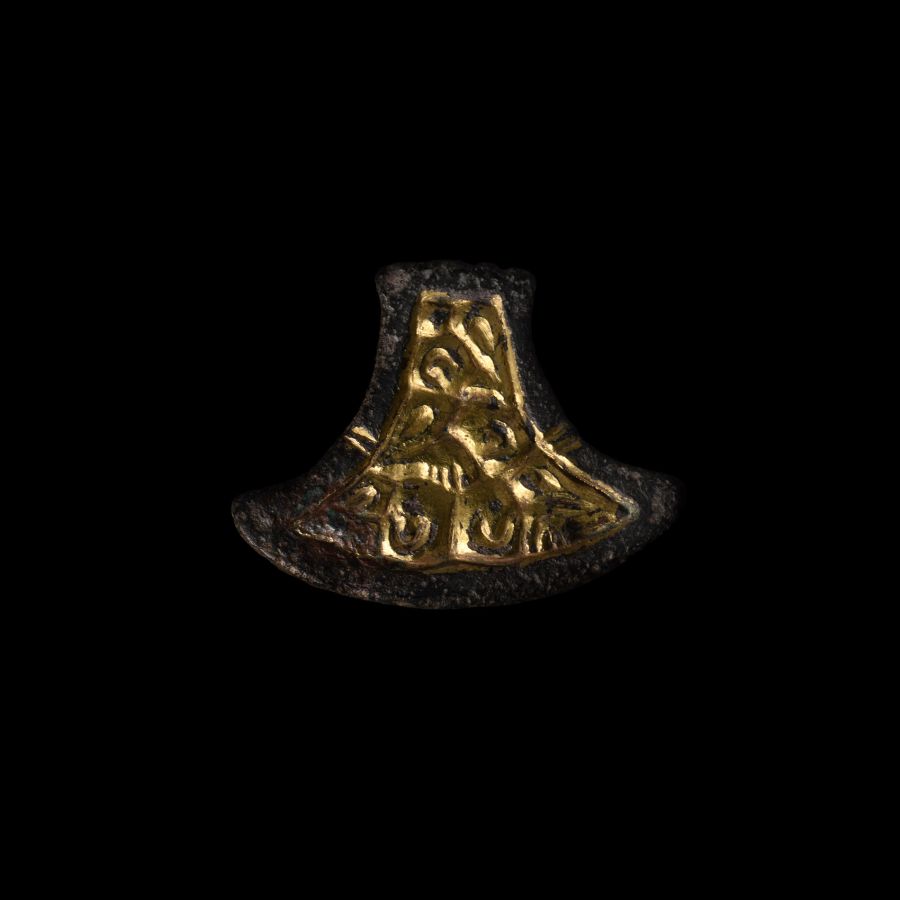
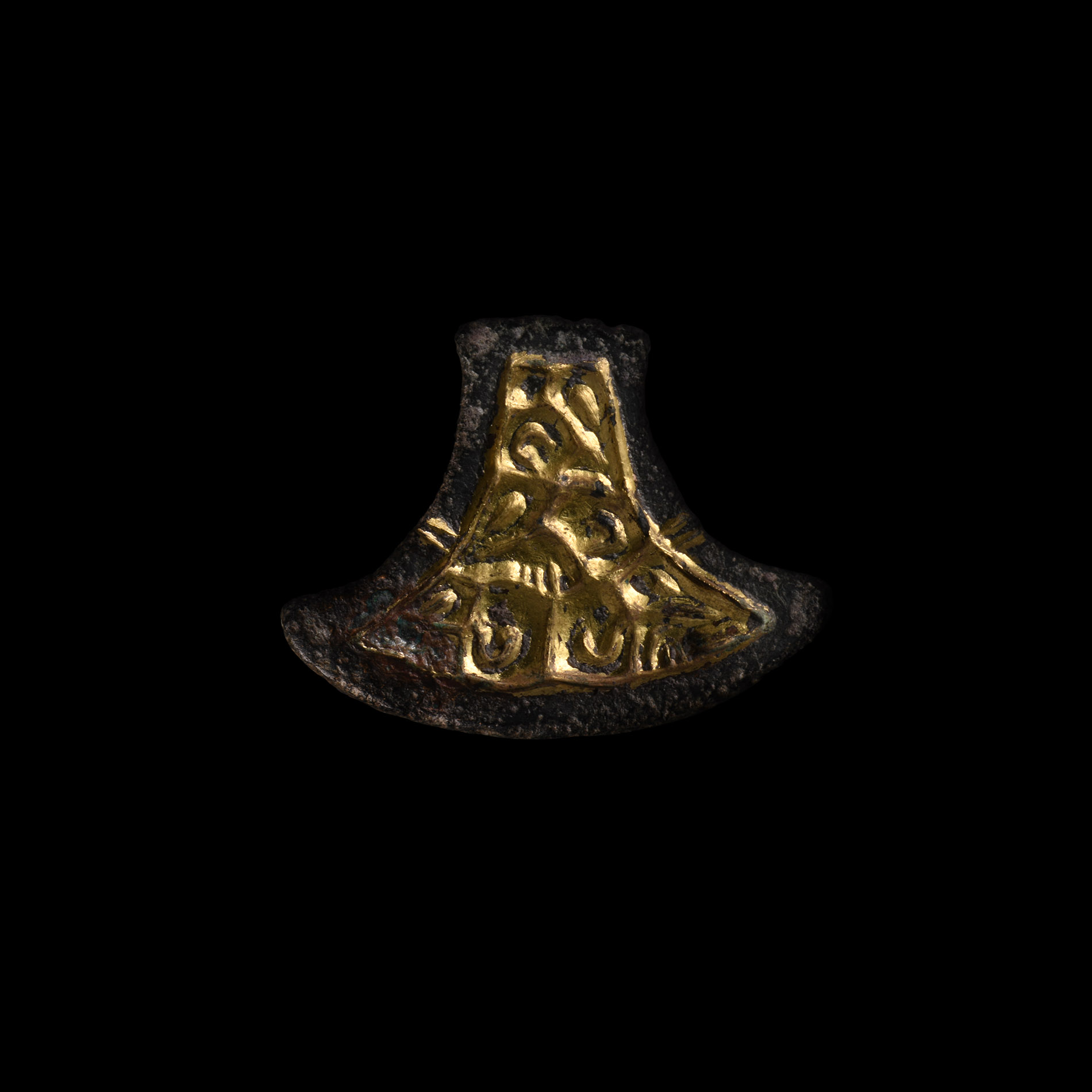
Anglo-Saxon Gilt Bronze Horse Harness Mount
6TH-7TH CENTURY A.D.
1 3/8 in. (6.4 grams, 35 mm).
Composed of a pelta-shaped body with broad border, central panel of dense Style II ornament, three studs to the reverse. [No Reserve]
ProvenanceEx property of a gentleman; acquired in the 1970s.
LiteratureCf. Carver, M., Sutton Hoo. A Seventh Century Princely Burial Ground and its Context, London, 2005, item 25cii; Fern, C., ‘The Archaeological Evidence for Equestrianism in Early Anglo-Saxon England c.450-700' in Pluskowski, A. (ed.), Just skin and bones? New perspectives in Animal-Human relations in the Historical Past, 2005, pp.43-71.
FootnotesThe pelta-shaped body could be a part of a circular decorative phalera usually attached to the breast of the horse, or to the muzzle of the horse's head, or decoration of the harness mount of antilina or strap-junction of the postilina (Fern, 2005, fig.5.18). It was usually positioned at the bottom of the phalera.
CONDITIONTimeLine Auctions follows a vetting process to ensure the authenticity and legality of all items, reinforcing our commitment to integrity and responsible trading. Each antiquity, antique, and coin lot undergoes thorough examination by a vetting committee of at least ten external specialists, professional trade association members, scientists, and archaeologists: Our Vetting Process
AUCTIONS:
TimeLine is a leading auction house specialising in antiquities, ancient art, collectables, natural history, coins, medals, and books. Our auctions offer museums, collectors, historians, and enthusiasts the opportunity to acquire unique and historically significant pieces.
LOT 1534
Anglo-Saxon Gilt Bronze Horse Harness Mount
Estimate £150 - 200€170 - 230 (for guidance only)$200 - 270 (for guidance only)
-
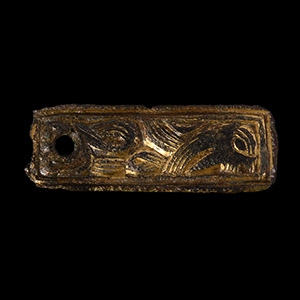
Anglo-Saxon Gilt Bronze Mount
6th century A.D.Sold for (Inc. bp): £72
Comprising a mounting lug to the reverse, hole to one end; raised border and panel of three-band Style I ornament. 2.9 grams, 33 mm
Found Saxmundham, Suffolk, UK. -

Saxon 'Sutton Hoo' Type Iron Cauldron Chain
6th-7th century A.D.Sold for (Inc. bp): £91
Or a hanging-bowl chain comprising: nine sets of two parallel-twisted 8-shaped links, with interstitial H-shaped twisted elements, the lower four each with a standing bull figure with prominent horns; a lateral hook with herringbone twisted shank; lower hooked flange with four herringbone-twist bars with looped ends; suspension ring and four-bar herringbone-twisted shank. 3.1 kg, 1.03 m
Acquired 1971-1972. From the collection of the vendor's father. Property of a London, UK, collector.
The chain and fittings closely resemble those recovered from Mound 1 at Sutton Hoo, Suffolk, England (British Museum accession ref. 1939,1010.167). It is understood that the chain was used to support a cauldron above the hearth, with additional hooks and suspension brackets for ancillary vessels. The bull-head detailing was present on the wrought-iron stand (ref. 1939,1010.161) from the same grave. -

Anglo-Saxon Gilt Bronze Mount with Wolf-Men
6th century A.D.Estimate: £1,200 - 1,700 (+bp*)
Opening Bid: £600
The majority of a mount bearing dense and enigmatic imagery recalling half-remembered legends which were already ancient when it was made; the obverse packed with a tangled mass of bands of detailed ornament which resolves itself into human (or divine?) figures, each gripping the ankles of the other, their bodies inverted and contorted in the classic Style I chip-carved fashion; the centre with a round cell, into which a flat-cut glass cloison is set, polished to reflect the light and to shimmer with blood-red brilliance. 9.08 grams, 32 mm
Fine condition. Unique.
Found Wiltshire, UK. Wiltshire gentleman, 2011. TimeLine Originals, 2000s. Property of an East Anglia gentleman. Accompanied by a report by Anglo-Saxon and Viking specialist S. Pollington. This lot has been checked against the Interpol Database of stolen works of art and is accompanied by search certificate number no.10381-168115.
Anglo-Saxon and Viking specialist Stephen Pollington writes: '...the scene presented may illustrate a legend or myth of which no record survives. That said, the execution of the piece is consistent with high-status Anglo-Saxon metalwork of the 6th century, and the quality of the gilding is remarkably high. The iconography is at present unique but entirely within the Anglo-Saxon tradition.'
