
Loading, please wait...
LOT 1628
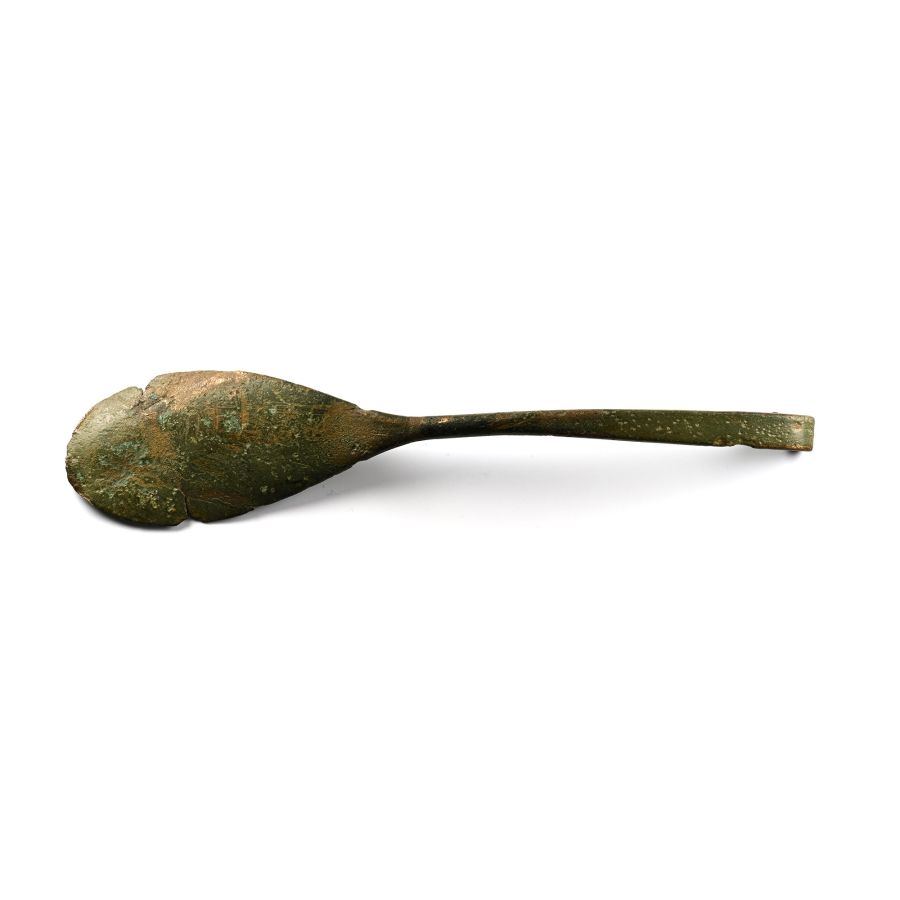
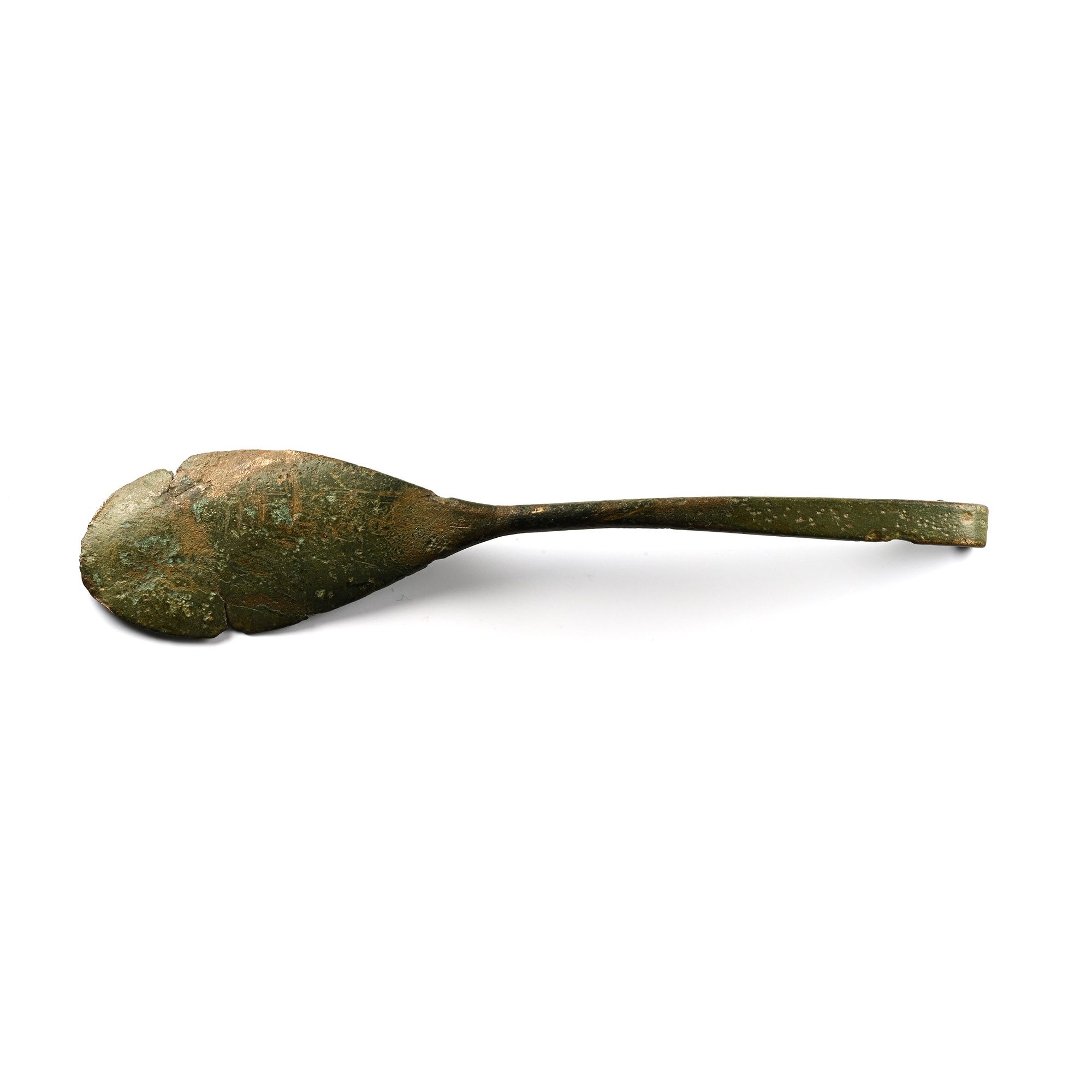
Anglo-Saxon Bronze 'Knife-Spoon'
7TH-10TH CENTURY A.D.
4 3/8 in. (9.77 grams, 11 cm).
Comprising an ovoid-shaped, typical almost flat bowl; round-section short neck with incised collars; flat-section handle with a loop at the end. [No Reserve]
ProvenanceProperty of a Cambridgeshire, UK, collector.
From his private collection since the 1970s; thence by descent circa 2000.
Ex private collection of a Bedfordshire gentleman.
This lot is accompanied by an illustrated lot declaration signed by the Head of the Antiquities Department, Dr Raffaele D'Amato.
Cf. Hammond, Brett, British Artefacts, Volume 2 - Middle Saxon & Viking, pp.106-107, fig.1.16-h.
CONDITIONTimeLine Auctions follows a vetting process to ensure the authenticity and legality of all items, reinforcing our commitment to integrity and responsible trading. Each antiquity, antique, and coin lot undergoes thorough examination by a vetting committee of at least ten external specialists, professional trade association members, scientists, and archaeologists: Our Vetting Process
AUCTIONS:
TimeLine is a leading auction house specialising in antiquities, ancient art, collectables, natural history, coins, medals, and books. Our auctions offer museums, collectors, historians, and enthusiasts the opportunity to acquire unique and historically significant pieces.
-
.jpg)
Anglo-Saxon Gilt Bronze Star Saucer Brooch with Composite Boss
Late 5th-6th century A.D.Sold for (Inc. bp): £468
With a deep flange, chamfered inner ridge and wavy line, second chamfered edge with a high-relief five pointed star within a multiple stranded border surrounding a central rivetted boss, remains of catchplate and pin-lug to verso; rare with composite boss. 20 grams, 18 mm
Found whilst searching with a metal detector in Middle Aston, Cherwell, Oxfordshire, UK, on Wednesday 8th August 2024. Accompanied by a copy of the British Museum's Portable Antiquities Scheme (PAS) report no.OXON-B9A7B7. This lot is accompanied by an illustrated lot declaration signed by the Head of the Antiquities Department, Dr Raffaele D'Amato.
Saucer brooches are a female Saxon fashion, contemporary with the Anglian penannular and cruciform types, normally worn at the shoulders to secure a tubular dress. -
.jpg)
Anglo-Saxon Gilt Bronze Wrist Clasp
450-570 A.D.Sold for (Inc. bp): £39
Rectangular in plan with six vandykes to the trailing edge, hook beneath the forward edge, transverse grooves flanking a panel of Salin's Style I ornament (Tiermensch). 6.69 grams, 43 mm
Found near Skirpenbeck, Yorkshire, UK, in 2019. From an old Yorkshire, UK, collection. Accompanied by a copy of the British Museum's Portable Antiquities Scheme (PAS) report no.YORYM-DDC0C9. This lot is accompanied by an illustrated lot declaration signed by the Head of the Antiquities Department, Dr Raffaele D'Amato. -
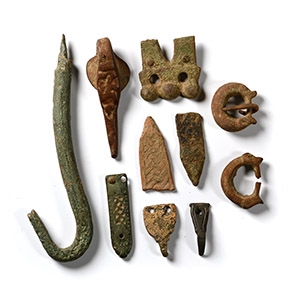
Anglo-Saxon Bronze Artefact Collection
6th-12th century A.D.Sold for (Inc. bp): £59
Comprising: two buckles; a snake-head hook; a Hiberno-Norse strap end with interlaced design; two hooked tags; a fragmentary strap end and belt end; a large hooked tag with interlaced design. 107 grams total including documents, 19-81 mm
Found Yorkshire and Lincolnshire, UK. From the private collection of Robin Sykes, Yorkshire, UK, formed since the late 1990s. Three objects with record sheets by Jim Halliday plus accompanied by various other correspondence from Lincolnshire museum services. This lot is accompanied by an illustrated lot declaration signed by the Head of the Antiquities Department, Dr Raffaele D'Amato.
