
Loading, please wait...
_900x900.jpg "Anatolian Black Stone Cylinder Seal with Figures Holding Clubs")
_200x200.jpg "Anatolian Black Stone Cylinder Seal with Figures Holding Clubs")
.jpg "Anatolian Black Stone Cylinder Seal with Figures Holding Clubs")
LOT 0217
Anatolian Black Stone Cylinder Seal with Figures Holding Clubs
CIRCA 2600-2300 B.C.
3/4 in. (6.76 grams, 19 mm).
Cylinder with cord and bead handles; accompanied by a copy of an old scholarly note, typed and signed by W.G. Lambert, late Professor of Assyriology, University of Birmingham, 1970-1993, which states: 'Description of Cylinder Seal of Soft Black Stone, 19.5 x 13 mm. Two standing human figures are striking with big clubs, the one at a seated (fallen?) human, the other at an uncertain depiction. A third standing human (inactive) and two quadrupeds make up the scene. From Syria or Anatolia, c. 2600-2300 B.C. Condition: edges worn, but the design still sharp.'; supplied with a museum-quality impression. [No Reserve]
ProvenanceUK private collection, acquired 1980-1983.
Accompanied by a copy of a scholarly note, typed and signed by Professor Wilfrid George Lambert in October 1987.
This lot has been cleared against the Art Loss Register database, and is accompanied by an illustrated lot declaration signed by the Head of the Antiquities Department, Dr Raffaele D'Amato.
TimeLine Auctions follows a vetting process to ensure the authenticity and legality of all items, reinforcing our commitment to integrity and responsible trading. Each antiquity, antique, and coin lot undergoes thorough examination by a vetting committee of at least ten external specialists, professional trade association members, scientists, and archaeologists: Our Vetting Process
AUCTIONS:
TimeLine is a leading auction house specialising in antiquities, ancient art, collectables, natural history, coins, medals, and books. Our auctions offer museums, collectors, historians, and enthusiasts the opportunity to acquire unique and historically significant pieces.
LOT 0217
Anatolian Black Stone Cylinder Seal with Figures Holding Clubs
Sold for (Inc. bp): £234
-
.jpg)
Large Proto-Elamite Silver Pendant with Bull's Head
Circa 3100-2900 B.C.Estimate: £25,000 - 35,000 (+bp*)
Opening Bid: £12,000
Comprising: a hollow sheet-silver panel formed as two comma-shaped stylised bovine bodies, each with transverse hatched bands at the ankles and perforations for attachment of studs; at centre top, a bull's head modelled in the round with long curved horns; loop to the reverse. 67.7 grams, 10.7 cm
with Mahboubian Gallery, New York, acquired prior to 1969. London, UK, collection. Accompanied by an academic report by Dr Raffaele D'Amato. This lot has been checked against the Interpol Database of stolen works of art and is accompanied by a search certificate number no.12710-235586. This lot has been cleared against the Art Loss Register database, and is accompanied by an illustrated lot declaration signed by the Head of the Antiquities Department, Dr Raffaele D'Amato. -
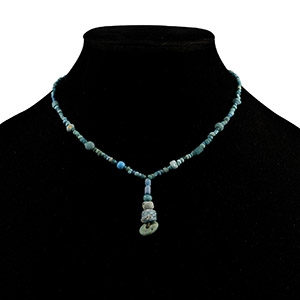
Achaemenid Pale Blue Glass Bead Necklace String
6th-4th century B.C. and laterSold for (Inc. bp): £46
Restrung group of tubular and other beads with a discoid dangle. 8.45 grams, 33.5 cm
Ex London, UK, collection, 1990s. This lot has been cleared against the Art Loss Register database, and is accompanied by an illustrated lot declaration signed by the Head of the Antiquities Department, Dr Raffaele D'Amato. -
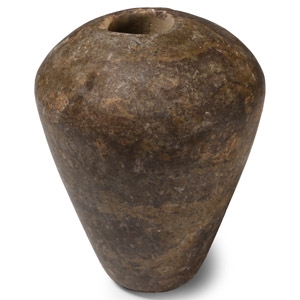
Western Asiatic Stone Macehead
3rd-2nd millennium B.C.Estimate: £100 - 140 (+bp*)
Opening Bid: £50
Piriform with vertical socket expanding towards the narrower end. 385 grams, 84 mm
From a West London, UK, collection, 1980-1990s. This lot has been cleared against the Art Loss Register database, and is accompanied by an illustrated lot declaration signed by the Head of the Antiquities Department, Dr Raffaele D'Amato.
