
Loading, please wait...
_900x900.jpg "Amlash Terracotta Vessel with Wide Spout")
_200x200.jpg "Amlash Terracotta Vessel with Wide Spout")
.jpg "Amlash Terracotta Vessel with Wide Spout")
LOT 0994
Amlash Terracotta Vessel with Wide Spout
1ST MILLENNIUM B.C. OR LATER
10 in. (465 grams, 25.3 cm).
A stylised zoomorphic bowl with bulbous body and wide U-shaped spout, two small projecting feet beneath the spout, loop handle to the rear. [No Reserve]
ProvenanceFrom a Mayfair gallery 1990s.
Ex London, UK, collection.
This lot has been cleared against the Art Loss Register database, and is accompanied by an illustrated lot declaration signed by the Head of the Antiquities Department, Dr Raffaele D'Amato.
TimeLine Auctions follows a vetting process to ensure the authenticity and legality of all items, reinforcing our commitment to integrity and responsible trading. Each antiquity, antique, and coin lot undergoes thorough examination by a vetting committee of at least ten external specialists, professional trade association members, scientists, and archaeologists: Our Vetting Process
AUCTIONS:
TimeLine is a leading auction house specialising in antiquities, ancient art, collectables, natural history, coins, medals, and books. Our auctions offer museums, collectors, historians, and enthusiasts the opportunity to acquire unique and historically significant pieces.
-
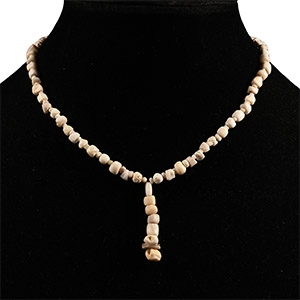
Western Asiatic White Stone Bead Necklace String
1st millennium B.C. and laterSold for (Inc. bp): £39
Restrung group of oblate, irregular, drum-shaped and other beads. 13.5 grams, 31 cm
Ex London, UK, collection, 1990s. This lot has been cleared against the Art Loss Register database, and is accompanied by an illustrated lot declaration signed by the Head of the Antiquities Department, Dr Raffaele D'Amato. -
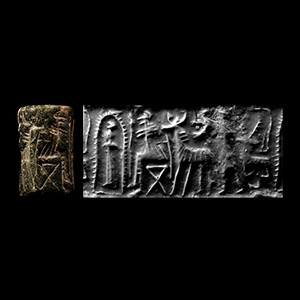
Anatolian Dark Green Cylinder Seal with God
Circa 2000 B.C.Sold for (Inc. bp): £1,105
Cylinder with cord and bead handles; accompanied by a copy of an old scholarly note, typed and signed by W.G. Lambert, late Professor of Assyriology, University of Birmingham, 1970-1993, which states: 'Cylinder of dark-green stone, 39 x 25 mm., some incrustation which could be removed; condition good. Figure ( god? ) under notched arch, seated figure to right, leaning forward and holding spear; two distinct horned animals with standing figure between them, bird. From North Syria or Anatolia, c. 2000 B.C.'; supplied with a museum-quality impression. 48.5 grams, 39 mm
UK private collection, acquired 1980-1983. Accompanied by a copy of a scholarly note, typed and signed by Professor Wilfrid George Lambert in November 1988. This lot has been cleared against the Art Loss Register database, and is accompanied by an illustrated lot declaration signed by the Head of the Antiquities Department, Dr Raffaele D'Amato. -
.jpg)
Bactrian Stone 'Hand Bag' Ceremonial Weight
Late 3rd-early 2nd millennium B.C.Sold for (Inc. bp): £1,950
Rectangular block with round-section loop handle. 9.95 kg, 27.5 cm
Ex West London, UK, collection, 1990s. This lot has been cleared against the Art Loss Register database, and is accompanied by an illustrated lot declaration signed by the Head of the Antiquities Department, Dr Raffaele D'Amato.
Among the most iconic intercultural style objects are the so-called 'lock' or 'hand bag' weights. These were probably not weights at all, but were likely badges of high office, carried to indicate authority. Similar objects have been found throughout Mesopotamia, the islands of the Persian Gulf, on the Iranian steppe, as well as the Indus Valley.
