
Loading, please wait...
_900x900.jpg "Amlash Terracotta Flagon")
_200x200.jpg "Amlash Terracotta Flagon")
.jpg "Amlash Terracotta Flagon")
LOT 1097
Amlash Terracotta Flagon
2ND-1ST MILLENNIUM B.C.
9 1/2 in. (735 grams, 24.5 cm high).
Globular in form with flared cylindrical neck and integral handle with triangular projection; applied pellets either side, likely a zoomorphic representation, with incised vertical bands to the neck.
ProvenanceEx Rabi Gallery, Mayfair, London, UK.
Ex private collection.
TimeLine Auctions follows a vetting process to ensure the authenticity and legality of all items, reinforcing our commitment to integrity and responsible trading. Each antiquity, antique, and coin lot undergoes thorough examination by a vetting committee of at least ten external specialists, professional trade association members, scientists, and archaeologists: Our Vetting Process
AUCTIONS:
TimeLine is a leading auction house specialising in antiquities, ancient art, collectables, natural history, coins, medals, and books. Our auctions offer museums, collectors, historians, and enthusiasts the opportunity to acquire unique and historically significant pieces.
-
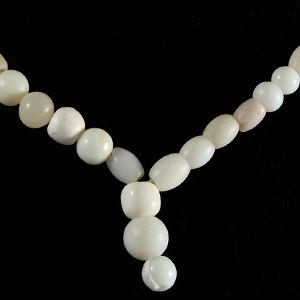
Western Asiatic Mixed Bead Necklace
1st millennium B.C. and laterSold for (Inc. bp): £33
A restrung designer necklace of glass beads, mainly spherical and fusiform types. 28.9 grams, 31.2 cm
Acquired on the London, UK, art market in the 1990s. Ex London, UK, gallery. -
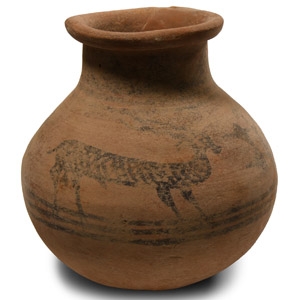
Western Asiatic Painted Terracotta Jar
1st millennium B.C.Sold for (Inc. bp): £59
Of bulbous profile with rounded underside and trumpet-shaped mouth, painted zoomorphic frieze to the shoulder. 740 grams, 15.5 cm
Acquired 1990s-2000s. From the late David Gold (d.2015) collection of pottery.
David Gold and his brother were famous for setting up the first clothes shop in Carnaby Street and dressed the famous in the swinging 1960s, making Carnaby Street famous. -
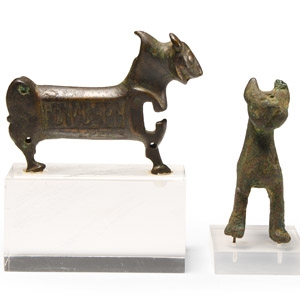
Western Asiatic Bronze Attachment Group
Circa 12th-14th century A.D.Sold for (Inc. bp): £65
Comprising: one side of a feline padlock with Kufic inscription to the flank; foreparts of a feline figurine with ledge to rear; each mounted on a display frame. 152 grams total, 63-79 mm including stand
Ex European collection since 1970. with Hermann Historica, Munich, Germany, Auction 95, no.6031 (Part). Property of a French collector.
