Loading, please wait...
LOT 0980
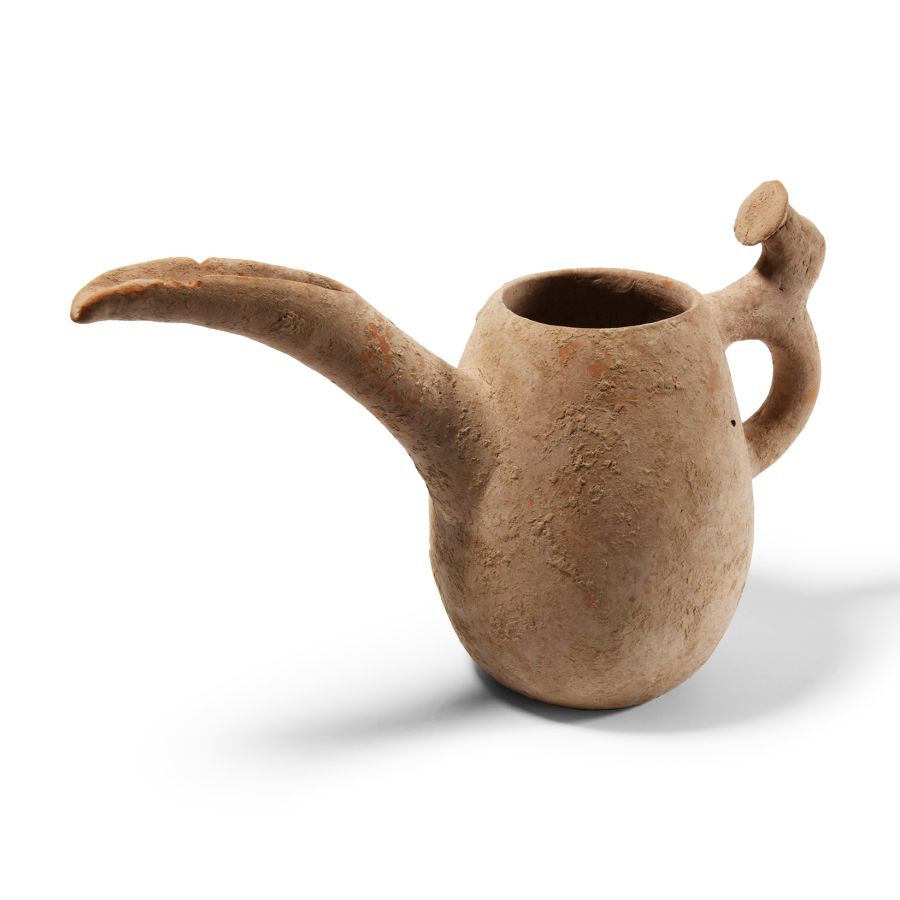
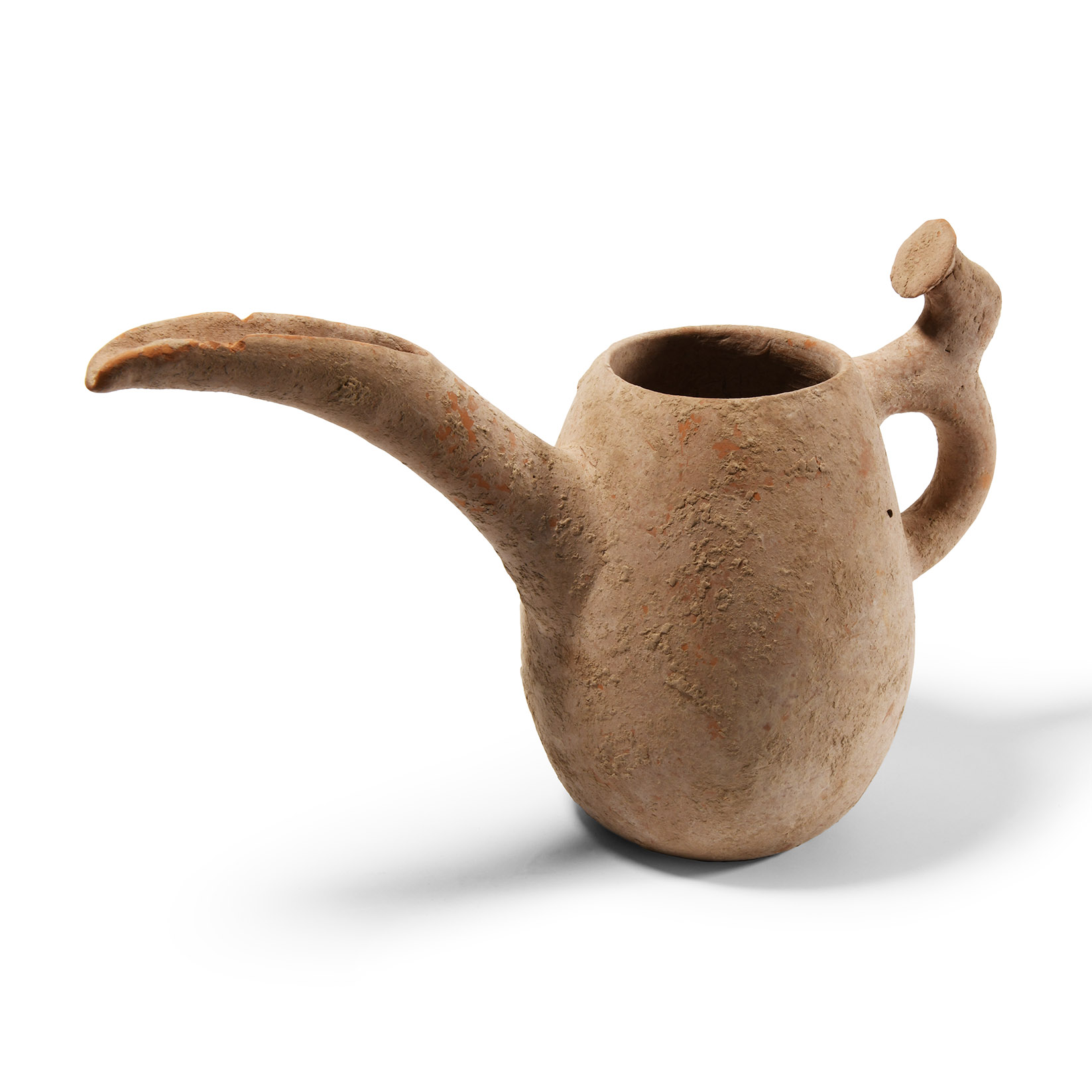
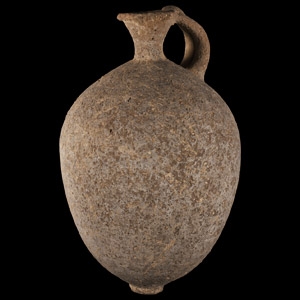
Amlash Spouted Terracotta Vessel
1ST MILLENNIUM B.C.
10 3.4 in. (700 grams, 27 cm wide).
Hollow-formed oblate vessel with curved spout, loop handle and thumb-pad.
ProvenanceEx Rabi Gallery, Mayfair, London, UK.
Ex private collection.
TimeLine Auctions follows a vetting process to ensure the authenticity and legality of all items, reinforcing our commitment to integrity and responsible trading. Each antiquity, antique, and coin lot undergoes thorough examination by a vetting committee of at least ten external specialists, professional trade association members, scientists, and archaeologists: Our Vetting Process
AUCTIONS:
TimeLine is a leading auction house specialising in antiquities, ancient art, collectables, natural history, coins, medals, and books. Our auctions offer museums, collectors, historians, and enthusiasts the opportunity to acquire unique and historically significant pieces.
LOT 0980
Amlash Spouted Terracotta Vessel
Estimate £400 - 600€460 - 700 (for guidance only)$540 - 810 (for guidance only)
-
Babylonian Nebuchadnezzar The Great Brick Section with Cuneiform Inscription
1st millennium B.C.Sold for (Inc. bp): £1,950
Rectangular mud-brick with 14 lines of impressed cuneiform text within a reserved border; supposed reference to 'Nabû-kudurri-uṣur' (Nebuchadnezzar); mounted in a custom-made display frame. 1.2 kg total, 27 x 20 cm
Ex B.A. family collection, Kent, pre 1990s. E.P. collection, Cambridge,1990s-2000’s. Latterly to the J.L. collection, Surrey, UK.
Nebuchadnezzar, known as 'the Great', was the second king of the Neo-Babylonian Empire, who reigned from the death of his father Nabopolassar in 605 B.C. to his own death in 562 B.C. He is often regarded as the empire's greatest ruler due to his military victories and his renovations at Babylon. -
Neo-Assyrian Bronze Two-Piece Belt Buckle with Winged Genii
9th-7th century B.C.Estimate: £2,500 - 3,500 (+bp*)
Opening Bid: £1,250
Comprising two halves decorated in chased low relief, each half with a standing winged figure dressed in long embroidered tunic, holding a stylised snake(?) in the raised hand, the other hand extended along the wing; the left side with three attachment hooks and the right side with a perforated plaque with two lines of holes providing the possibility of extending the belt. 191 grams total, 80 mm each
Nice bronze patina with small scratches on the surface, antique deformations
Acquired prior to 2000. British private collection of Mr D.M., London, UK. Accompanied by an academic report by Dr Raffaele D’Amato. This lot has been checked against the Interpol Database of stolen works of art and is accompanied by search certificate number no.11753-202365.
The genii symbolised both protection and fertility - their role was to safeguard and replenish the ancient kingdom of Assyria and therefore, on a personal buckle, the wearer of the belt. The representation of divine genii upon a belt plaque provided a link with the king and with the royal family, and it could be that such a belt was worn by important dignitaries, although the structure of the belt and its composition exclude the possibility of military use. -
Central Asian Bronze Compartmented Seal Matrix
2300-2000 B.C.Sold for (Inc. bp): £26
Wheel-shaped stamp seal; accompanied by an old scholarly note, typed and signed by W.G. Lambert, late Professor of Assyriology, University of Birmingham, 1970-1993, which states: 'Stamp Seal of Bronze. 38 x 37 x 15 mm. This is round, with flat face and flat back, on which is a handle of inverted U-shape. The design, which is compartmented and open-work, consists of a plain outer band, and within it but not touching it is a central rhomb, joined to the outer band by two rough crescent shapes, bulging at the ends, and close to each other in the middle. This comes from west central Asia and dates to c. 2300-2000 B.C. It is in very good condition save that the outer rim is worn down.' 15 grams, 37 mm
From an important London, UK, collection, 1970s. Accompanied by a scholarly note by Professor Wilfrid George Lambert FBA (1926-2011), historian, archaeologist, and specialist in Assyriology and Near Eastern archaeology.