
Loading, please wait...

LOT 1485
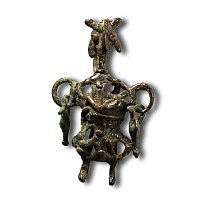
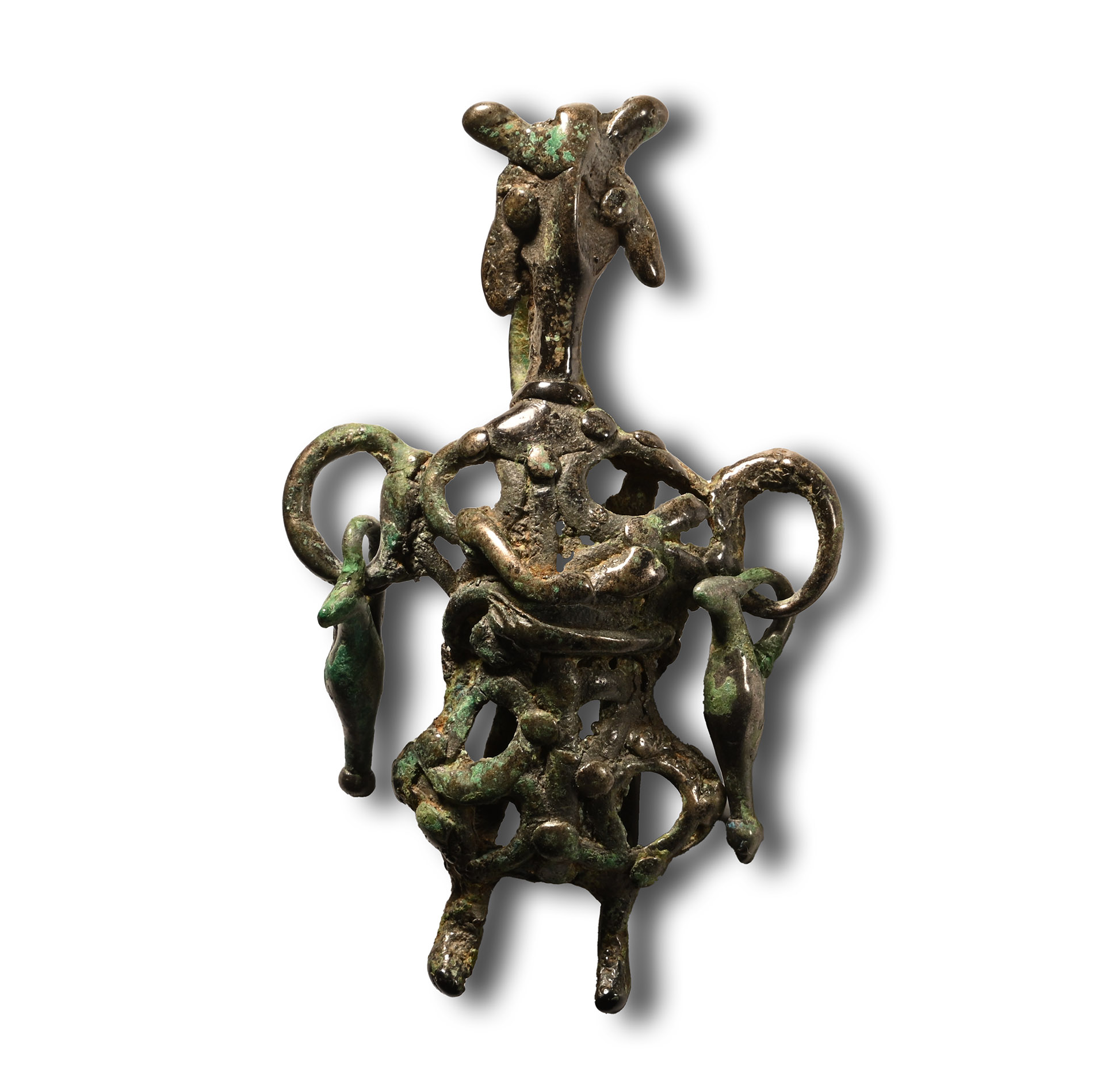
Amlash Bronze Figural Pendant
CIRCA 10TH CENTURY B.C.
3 3/4 in. (74 grams, 97 mm).
Fertility figure with openwork decoration, loop arms suspending pendants formed as slender figurative horned animals; suspension loop to reverse and cage-style torso. [No Reserve]
ProvenanceUK private collection before 2000.
Acquired on the UK art market.
Property of a London gentleman.
See The Virtual Museum of Iran Art, 'bronze openwork statue of a fertility Idol, ca 1000 BC', for a comparable figure.
CONDITIONTimeLine Auctions follows a vetting process to ensure the authenticity and legality of all items, reinforcing our commitment to integrity and responsible trading. Each antiquity, antique, and coin lot undergoes thorough examination by a vetting committee of at least ten external specialists, professional trade association members, scientists, and archaeologists: Our Vetting Process
AUCTIONS:
TimeLine is a leading auction house specialising in antiquities, ancient art, collectables, natural history, coins, medals, and books. Our auctions offer museums, collectors, historians, and enthusiasts the opportunity to acquire unique and historically significant pieces.
-
Roman Military Bronze Cavalry Spur
1st-2nd century A.D.Sold for (Inc. bp): £78
Crescentic in plan with carinated profile, discoid lug to each end, sturdy square-section ferrous stud to the centre. 45 grams, 64 mm
Private collection, UK, formed 1980s-1990s. -
Greek Bronze Arrowhead with Maker's Mark
4th-2nd century B.C.Sold for (Inc. bp): £78
Substantial barbed and tanged arrowhead, lozengiform in section with triangular lug to each face; punched 'crown' maker's mark to one face. 10.2 grams, 57 mm
Ex German art market, 2000s. Acquired from an EU collector living in London. From the collection of Surrey, UK, gentleman. -
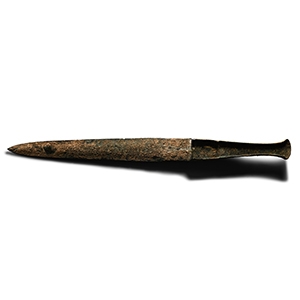
Luristan Bronze Dirk
13th-12th century B.C.Estimate: £300 - 400 (‡+bp*)
Opening Bid: £167
With lentoid-section blade, tongue-shaped in plan, integral tapering hilt with flared finial, lateral flanges to accept a panel of bone or wood to each face forming the grip. 174 grams, 34 cm
Ex Joseph J. Gancie (1923-2010), Washington, Silver Spring, Maryland. with Alex Cooper Auctioneers Inc., sale 1035, 27 January 2013, lot 162a.
The dirk belongs to the type III in the Medvedskaya classification, used in Near East from the 13th to the 6th century B.C. The type is the 32a of the Maxwell-Hyslop study. The Asiatic daggers of this type are confined to Syria and Persia, but Transcaucasia also provides an interesting analogy from Kalekent on the Baku peninsula, where a pointed straight-sided dagger blade has a flanged hilt with the whole of the side flanges bent over the centre.
