
Loading, please wait...
LOT 1273
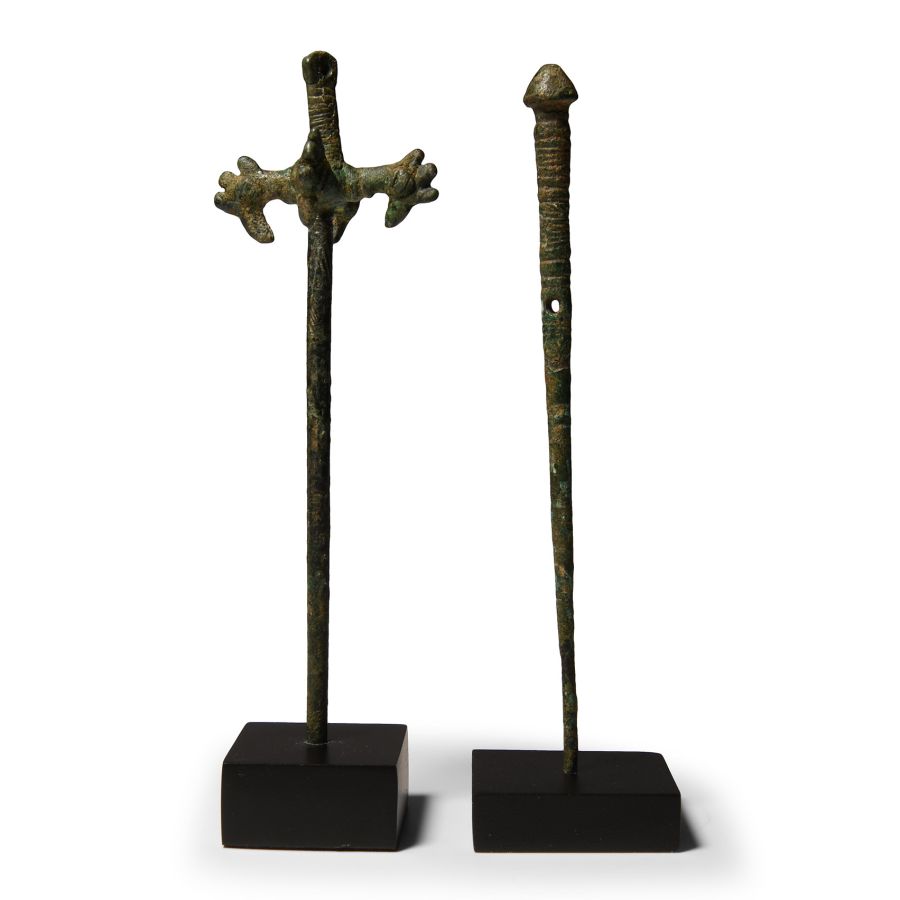
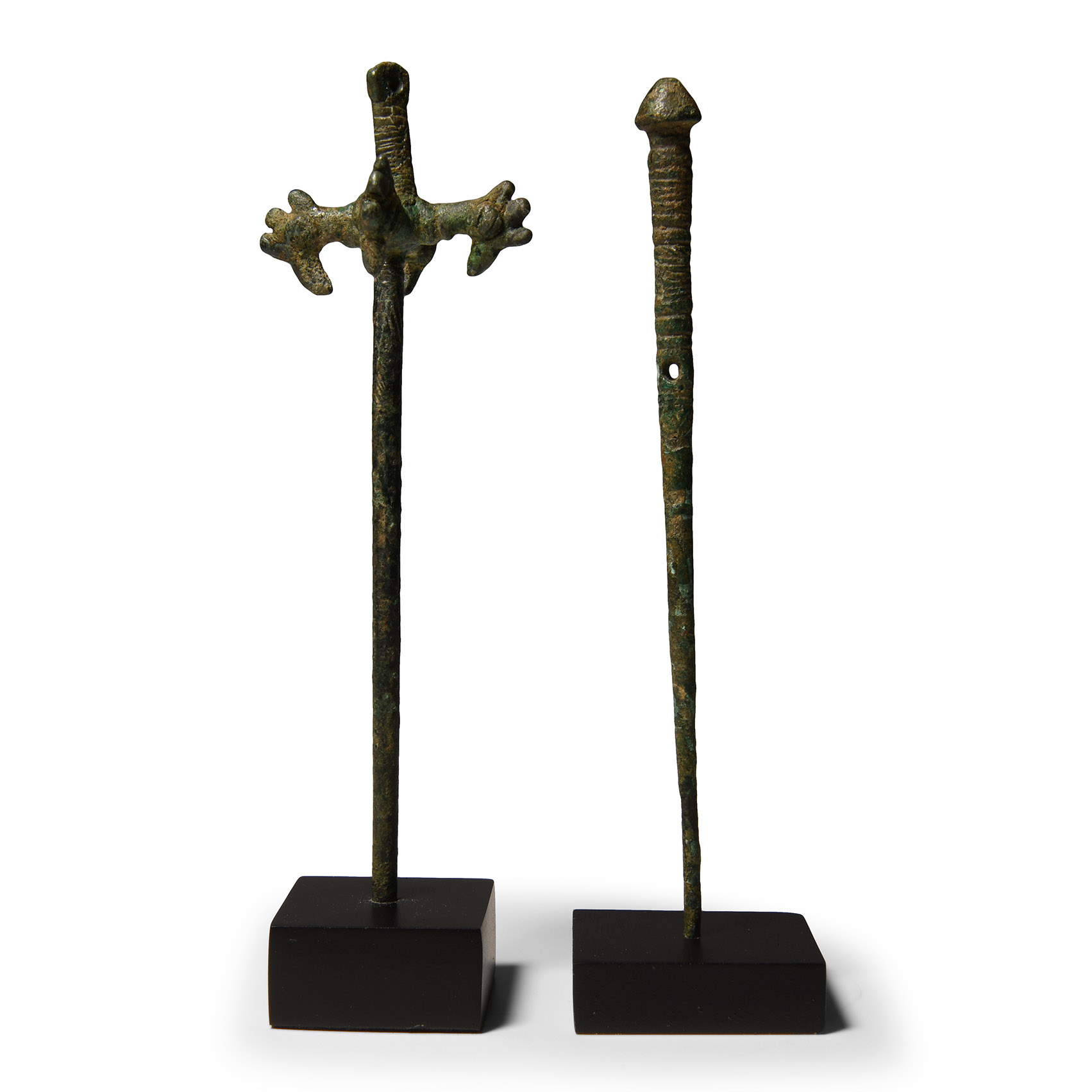
Amlash Bronze Cloak Pin Collection
1ST MILLENNIUM B.C.
6 - 6 1/8 in. (113 grams total, 15.2-15.5 cm including stand).
Comprising: Amlash bronze cloak pin, the top of the shank decorated with encircling bands of various widths and surmounted by a conical head, a piercing in the shaft allowed for the attachment of a crescentic slip-ring, the surface with areas of corrosion, the very tip broken away; similar with pierced lug finial and four radiating birds' heads; each with old collector's label '10633' and '10689'; each mounted on a custom-made display stand. [2, No Reserve]
ProvenanceAcquired on the UK art market 1970s-1980s.
Private collection, London, UK.
Cf. Moorey, P.R.S., Catalogue of the Ancient Persian Bronzes in the Ashmolean Museum, Oxford, 1971, pl.43, no.248, for type.
CONDITIONTimeLine Auctions follows a vetting process to ensure the authenticity and legality of all items, reinforcing our commitment to integrity and responsible trading. Each antiquity, antique, and coin lot undergoes thorough examination by a vetting committee of at least ten external specialists, professional trade association members, scientists, and archaeologists: Our Vetting Process
AUCTIONS:
TimeLine is a leading auction house specialising in antiquities, ancient art, collectables, natural history, coins, medals, and books. Our auctions offer museums, collectors, historians, and enthusiasts the opportunity to acquire unique and historically significant pieces.
-
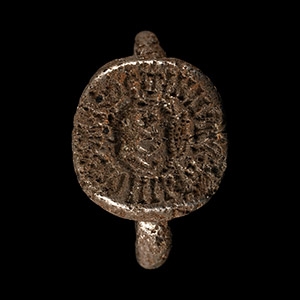
Silver Seal Ring with Cyrillic Inscription
Circa 15th-16th century A.D.Estimate: £300 - 400 (+bp*)
Opening Bid: £150
With drum-shaped bezel, animal motif and enigmatic surrounding text. 5.43 grams, 22.92 mm overall, 18.77 mm internal diameter (approximate size British P 1/2, USA 7 3/4, Europe 16.86, Japan 16)
UK private collection before 2000. On the UK art market. Property of a London gentleman. -
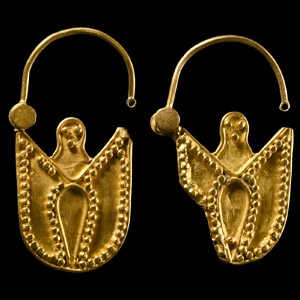
Western Asiatic Gold Floral Earrings
Circa 1st millennium B.C. or laterEstimate: £500 - 700 (+bp*)
Opening Bid: £250
Each formed as an open flower with the carpel emerging between the petals, applied pellets forming the petals and three pellets to the carpel; hinged loops. 7.04 grams total, 34-35 mm
From a late Japanese specialist collector, 1970-2000s. -
.jpg)
Western Asiatic Alabaster Bowl
Circa 1st millennium B.C. or laterSold for (Inc. bp): £98
Squat in profile with rounded underside, gently curved rim. 1.03 kg, 16 cm wide
From a collection acquired on the UK art market from various auction houses and collections mostly before 2000. From an important Cambridgeshire estate; thence by descent.
