
Loading, please wait...
LOT 0238
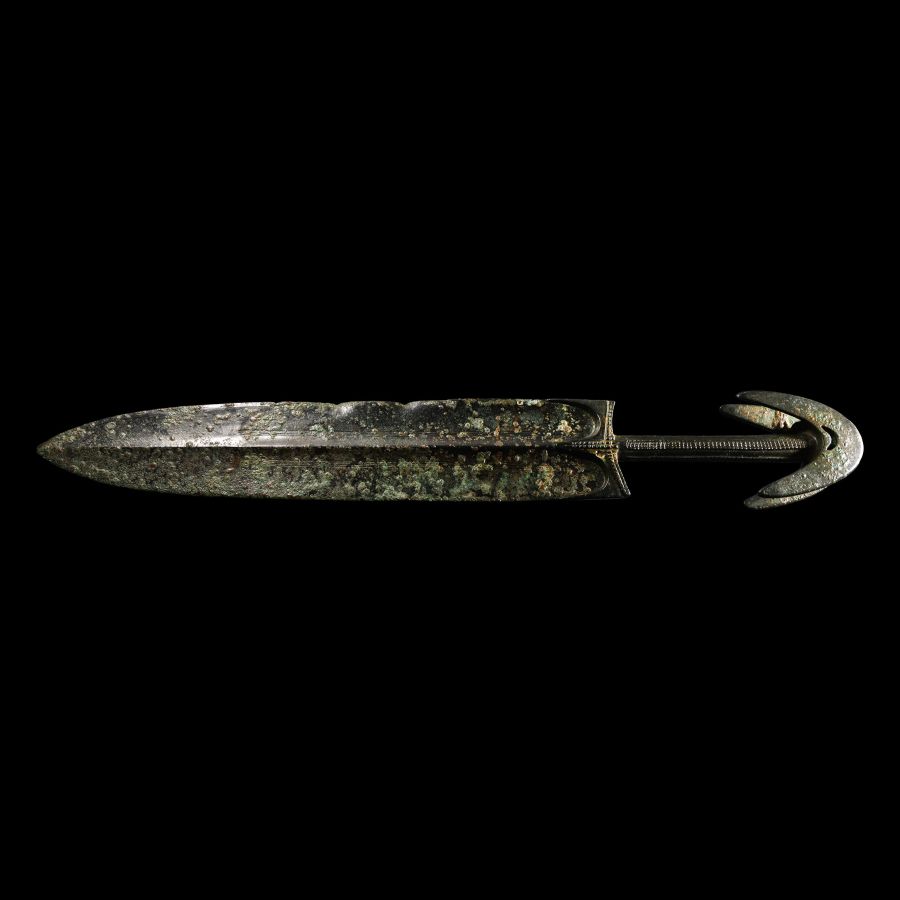
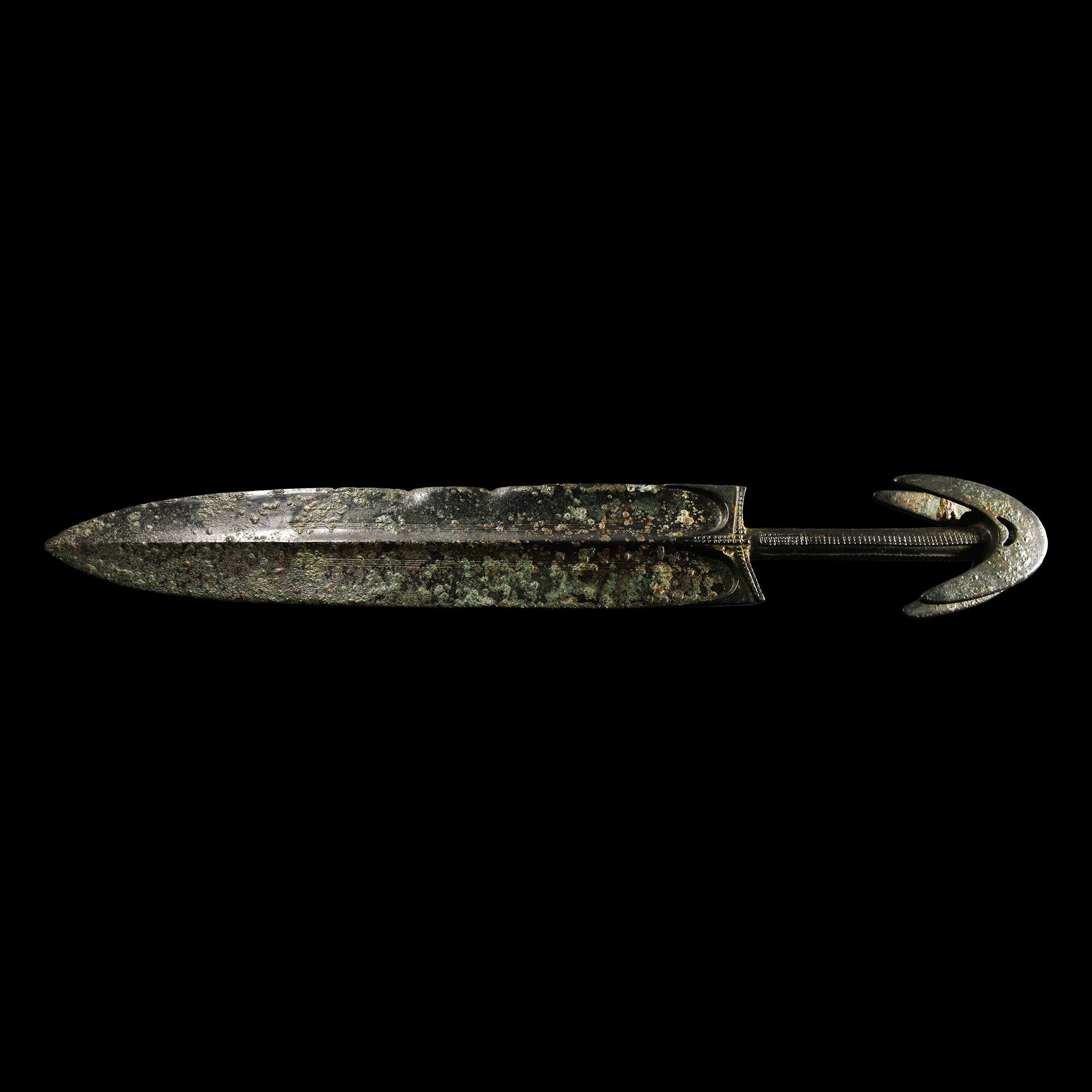
Amarlu Type Bronze Short Sword
LATE 2ND MILLENNIUM B.C.
20 7/8 in. (911 grams, 53 cm).
Composed of a massive triangular blade with a slightly raised mid-rib flanked by three parallel rows on each side, the guard formed with a pronounced trident shape, ornamented with small geometric square recesses, the hilt with square-section grip incised with four vertical rows of similar square recesses, double broad crescentic open pommel surmounted by a broad raised median rib which links the double crescentic halves; repaired.
ProvenanceAcquired 1970s-1980s.
From the collection of a Surrey, UK, gentleman.
Moorey, analysing similar swords found in Amarlu, stated that the blade and tang were made first, forged to shape by hammering at a high temperature. The next step was to cover the tang with a clayed material. Once dry, this material formed the core for the casting. Then a hollow mould of the exact shape of the shoulder, grooved hilt and pommel was made around the clay core covering the tang. Finally, liquid metal was poured into the mould. The weapon was then finished by hammering the pommel and shoulder to the hilt.
CONDITIONTimeLine Auctions follows a vetting process to ensure the authenticity and legality of all items, reinforcing our commitment to integrity and responsible trading. Each antiquity, antique, and coin lot undergoes thorough examination by a vetting committee of at least ten external specialists, professional trade association members, scientists, and archaeologists: Our Vetting Process
AUCTIONS:
TimeLine is a leading auction house specialising in antiquities, ancient art, collectables, natural history, coins, medals, and books. Our auctions offer museums, collectors, historians, and enthusiasts the opportunity to acquire unique and historically significant pieces.
-
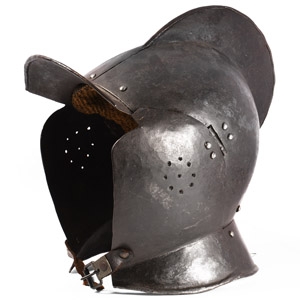
South German Burgonet Helm
Circa 1580-1610 A.D.Sold for (Inc. bp): £2,340
The rounded two-piece skull joined along the crest with a high medial comb, internally fitted with a quilted canvas lining sewn to a leather lining-band, the brow with a fixed rounded peak, outward-flanged rear edge with a matching one-piece neck guard, hinged cheek-pieces flanged outwards at the lower edge to serve as a continuation of the neck-guard. 1.7 kg, 29 cm
with Thomas Del Mar Ltd, 7th December 2017, lot 542. The Kusmirek Collection, UK. Accompanied by a copy of the Thomas Del Mar invoice. Accompanied by an academic report by Dr Raffaele D'Amato. This lot has been checked against the Interpol Database of stolen works of art and is accompanied by search certificate number no.11762-203983.
The burgonet (Italian borgognotta) had developed at the beginning of the 16th century from the sallet and soon became a very popular helmet worn in many parts of Europe (especially in Germany and Northern Italy) by infantry and later cavalry units. A clear advantage of this helmet was the unifying a good protective function against cut and thrust weapons with a unhindered field of sight, good ventilation and user comfort due to the small weight and the fact it could be worn independently without an armour. -
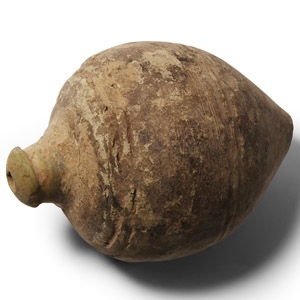
Byzantine 'Greek Fire' Ceramic Fire Bomb or Hand Grenade
9th-11th century A.D.Sold for (Inc. bp): £104
Pear-shaped ceramic vessel with domed filler-hole, circumferential impressed bands to the shoulder and equator; intended to be filled with explosive liquid and wick, used as a hand grenade. 490 grams, 15 cm
Ex London, UK, collection, 1990s. Accompanied by an academic paper by military specialist Dr Raffaele D'Amato, dated 15 July 2019 and titled 'Eastern Roman Empire - Greek Fire Bomb or Hand Grenade (μεσαίον kακάβιον) 9th-11th century AD'.
Apart from the use of siphons or manual flame-throwers called cheirosiphona, special corps of Roman soldiers employed terracotta grenades, in the form of small jars, abundantly evidenced in archaeological excavations. Such were the γανωτα, vessels (sometimes also of bronze) used for Greek fire. They were called μεσαία kακαβιά or κυτροκακάβια where the former had a bulbous shape and the latter a more cylindrical form. -
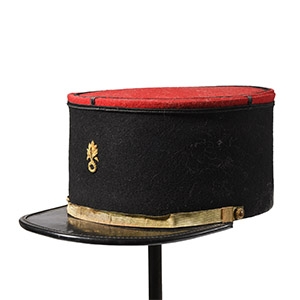
French Foreign Legion Kepi
Circa 1930-1940s A.D.Sold for (Inc. bp): £104
Black and red cloth with gold-coloured banding and 'button'; red lining and typed label reading 'Sergent BUYUKISPIR Haluk 1o R.E. Quartier Viénot C.S.L.E./S.I.H.L.E....'. 197 grams, 24.5 cm wide
Acquired from Czerny's Auctions, Italy, lot 104, 2016. The Kusmirek Collection, UK. Accompanied by copy of Czerny's invoice and information.
