
Loading, please wait...
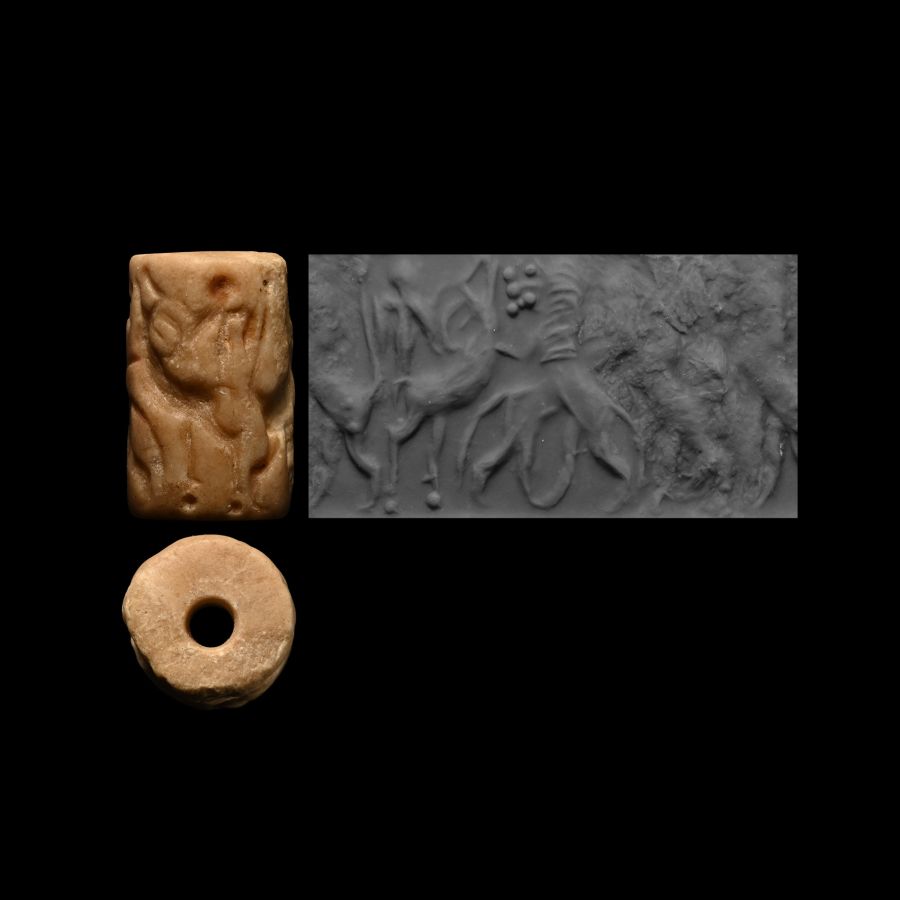

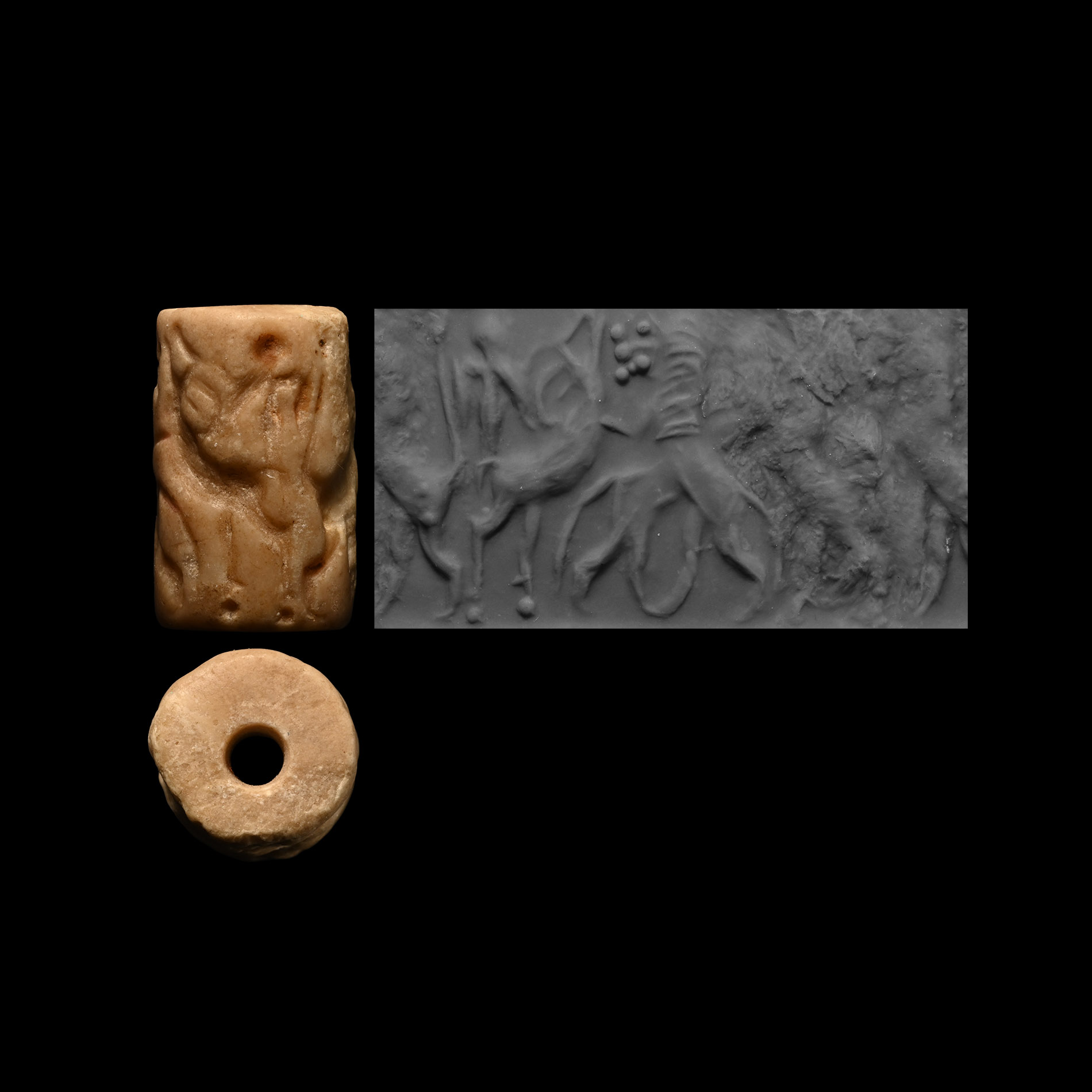
LOT 1267
Akkadian Marble Cylinder Seal with Contest Scene
2ND MILLENNIUM B.C.
1 1/8 in. (16.7 grams, 28 mm).
With incuse frieze depicting a male figure holding a sceptre between two rampant stags; behind, a second pair of rampant beasts (probably lions) fighting; supplied with a museum-quality impression. [No Reserve]
ProvenanceUK private collection before 2000.
Acquired on the UK art market.
Property of a London gentleman.
TimeLine Auctions follows a vetting process to ensure the authenticity and legality of all items, reinforcing our commitment to integrity and responsible trading. Each antiquity, antique, and coin lot undergoes thorough examination by a vetting committee of at least ten external specialists, professional trade association members, scientists, and archaeologists: Our Vetting Process
AUCTIONS:
TimeLine is a leading auction house specialising in antiquities, ancient art, collectables, natural history, coins, medals, and books. Our auctions offer museums, collectors, historians, and enthusiasts the opportunity to acquire unique and historically significant pieces.
-
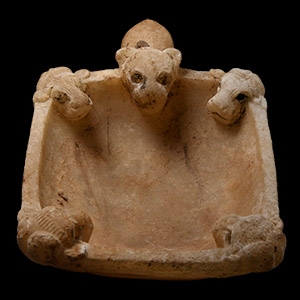
Mesopotamian Alabaster Offering Dish with Lion Handle
2nd-early 1st millennium B.C.Estimate: £18,000 - 24,000 (+bp*)
Opening Bid: £10,000
An Aramean rectangular dish with sloping sides, an inward-facing goat-head at each corner; handle formed as a recumbent lion biting the rim; each beast with recessed eyes to accept inserts; ropework band to the underside. 698 grams, 22 cm
Windermere Collection, Germany, 1960s. American collection, Phillips, 1960s-1980s. with Fortuna Fine Arts, 2012. From the S.M. collection, 2012-2016. From an important London collection, 2016. Private collection. Accompanied by a copy of an Art Loss Register certificate no.S00118561. Accompanied by an academic report by Dr Raffaele D’Amato. This lot has been checked against the Interpol Database of stolen works of art and is accompanied by search certificate number no.12164-218579.
The Aramean civilisation produced superb specimens of vessels, in which the lion, symbol of royal power, was one of the most relevant decorative motifs. Vessels of this typology are already known from the Anatolian culture of Kültepe, the first Hittite capital, since the Middle Bronze Age. Also the culture of Ugarit (Ras Shamarra) produced cups with similar lion heads, in a period of 1500 and 1300 B.C. -
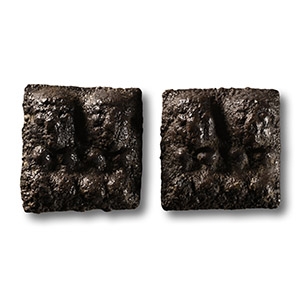
Western Asiatic Silver Inlay Pair with Human Heads and Animals
1st millennium B.C.Estimate: £100 - 140 (+bp*)
Opening Bid: £50
Comprising two matched inlays, each with a pair of facing heads, zoomorphic motifs below. 2.6 grams total, 16 mm each
Collected from 1970-1999. From the collection of the late Mr S.M., London, UK. -
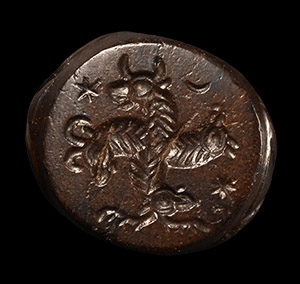
Sassanian Stone Seal with Four Animal Heads
4th-5th century A.D.Sold for (Inc. bp): £130
Plano-convex seal with conjoined animal heads; accompanied by a copy of an old scholarly note dated April 1999, typed and signed by W.G. Lambert, late Professor of Assyriology, University of Birmingham, 1970-1993, which states: 'Stamp Seal of Goethite 16x19x15.4 mm. This is a decorated ellipsoid with nearly round flat face, the back with large suspension hole and decorated with three pairs of two raised circles. The design consists of the protomes of four creatures joining the middle: bull, ram (or ibex), stag and eagle. Around them are three fillers: two stars and a crescent. This is a Sassanian seal. c.200-500 A.D. It is in very good condition and has a very rare design. No doubt there is some symbolism in these four creatures, but the present writer does not know what it is.' 8.46 grams, 19 mm
UK private collection, 1980-1983. Accompanied by a copy of a scholarly note dated April 1999, typed and signed by W.G. Lambert, late Professor of Assyriology, University of Birmingham, 1970-1993.
