Loading, please wait...
Details
LOT 1207
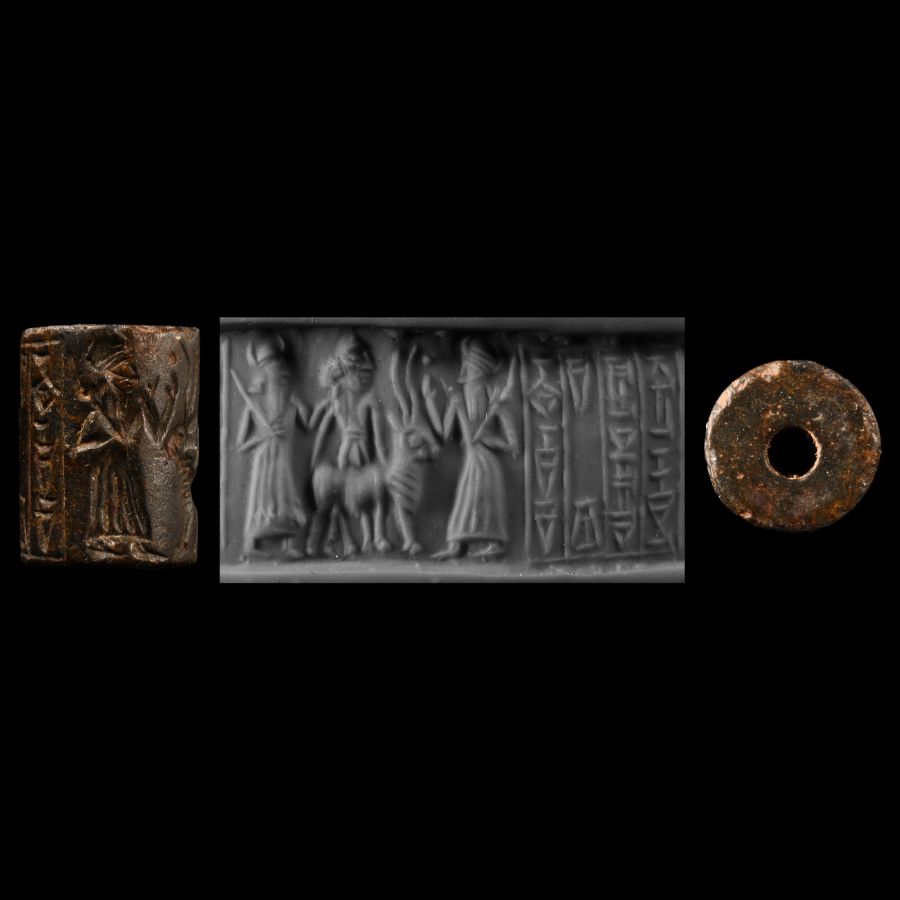
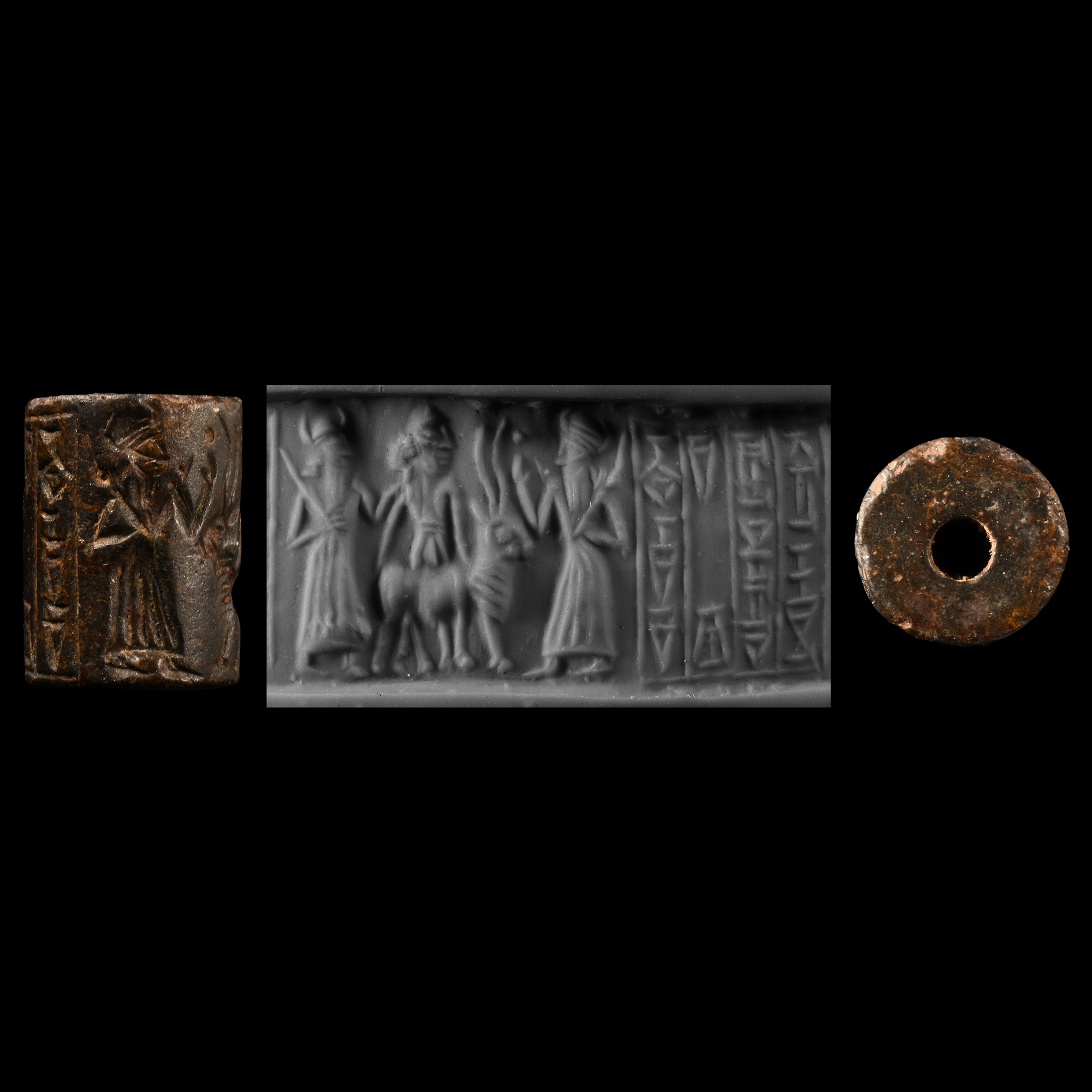
Akkadian Cylinder Seal with Worship Scene
2ND MILLENNIUM B.C.
1/2 in. (4.24 grams, 14 mm).
Black stone with a figure wearing a long robe and horned cap, holding a sceptre, other hand raised in greeting to a central male figure seated on a bull; behind a bearded male figure wearing long robes and horned cap and carrying a sceptre; behind a panel with four rows of cuneiform text. [No Reserve]
Provenance
From an important North London collection formed in the late 1980s.
From a collection acquired from various auction houses in the UK.
From the estate of Mr R.W., a private Wiltshire, UK, collector; thence by descent.
VETTING:
TimeLine Auctions follows a vetting process to ensure the authenticity and legality of all items, reinforcing our commitment to integrity and responsible trading. Each antiquity, antique, and coin lot undergoes thorough examination by a vetting committee of at least ten external specialists, professional trade association members, scientists, and archaeologists: Our Vetting Process
AUCTIONS:
TimeLine is a leading auction house specialising in antiquities, ancient art, collectables, natural history, coins, medals, and books. Our auctions offer museums, collectors, historians, and enthusiasts the opportunity to acquire unique and historically significant pieces.
RELATED LOTS
-
Amlash Terracotta Flagon
2nd-1st millennium B.C.Sold for (Inc. bp): £156
Globular in form with flared cylindrical neck and integral handle with triangular projection; applied pellets either side, likely a zoomorphic representation, with incised vertical bands to the neck. 735 grams, 24.5 cm high
Ex Rabi Gallery, Mayfair, London, UK. Ex private collection. -
Early Dynastic Cylinder Seal with Worshipping Parade
Circa 2550-2350 B.C.Sold for (Inc. bp): £650
Haematite cylinder seal featuring two horizontal registers with worshipping parades comprising long-robed male priests wearing ankle-length garments, seated on the stool-shaped throne, elegantly raising their left hands to hold a cup; other male priests in long garments either holding a vessel containing holy water or oil, or standing in a solemn gesture with hands raised or clasped in front of their chests. 5.26 grams, 32 mm
Acquired in the 1990s. Ex West London family collection. Property of a Bristol, UK, gentleman.
Iconographies and religious scenes seen on Early Dynastic seals are renowned for the further elaborations that depict contesting scenes, usually portraying nude heroes confronting bull-men or rampant, roaring lions. However, animals and heroes were not employed as the favourite motifs during the last part of the Early Dynastic period. Increased popularity of funerary art and banquets were richly practised in Ur, given an ample amount of royal cylinder seals that bear banquet or seated-king related scenes. On Early Dynastic cylinder seals, the image of a seated male figure holding a cup cannot always be interpreted with an extender divinity. It might have suggested a ruler's identity within a royal banquet scene. However, on this seal, the holy vessel and the representations of male worshippers indicate a clear religious significance. Within the traditional Mesopotamian religion, secular kings would have obtained divine power if they had engaged with the goddess Inanna during a sacred marriage. The cup, containing holy ointment or oil, held in the king's hand, might have been as an emblem to signify the elevated rank of a deified king. It might also have been used as an alternative religious practice, connecting the secular authority and the divine power during the Early Dynastic period. -
Proto-Sumerian Pictographic Tablet for Distribution of Sheep by the Wife of E.Kisal
Uruk III, circa 3200-3000 B.C.Sold for (Inc. bp): £10,400
Terracotta pillow-shaped tablet with grid to each broad face, each cell with an impressed image and a corresponding number of impressions from the tip of a rod, a list for the distribution of animals to the contrary reading: Obverse: Column 1 1. 2(N01) , U8 2 ewes 2. 3(N01) , UDUNITA~a 3 male sheep 3. 1(N01) , UD5~a 1 …-sheep 4. 4(N01) , MASZ2 |U4x1(N57)|# 4 goats day 1 5. , GAL~a SAL E~a (name?) Column 2 1. 1(N01) , U8 1 ewe 2. 4(N01) , UDUNITA~a 4 male sheep 3.a. 5(N01) , MASZ2 5 goats 3.b1. 1(N01) , |U4x3(N57)|# GAL 1 large 3.b2. 4(N01) , |U4x1(N57)|# TUR 1 small 4. , |SZE~a.NAM2| … Reverse: Column 1 1. 1(N14) , SAL E~a [...] 1 … 2. 1(N14)# [...] 1 … Column 2 1. 3(N01) , U8 (total) 3 ewes 2. 7(N01) , UDUNITA~a (total) 7 male sheep 3. 9(N01) , MASZ2 (total) 9 goats 4. 1(N01) , UD5~a (total) 1 …-sheep Column 3 1. , |SIxKU~b1| 2(N14) , BA MASZ GAN2 SAL E~a KISAL~b1 (interpretation: distributed in the SI.KU settlement, the wife of E.KISAL being responsible). 72.3 grams, 80 mm
From specialised collection of cuneiform texts, formed in the 1950s-1990s. The property of a London gentleman and housed in London, thence by descent to family members. Examined by Professor Wilfrid George Lambert FBA (1926-2011), historian, archaeologist, and specialist in Assyriology and Near Eastern archaeology, in the late 1980s and 1990s. The collection is exceptional for the variety of types, including some very rare and well preserved examples. This lot has been checked against the Interpol Database of stolen works of art and is accompanied by a search certificate number no.12117-215351.