
Loading, please wait...
_900x900.jpg "Akkadian Cylinder Seal with Worship Scene")
_200x200.jpg "Akkadian Cylinder Seal with Worship Scene")
.jpg "Akkadian Cylinder Seal with Worship Scene")
LOT 1184
Akkadian Cylinder Seal with Worship Scene
LATE 3RD MILLENNIUM B.C.
5/8 in. (4.32 grams, 15 mm).
Haematite with a group of four standing figures consisting of a bearded male wearing a kilt and horned cap, crescent moon to the top; in front a male wearing long robes, hands raised in worship, behind a female in long robes and with arms crossed over chest; behind a male figure in long robes and wearing a horned cap, hand resting on shoulder of female; rectangular panel with three rows of cuneiform text. [No Reserve]
ProvenanceFrom an important North London collection formed in the late 1980s.
From a collection acquired from various auction houses in the UK.
From the estate of Mr R.W., a private Wiltshire, UK, collector; thence by descent.
TimeLine Auctions follows a vetting process to ensure the authenticity and legality of all items, reinforcing our commitment to integrity and responsible trading. Each antiquity, antique, and coin lot undergoes thorough examination by a vetting committee of at least ten external specialists, professional trade association members, scientists, and archaeologists: Our Vetting Process
AUCTIONS:
TimeLine is a leading auction house specialising in antiquities, ancient art, collectables, natural history, coins, medals, and books. Our auctions offer museums, collectors, historians, and enthusiasts the opportunity to acquire unique and historically significant pieces.
-
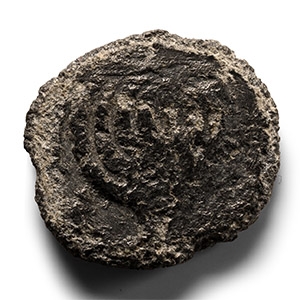
Jewish Lead Sealing with Menorah and Eagle
Circa 4th century A.D. or earlierSold for (Inc. bp): £293
Impressed menorah to one face, the other side with faint remains of an eagle. 1.08 grams, 12 mm
From the property of late Mr SM, London, UK, 1969-1999. -
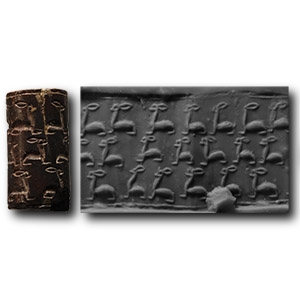
Western Asiatic Stone Cylinder Seal with Quadrupeds
Late 2nd-early 1st millennium B.C.Sold for (Inc. bp): £975
With frieze of advancing quadrupeds in three tiers; supplied with a museum-quality impression. 4.07 grams, 18 mm
From the 'S' collection, acquired 1970-1990s. The collection was seen and studied by W.G. Lambert, late Professor of Assyriology at the University of Birmingham, 1970-1993. -
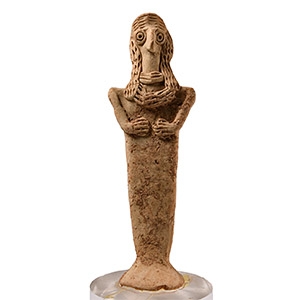
Syro-Hittite Terracotta Fertility Figure
Circa 2nd-1st millennium B.C.Sold for (Inc. bp): £572
Flat-section figurine with flared base; applied annular eyes, pinched nose, applied textured hair, collar and necklace; arms held bent across the chest; mounted on a custom-made stand. 361 grams total, 22 cm high including stand
Mounted on a perspex column in the 1970s. From the property of late Mr SM, London, UK, 1969-1999.
