
Loading, please wait...
_900x900.jpg "African Wooden Ceremonial Face Mask")
_200x200.jpg "African Wooden Ceremonial Face Mask")
.jpg "African Wooden Ceremonial Face Mask")
LOT 2330
African Wooden Ceremonial Face Mask
LEGA WAREGA TRIBE, EARLY 20TH CENTURY A.D.
8 7/8 in. (158 grams, 22.5 cm).
Lentoid in plan with vertical lug for the bose and slits for the eyes; applied hair strip to lower face. [No Reserve]
ProvenanceFrom Democratic Republic of the Congo, Central Africa.
From the Estate of Dr J Bynon; acquired 30 July 1911.
From the property of a late Lincolnshire, UK, gentleman.
Most of Lega masks are sculptures of a human face that are rarely worn over the face and never for purposes of true transformation. The Lega masks can be assigned different uses and meanings depending on the context of the performance. In Bwami ceremonies, masks are attached to different parts of the body, fixed to hat, piled in stacks, hung on fences, held in the hand, dragged on the ground, and occasionally worn on the forehead with the beard draping over the face of the wearer or arranged on a miniature palisade. Participants in most rites display their masks as a group in conjunction with particular dance movements and aphorisms, which vary depending on the context in which they are used. Lega masks differ from those used in many other African masquerades in that while women do not own them, both men and women handle and present them in very similar performances. Masks are among the initiation objects displayed on the grave before being passed to new owners. They are usually passed from an uncle to a nephew.
CONDITIONTimeLine Auctions follows a vetting process to ensure the authenticity and legality of all items, reinforcing our commitment to integrity and responsible trading. Each antiquity, antique, and coin lot undergoes thorough examination by a vetting committee of at least ten external specialists, professional trade association members, scientists, and archaeologists: Our Vetting Process
AUCTIONS:
TimeLine is a leading auction house specialising in antiquities, ancient art, collectables, natural history, coins, medals, and books. Our auctions offer museums, collectors, historians, and enthusiasts the opportunity to acquire unique and historically significant pieces.
-
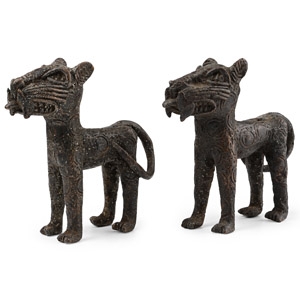
African Bronze Leopard Figure Pair
Edo Tribe, 20th century A.D.Sold for (Inc. bp): £46
Two lost wax bronze cast decorated standing leopards. 943 grams total, 13.4-13.5 cm wide
From Benin. From the late Brian Morley collection, 1950s. From the property of a late Lincolnshire, UK, gentleman.
The leopard is a motif that occurs throughout many of the Benin Bronzes as it is the animal who symbolises both the Oba (king) and justice. -
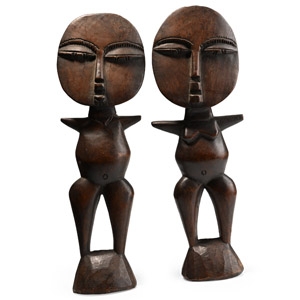
African Wooden 'Akuaba Doll' Wedding Fertility Figure Pair
Ashanti Tribe, early-mid 20th century A.D.Sold for (Inc. bp): £26
Each with exaggerated discoid head, squat body with stub arms, standing on a conical base. 985 grams total, 36-36.5 cm
From Ghana, West Africa. Ex private Cheshire, UK, collection. From the property of a late Lincolnshire, UK, gentleman.
Among the Ashanti people in Ghana, women hoping for offspring carry these ‘Akuaba dolls’ in their clothes. Traditionally, these ‘Akuaba’ have a large, round, flat head that is reminiscent of its origin as a representation of the moon goddess, which is associated with fertility. Once the ‘Akuaba’ figure has fulfilled its purpose, the mother of the desired child places it on her domestic altar, where it is worshipped in a shrine, or she passes it on to the next generation. -
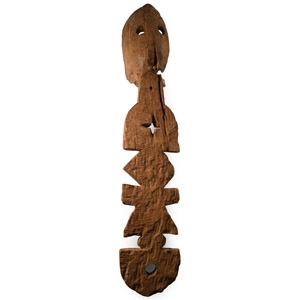
African Wooden Ceremonial Face Mask
Mossi Tribe, early-mid 20th century A.D.Sold for (Inc. bp): £33
Comprising an ellipsoid hollow face with parallel tusks; board of pierced geometric elements. 779 grams, 81 cm
From Burkina Faso, West Africa. Private Hampshire, UK, collection of tribal art; acquired in the 1960s. From the property of a late Lincolnshire, UK, gentleman.
Masks were regarded as the seat of the spirit, but they might also represent the totemic animal of the clan.
