
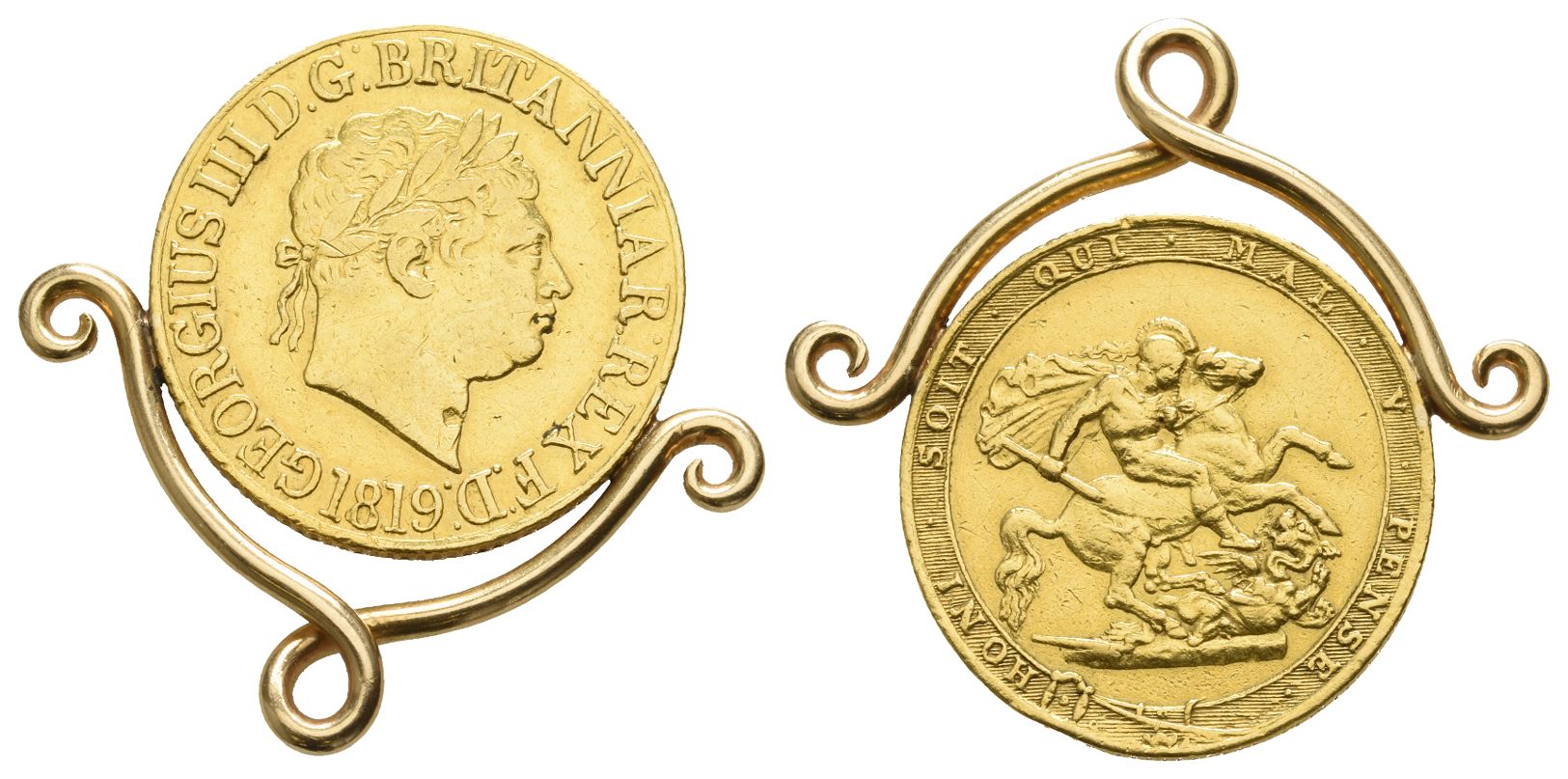
The 1819 sovereign is the rarest date in the London series, and lot 4422 presents one that was turned into jewellery. It weighs 9.45 grams with its mount, against a little under eight grams for the coin alone, and the difference is a single gold wire, scrolled at both ends, that holds the rim at two points and twists into a loop above St George's helmet. The sovereign's two sides were struck head to foot, so the coin hung from that loop shows the saint the right way up and keeps George III, upside down, at the back.
The Royal Mint struck 3,574 sovereigns in 1819 in the year Parliament voted to put Britain back on gold while the public, offered gold, kept to its banknotes. A census of the survivors published in 2020 found ten that had passed as money, and at least four of them had been holed or mounted as jewellery.
A gold coin for a country that used paper
The Bank of England stopped paying gold for its notes in February 1797, and for the rest of the war with France the country did its business in paper. When peace came, the Coinage Act made gold the only standard of value and ordered a twenty-shilling coin to replace the guinea, struck to the same 22-carat standard and named after the "new money of gold" that Henry VII ordered in 1489. The Prince Regent, acting for his ailing father, announced the "sovereigns or twenty shilling pieces" in a proclamation of 1 July 1817, with the king's head on one side and on the other St George on horseback "encountering the dragon with a spear", within the Garter and its motto, Honi soit qui mal y pense.
Pistrucci's St George and the servant at Brunet's Hotel
The proclamation's St George is "armed", but the one on the coins is a naked rider in a crested helmet, cut by Benedetto Pistrucci, a gem engraver from Rome who came to England just after Waterloo and put up at Brunet's Hotel in Leicester Square.
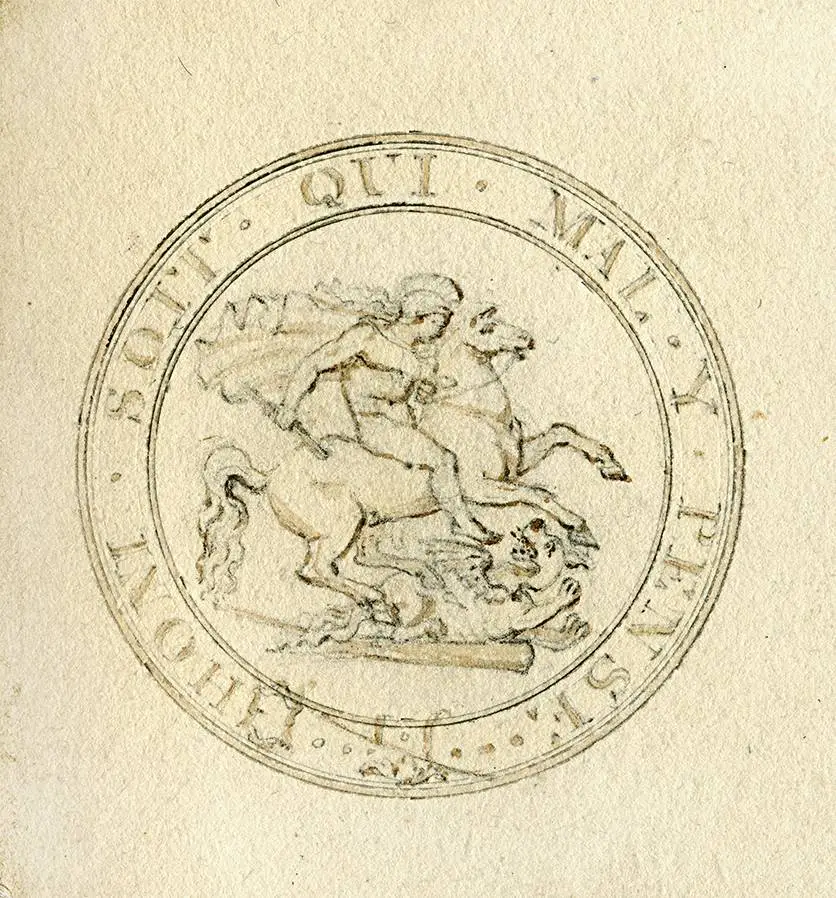 Pistrucci's sketch for the reverse of the sovereign, 1816 or 1817, with the broken lance and the Garter that the coin kept until 1820. Public domain, via Wikimedia Commons.
In the autobiography that the physician Archibald Billing published in 1867, the naturalist Sir Joseph Banks hands Pistrucci a three-shilling piece to copy, since he could not personally see the king, and Pistrucci cut the head of George III in red jasper. In 1816 Banks used the gem to introduce him to the Master of the Mint, William Wellesley Pole, the Duke of Wellington's elder brother, and the head made its way onto the new half-crown and later in February 1817 onto the sovereign.
According to Billing it was Pistrucci who suggested St George and the dragon for the new gold. When Edward Hawkins of the British Museum claimed in 1841 that the coin copied an earlier gem made for Lady Spencer, Billing answered that the saint had been modelled in wax from life, and that the model "was an Italian domestic in Brunet's Hotel", the man whose side faces out on lot 4422.
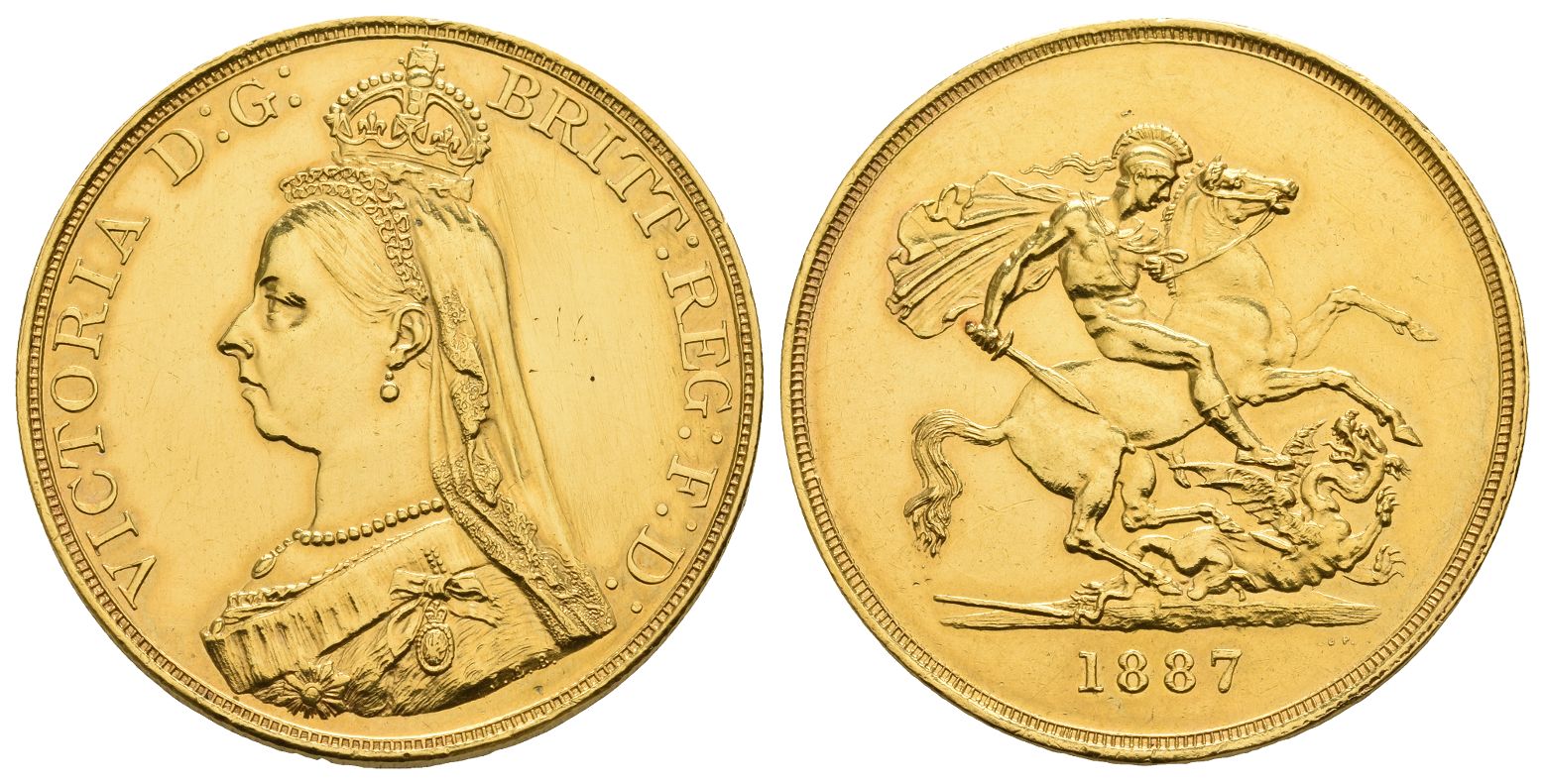
On the coin St George rides to the right, the dragon under his horse's hooves and a broken lance in his hand, with Pistrucci's initials, BP, in the ground line and Pole's, WWP, on the Garter buckle. From 1821 the sovereign took the sword-wielding saint Pistrucci had made for the crown of 1818, without the Garter, and that is the version Victoria's Mint brought back in 1871 and the one on lot 4424, an 1887 five-pound piece in good extremely fine condition. The lance and Garter of lot 4422 belong only to the sovereigns of 1817 to 1820.
Why is the 1819 sovereign so rare?
Soon after the sovereigns were issued in July 1817 the market price of gold rose above the price at which the Mint coined it and stayed there for two years, so that a sovereign was worth more as metal than as money, and many of them left the country. Robert Peel, the future prime minister, said in 1819 that three-quarters of the gold coined in France since the previous October was believed to be British, and in eighteen months the Bank's stock fell from £11.5 million to under £4 million. A Norfolk banker told a parliamentary committee that year that he had never seen a new sovereign in circulation.
A plan for returning to gold, largely the economist David Ricardo's, became law on 2 July 1819. The Bank would pay its notes in gold ingots from February 1820 and in coin only from May 1823. Of the ingots, just over 2,000 were made and thirteen were sold.
The Mint struck 3,235,239 sovereigns in 1817, 2,347,230 in 1818, 3,574 in 1819 and 931,994 in 1820. The 1819 gold came from private sources, most likely City firms, rather than the Bank, and was coined in five instalments between August and November, though the Mint could have struck them all in a day. When the Bank began paying its notes in coin on 1 May 1821, two years early, the few thousand dated 1819 were spent among millions of new sovereigns, as the wear on the survivors shows.
Where the 3,574 went
In 1829 the Mint asked the Bank of England for a hundred sovereigns of each date to melt as a test, and the Bank found every one except the 1819s, of which it could find two. In 1882 a banker named Martin recorded some 105,000 sovereigns passing through banks, post offices and railway stations, and again two were dated 1819. His survey of worn gold helped clear it out. Under the Coinage Act of 1889 light gold from before Victoria's reign could be exchanged at face value, and a proclamation of November 1890 called in the rest by 28 February 1891. Many of the 3,574 probably went to the furnace then, the end that met most ancient coinage too.
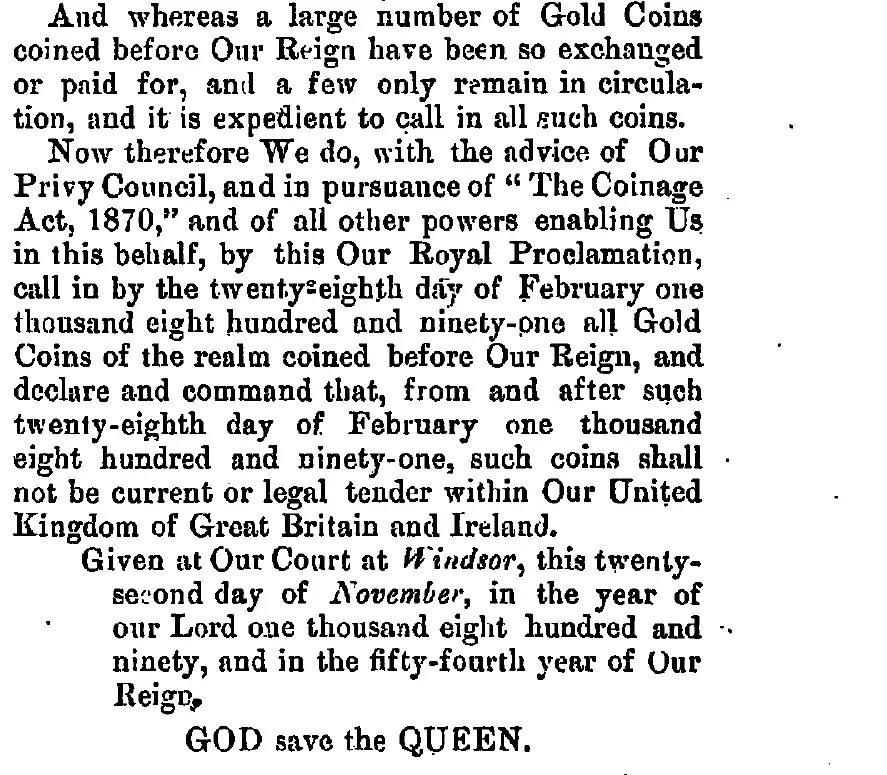 The close of Victoria's proclamation of 22 November 1890, printed in the London Gazette three days later. The London Gazette, Open Government Licence v3.0.
A circulated 1819 was not formally identified until July 1964, when one appeared on the front cover of a London dealer's bulletin at £1,000. The collector Captain J. J. Cullimore Allen bought it and recorded the date in his book on sovereigns the following year. Six were known by 2001, and ten by 2020.
The sovereigns people wore
Horatia Nelson, the admiral's daughter, is said to have worn a guinea, a half-guinea and a third-guinea on her watch chain, a set now at Royal Museums Greenwich. A sovereign case on a watch chain held coins ready to spend, while a mount held a coin that was not going to be spent, and when the exchange of 1889 to 1891 swept the old gold out of tills and bank drawers, a coin on a chain had no reason to go with it. No record follows any single 1819 through the recall, but the argument suits a date where so many of the survivors bear the marks of jewellery.
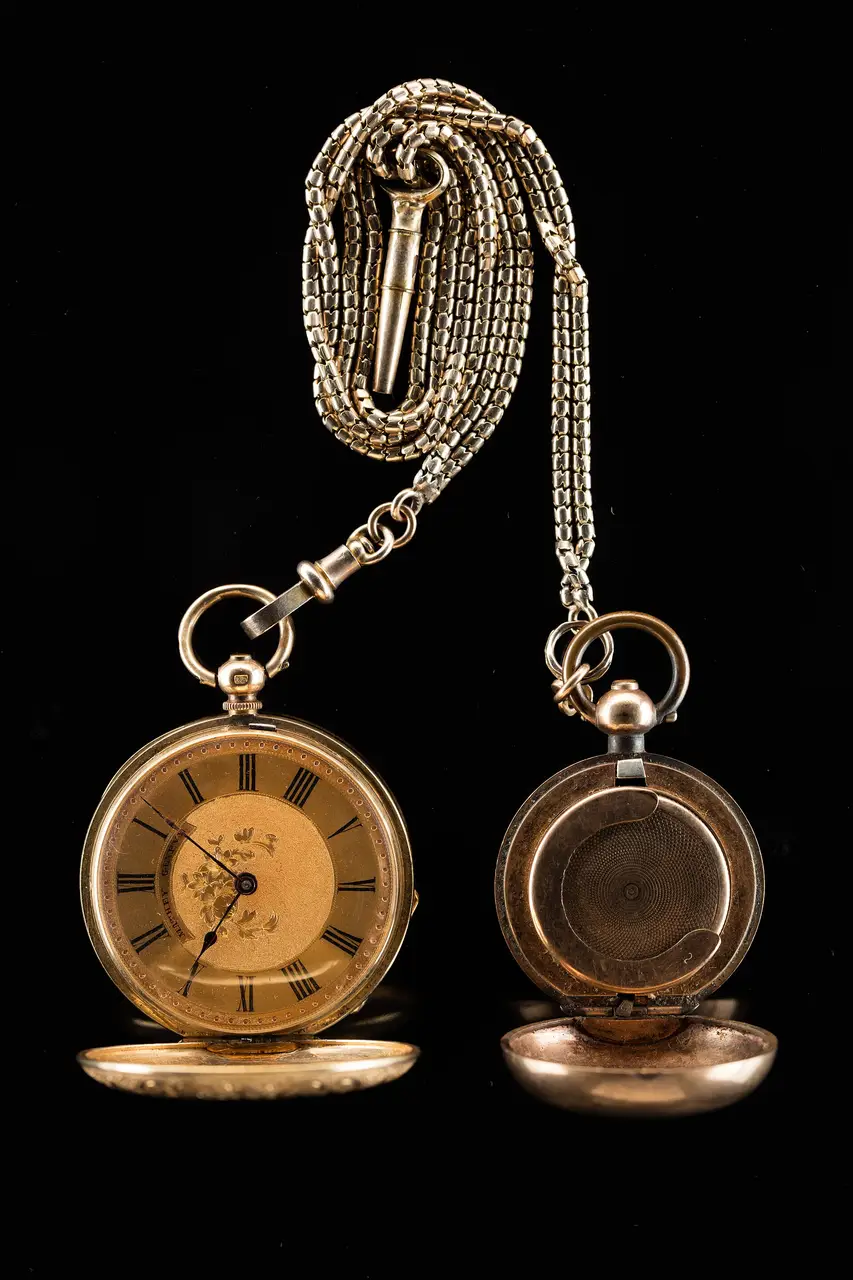 A lady's gold fob watch and gold-plated sovereign case on a double chain, sold in Invercargill, New Zealand, in 1875. Photo: Auckland Museum Tāmaki Paenga Hira, CC BY 2.0, via Wikimedia Commons.
One of the ten has a small clasp soldered to its rim, put there by a Victorian owner who spoilt the coin for a purist and probably saved it from the furnace. The date may also have been prized as the year of Queen Victoria's birth, on 24 May 1819, and it was her proclamation that ended the old gold as money.
Lot 4422 comes from the early twentieth-century family collection of a Suffolk lady. It is better than Fine, though mounted, and its wire covers none of the design, leaving the king, the date, the saint and the Garter motto all clear.
