
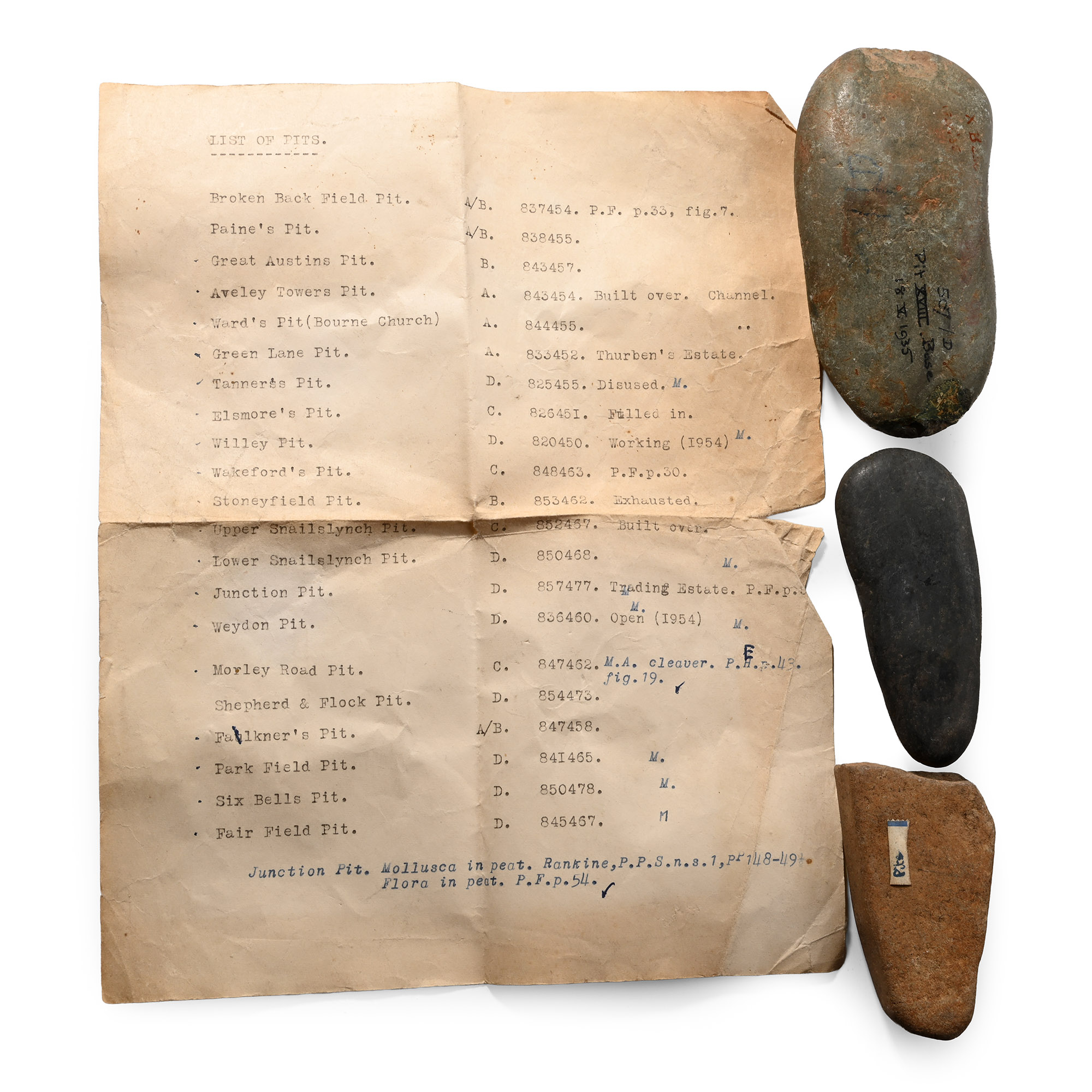
The sheet is typed, folded with a heading that writes "LIST OF PITS." Down its left side run twenty-one gravel pits round Farnham in Surrey, each with a letter for the river terrace it was dug into, a six-figure map reference and sometimes a note on its fate: "Built over", "Filled in", "Working (1954)". Two of the pits belonged to men who collected the Stone Age flint tools that came out of them. "Falkner's Pit" was an architect's, and "Stoneyfield Pit", marked "Exhausted", was dug for C.E. Borelli, a town councillor who watched over the work himself until the gravel ran out.
The list comes with lot 2985 in TimeLine's Lithics Sale, 201 lots of flint tools and other stone implements offered on Saturday 5 December. It was annotated by W.F. Rankine, the local schoolmaster who dug many of the sites round the town, and it is sold with a group of polished stones, among them a smoothing stone lettered "Farnham Pit Dwelling" and a cleaver inked "507/D Pit XVIII Base 18 v 1935".
Seventy-eight lots in the sale came down through the Borelli family. Most are Farnham finds from the excavations of the 1930s and 1940s, and many still carry what their finders wrote: cards inked "O'Farrell Coll.", matchboxes labelled "Ex. Edge Coll.", a card of tiny flints with a museum committee's form lettered on the back. The marks lead back to five men, a schoolmaster, an architect, a councillor, a canon of Aldershot and the vicar of Tilford. A flint tool carries no inscription of its own, so most of what it can tell a later owner about where it was found is what somebody wrote on it, and in Farnham a small circle of friends wrote a great deal.
Site 507, Pit 18
William Francis Rankine taught at Badshot Lea, just outside Farnham, and in 1928 he began walking the ploughed land east of the town to map where worked flint lay. In the spring of 1929 he came on a scatter by the Bourne Mill Spring and called it site 507, after the field's parcel number on the Ordnance Survey map. Trial holes found pits sunk into the gravel and filled with red earth, hearths and burnt flint, and in July 1931 they gave up the first microliths, the tiny blunted points and bladelets that were set into shafts as tips and barbs.
By June 1935 Rankine had conducted eighteen excavations, and his report for the Surrey Archaeological Society the following year goes through them pit by pit. Pit 18 was a small one filled with compact red earth. Twenty-five microliths were sifted from the floor of its lowest layer, and a green sandstone polisher came from the same level. The cleaver in lot 2985 is inked with that site, that pit and that layer, and a date in 1935. The report brought Grahame Clark from Cambridge to dig alongside Rankine in the summers of 1937 and 1938, and by that December finds from site 507 were on show at the British Museum.
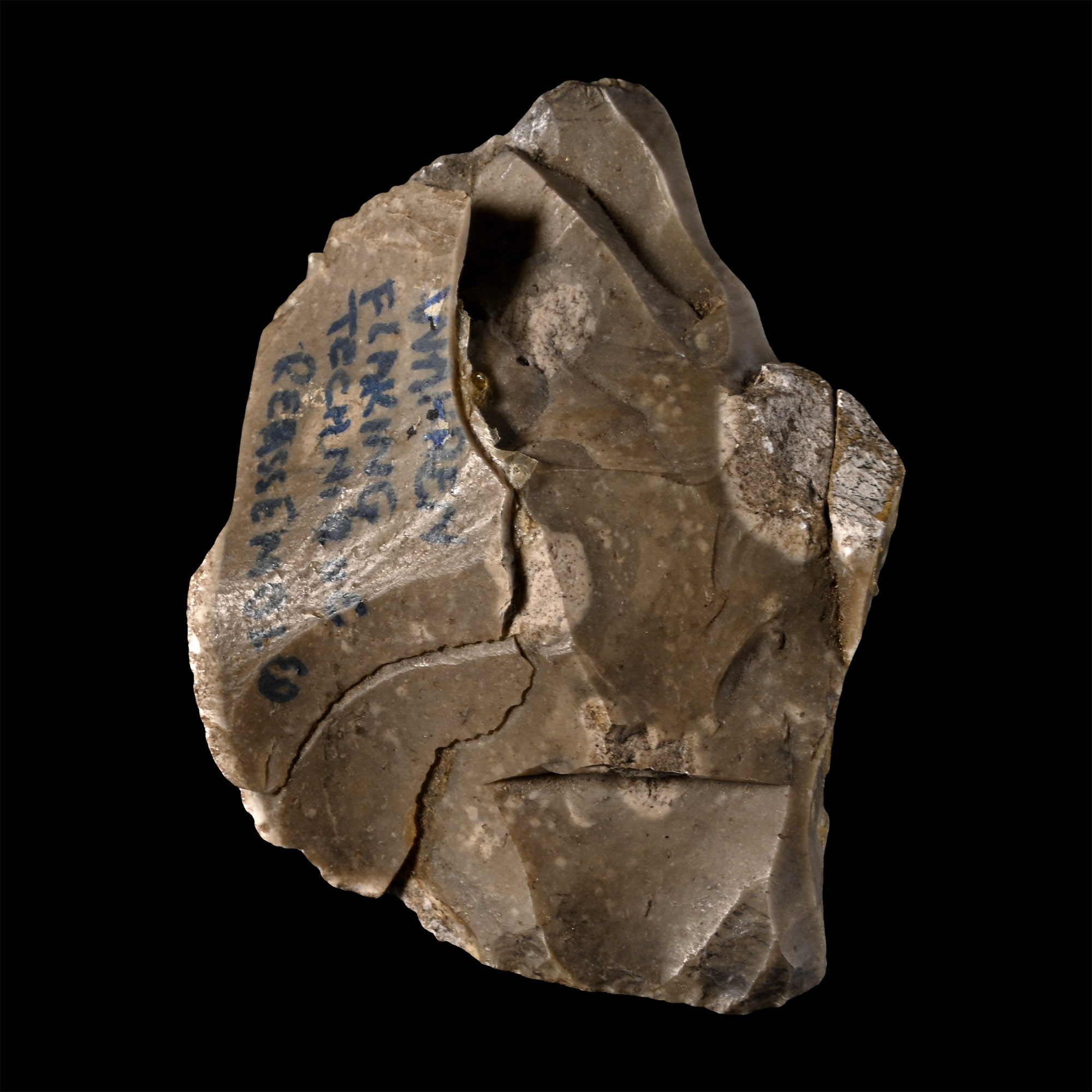
Rankine's obituary in 1964 said that many people round Farnham owed their interest in the subject to what he had taught them, and one of the Borelli lots is a teaching piece of that kind. It is a flint core from the Warren with several of its flakes glued back in place and "Warren flaking technique reassembled" inked on its side. Put back together, a core shows the order in which a knapper struck the flakes away, which no single flake can show.
How do you know where a Stone Age flint tool was found?
Usually from whatever was written on it, or kept with it, when it came out of the ground. A handaxe from one Farnham gravel pit looks much like a handaxe from the next, but the pits were dug into gravels of different heights and ages, and the letters on the typed list are those gravels: the Farnham terraces, lettered from A, the highest and oldest, downwards. In general a handaxe from terrace A is older than one from terrace D, and a handaxe labelled only "Farnham" could have come from either. Many of the early finds were labelled no better than that, or were never marked at all.
Harold Falkner (1875-1963), a Farnham architect of the Arts and Crafts generation, had his own pit, about an acre south of Great Austins Road where terraces A and B meet, dug by two hired men from 1912 to 1925. He recorded each find with its date and, where he could, its depth, and many of his handaxes are dated to the day, as in "Found June 17, 1914". Rankine thought Falkner's seventy or so pieces the only group of flints from the Farnham terraces with a trustworthy record of their discovery, and "Falkner's Pit. A/B. 847458." on the typed list is that acre, to the grid square.
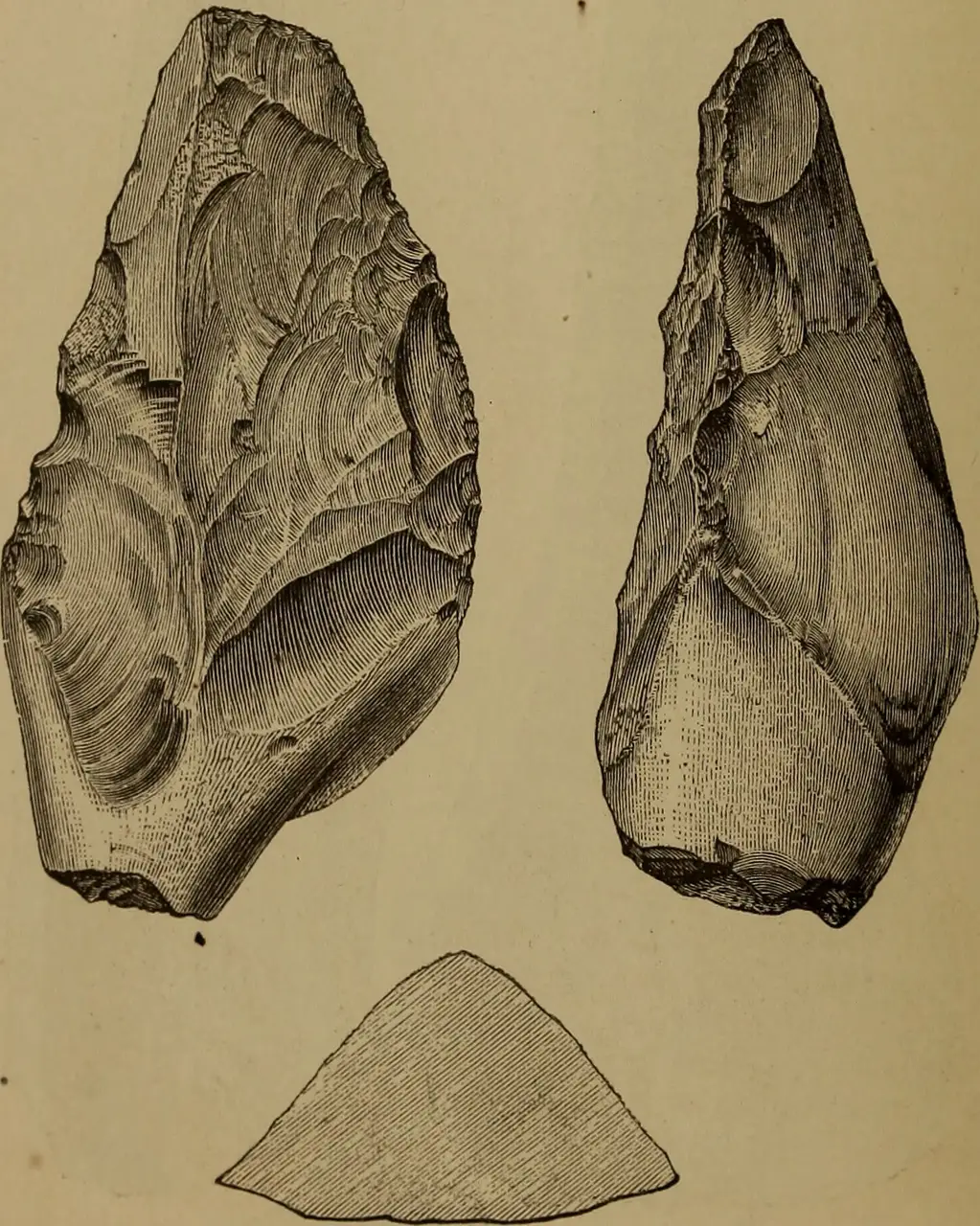 A "shoe-shaped" flint handaxe from Redhill, Thetford, engraved as Fig. 429 in John Evans's 1872 survey of the ancient stone implements of Great Britain; on the same page Evans cites Henry Prigg on the forms found there. Internet Archive Book Images, public domain, via Wikimedia Commons.
Charles Ernest Borelli, whose family's watch and jewellery business stood in The Borough, founded the Farnham Society with Falkner in 1911 and sat on the Urban District Council from 1906 until his death in 1950. Clark, thanking those who had helped at site 507, wrote of his "un-tiring efforts towards the preservation of ancient Farnham". A great many of his handaxes came from his own pit at Stoneyfields, on terrace B, which was dug under his personal supervision from about 1935 until it was exhausted in 1950, some nine acres of gravel later. From Ward's Pit he had two handaxes almost identical in size, shape and flint, found almost side by side some eight feet down, which Reginald Smith of the British Museum named "The Twins".
A canon, a vicar and a museum in one room
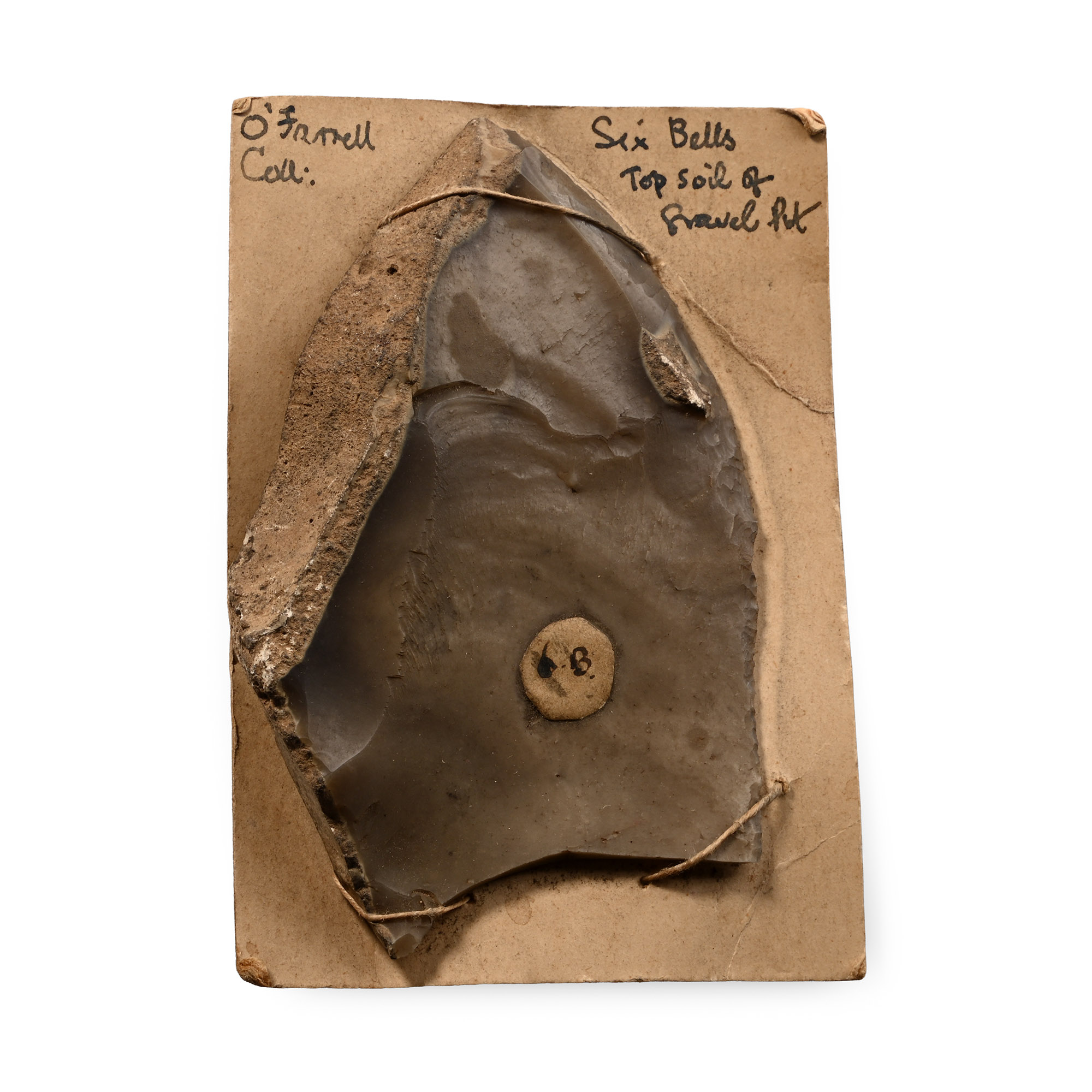
Canon F. O'Farrell of Aldershot found and investigated a group of hill-top sites north of Farnham, and Rankine drew on his flint collection again and again in print. Among the Borelli lots he is a card: a large scraper tied on with thread, a small round label reading "6 B.", and the inked words "O'Farrell Coll." and "Six Bells Topsoil of gravel pit". Six Bells Pit is on the typed list as well, on terrace D.
The Rev. W.H.F. Edge was vicar of Tilford for some fifty years, and a survey of Farnham published in 1939 records arrowheads found at the edge of the Badshot Lea recreation ground by a ploughman who had once worked in the Tilford district and "had learned about arrow-heads from the late Rev. W. H. F. Edge". Edge's name is on a matchbox of barbed-and-tanged arrowheads in lot 2839, labelled "A/Hds BxT / Tilford / Ex. Edge Coll.", which comes with a second matchbox holding a leaf arrowhead from Crooksbury. Two axes in lot 2952 are marked "Edge", and a twenty-centimetre pick in lot 2799 is inked "Tilford".
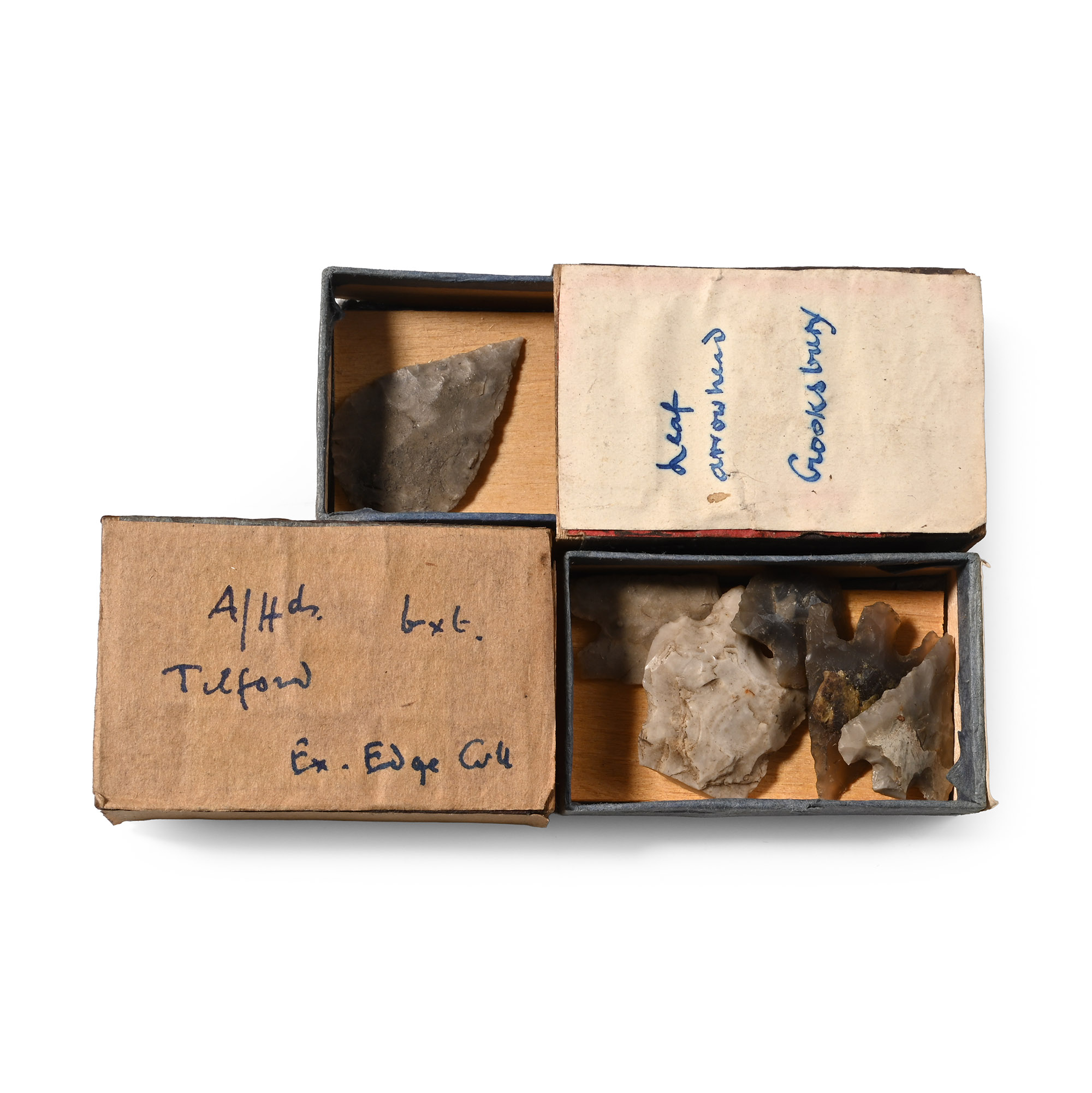
On Midsummer Day 1939 the Farnham Urban District Council opened a prehistoric museum in one room at the Chestnuts, in East Street. It drew on the collections of C.E. Borelli, Canon O'Farrell, the late Rev. Edge and Rankine himself, among others, and all four of those men have pieces in this sale.
Much of what the circle found is in the Farnham museum today. The part in this sale was given to their good friend Charles Borelli (c.1914-2000) of Farnham, the parish priest at Haslemere, and has come by family descent to his nephew. Father Charles was the son of Leo Borelli, the councillor's brother, so the flints went to a nephew of the man who dug Stoneyfields and have come down to a nephew of his.
The Stone Axe Committee and the Neolithic axe factories
The microliths in lot 2905 are tied with thread to a folded card typed "FRENSHAM GREAT POND (South). November 1947." The card is ruled into six fields with two or three flints to a field, sorted by colour: "Bluish-grey", "Brown", "Grey", "Black", "Yellow". A pencil note counts "4 sorts of flint". On the back the thread runs through hand-lettered capitals, "South Western Group of Museums and Art Galleries / Report of Stone Axe Committee", over the headings of the committee's record form.
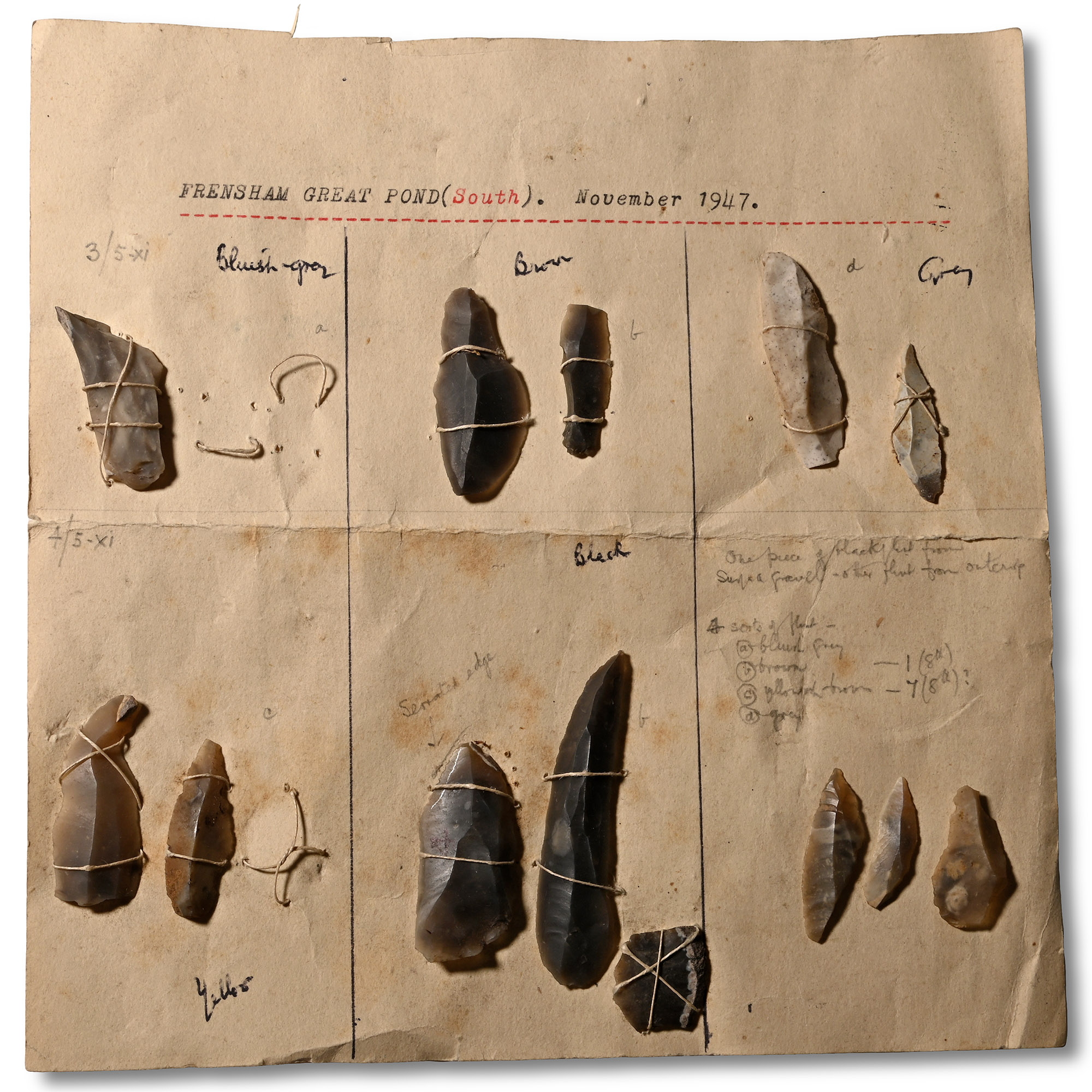
The committee was appointed in 1936 to name the rock of as many stone axes as it could reach and trace that rock to its outcrop, which would show how far the axes had been traded. An axe's surface was too ground and weathered to judge by eye, so the committee asked owners for leave to cut. A small wedge was taken from each axe and ground into a slice thin enough for the microscope, and the gap was filled with plaster and coloured so that the axe looked exactly as it had before. The owners agreed readily, and the committee's report of 1941 announced that "the old 'collector' mentality is quickly disappearing".
The slices were sorted into numbered groups and the outcrops behind them tracked down. Group VI, a volcanic tuff from Great Langdale in the Lake District, turned out to be the commonest raw material of Neolithic stone axes in Britain, and in 1949 an extensive working site was published on the screes of Pike o' Stickle. Two blades in the Borelli collection are each inked "Pike O' Stickle" (lot 2912). A large scraper carries the painted legend "Craiglwyd / Penmaenmawr / 19.8.39" (lot 2858), for the Welsh hill that had been identified in 1919 as the first Neolithic axe factory found in Britain.
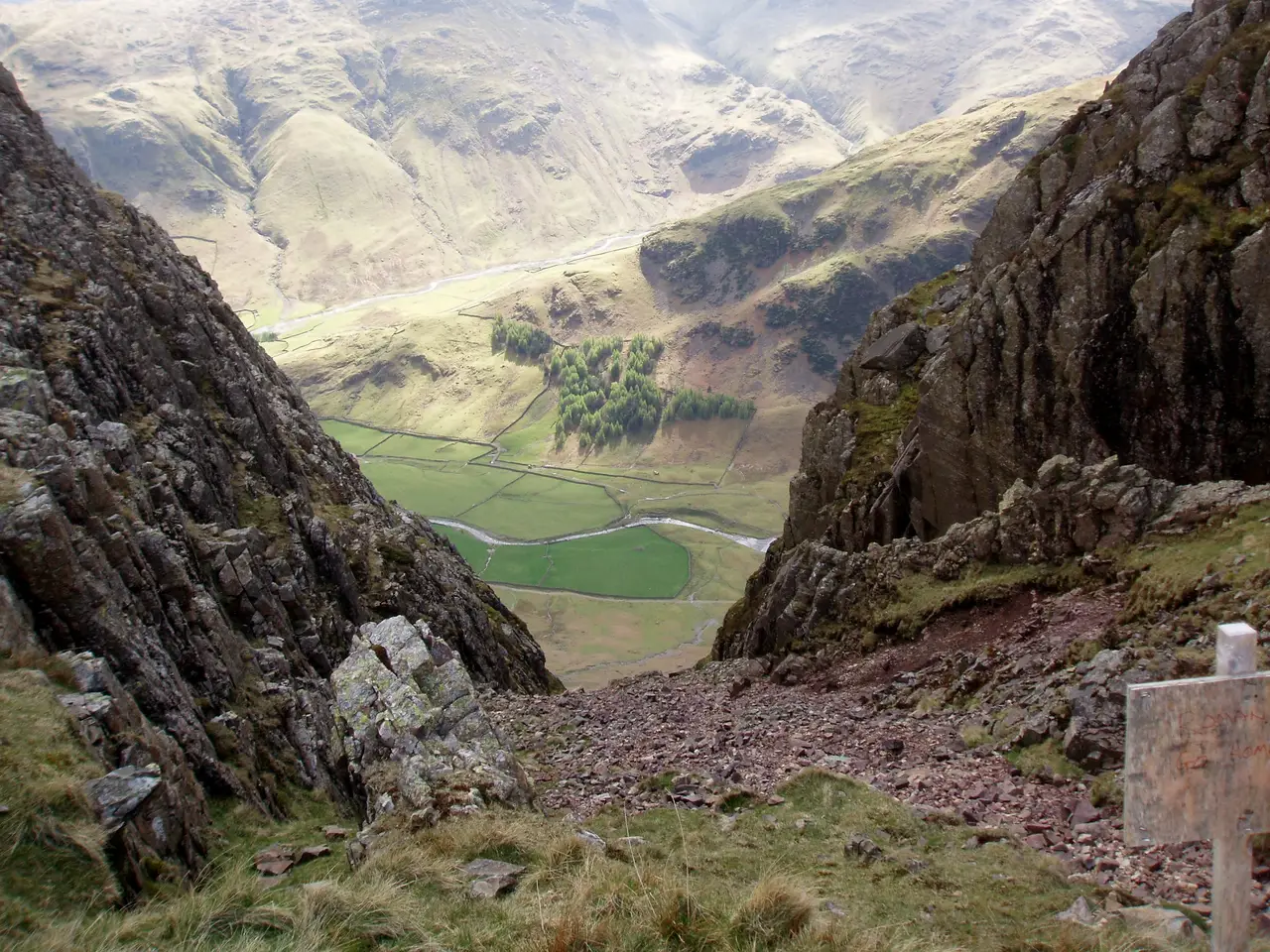 Great Langdale from just below Pike o' Stickle, on whose screes the Group VI axe-working site was found. Photo: Bikeboy, CC BY-SA 2.0, via Wikimedia Commons.
In County Antrim a generation earlier, W.J. Knowles had been buying flakes and broken axes from farmers on market days in Ballymena when, he wrote in 1903, "a man named Henry Green, a sort of pedlar, seeing me buy poor objects like black flakes", brought him some of black rock from near Cushendall. Knowles went at once, found an axe factory and followed further sites up towards Tievebulliagh. The committee later named the Tievebulliagh rock, porcellanite, as its Group IX, and an axe of black stone in the Borelli collection has a pasted label reading "Tievebulliagh" and was found there on 1 October 1953 (lot 2801).
Labels from Stonehenge and La Madeleine
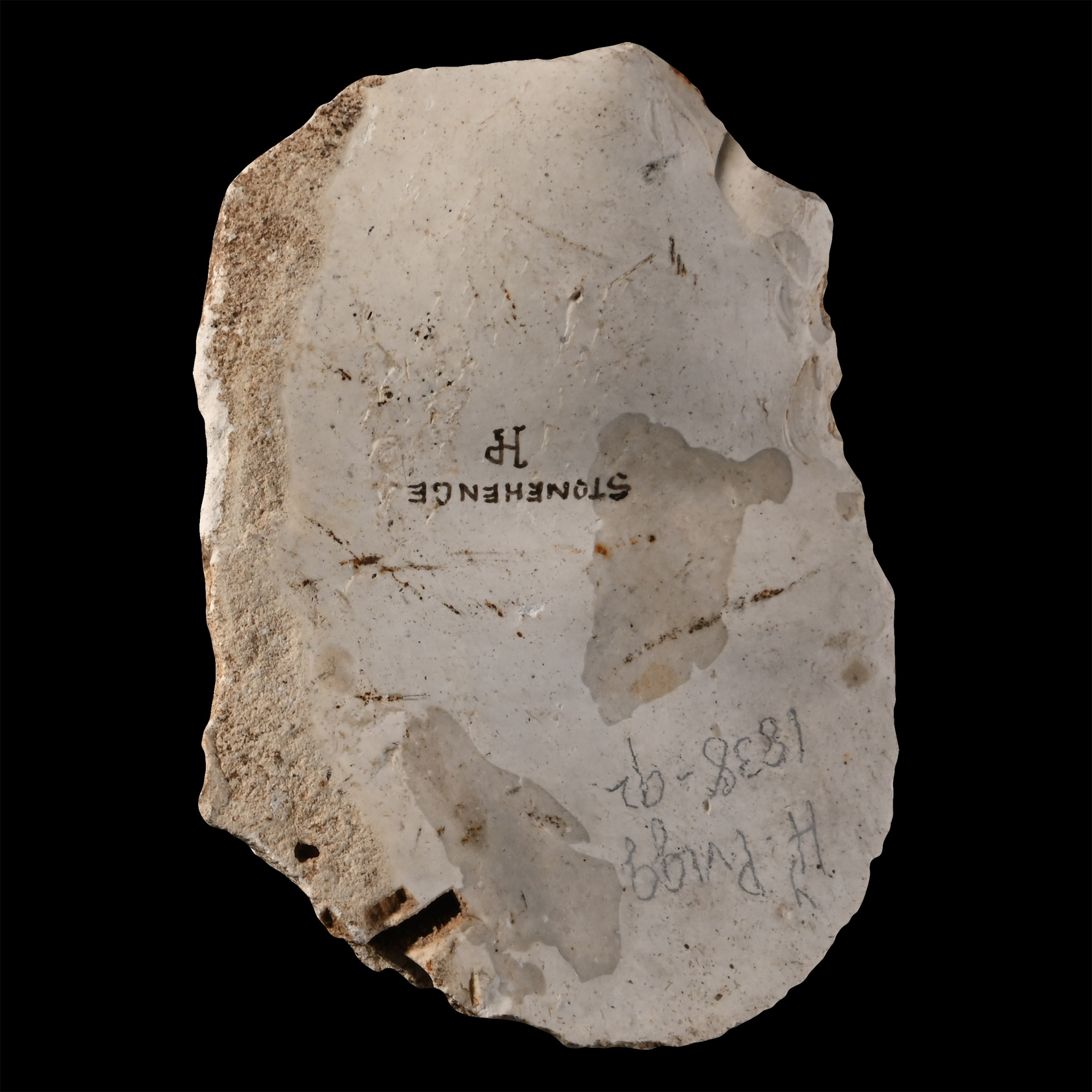
Two pieces given to Father Borelli carry the labels of collectors from further back and further afield. The first, lot 2828, is a scraper with a broad scooped edge, inked with an "HP" monogram over the word "STONEHENGE" and pencilled "H Prigg 1838-92". Henry Prigg, who found it at Stonehenge, was a Bury St Edmunds geologist and antiquary whose name turns up often in John Evans's survey of British stone implements, and when a party from the Geologists' Association called on him in 1887 he showed them some hundreds of worked flints.
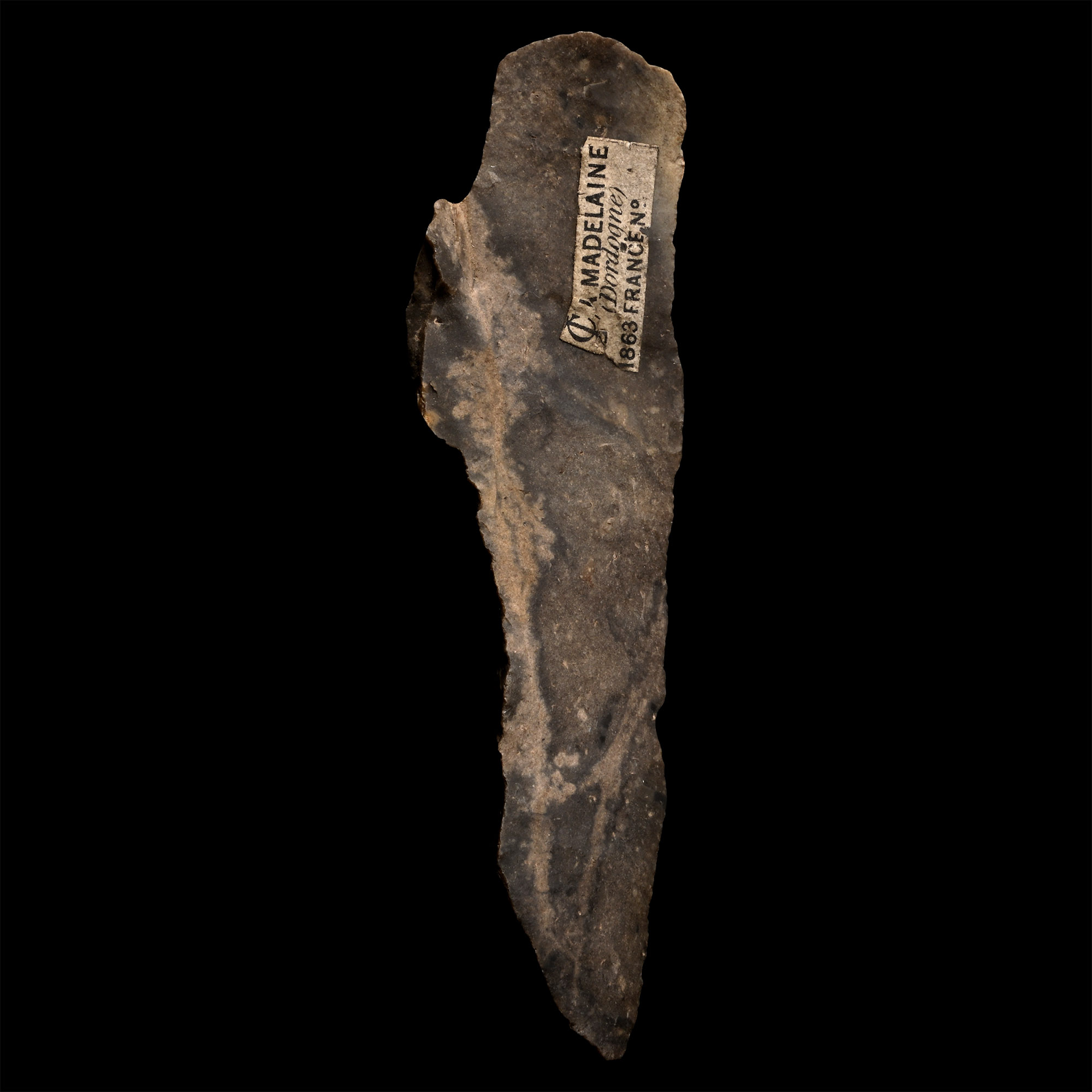
The second is a long-edged knife with a printed paper label reading, beside a monogram, "La Madelaine / (Dordogne) / 1863 France No." Édouard Lartet found it at La Madeleine in 1863, the year he began the first systematic excavation of the rock shelter with the money and help of Henry Christy, a London banker. Lartet did as much as anyone to found the study of prehistory in France, and collectors look for his labels. This one spells the site as he and Christy spelt it throughout Reliquiae Aquitanicae, their book on the archaeology of the Périgord. When Lartet sent a box of finds to the Smithsonian in Washington in 1869 he promised that "each specimen will be found to bear its label".
What are Stone Age flint tools worth?
Most cost a few hundred pounds or less: in the Lithics Sale, 133 of the 201 lots have a top estimate of £100 or less, and the top lot is estimated at £800 to £1,000.
In September, forty-five lots from the Borelli collection were offered and all forty-five sold. A Farnham polished axehead made £2,470, five knapped Farnham axes made between £1,170 and £1,820, and a Farnham arrowhead collection £442 on an estimate of £300 to £400, the same estimate as the five arrowheads in lot 2800.
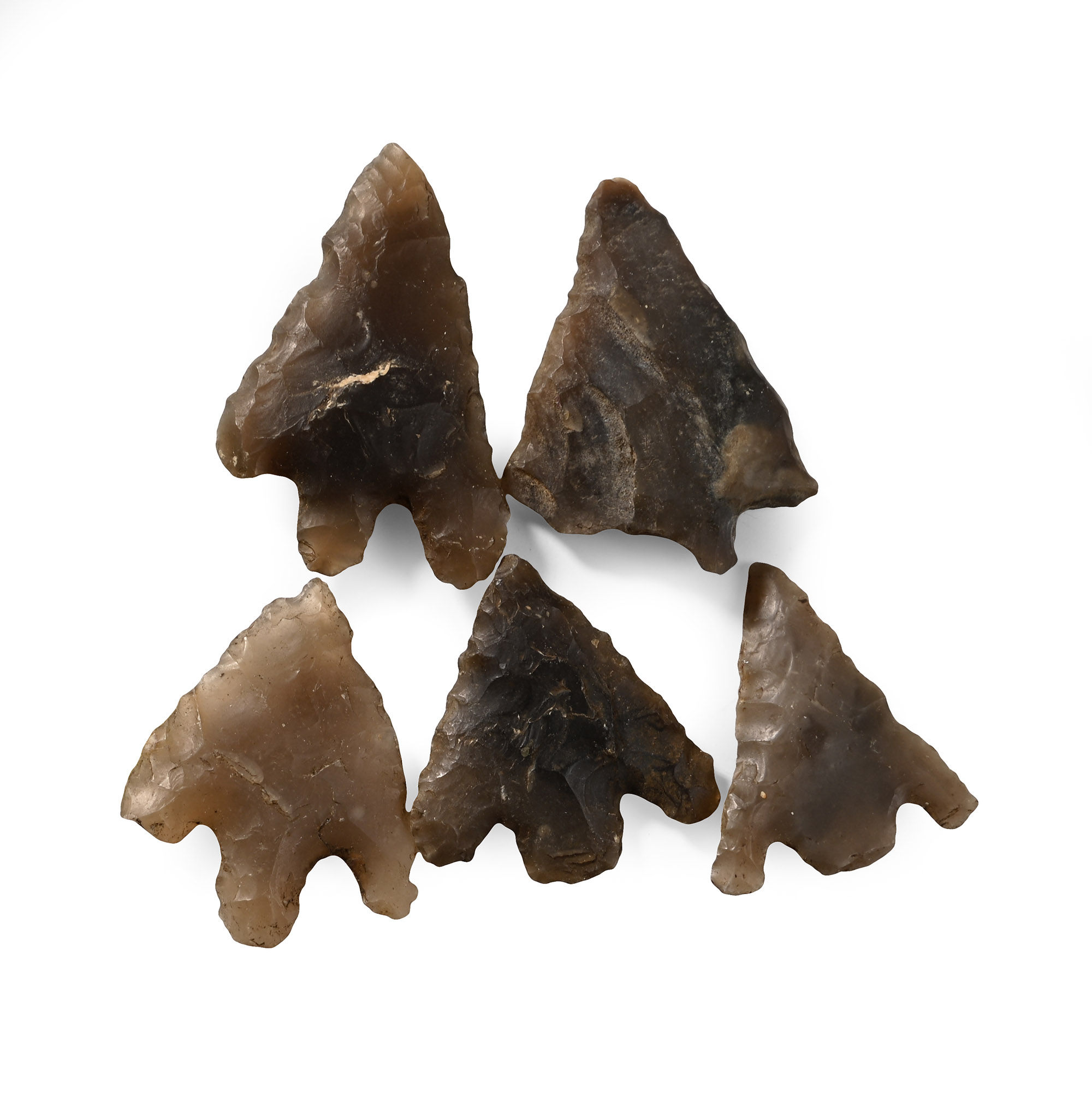
A Stone Age hand axe can still be bought for under £200, and what lifts one flint above its neighbour in a sale like this is a findspot in ink and a name a buyer can look up, the flint collector's equivalent of the painter's name that separates a £100 vase from a £10,000 one. The Farnham pieces still have their cards and matchboxes, and the Lithics Sale is session three of TimeLine's December auction.
Rankine wrote in 1954 that the pits which had made Farnham famous were by then "obliterated by building". Six Bells Pit, where the O'Farrell scraper came out of the topsoil, had become the Roman Way Estate, and Junction Pit was a trading estate. On the typed list in lot 2985, Ward's Pit, where the Twins lay side by side eight feet down, has a terrace letter, A, a grid reference, 844455, and in brackets the building that stands on it now: Bourne Church.
