
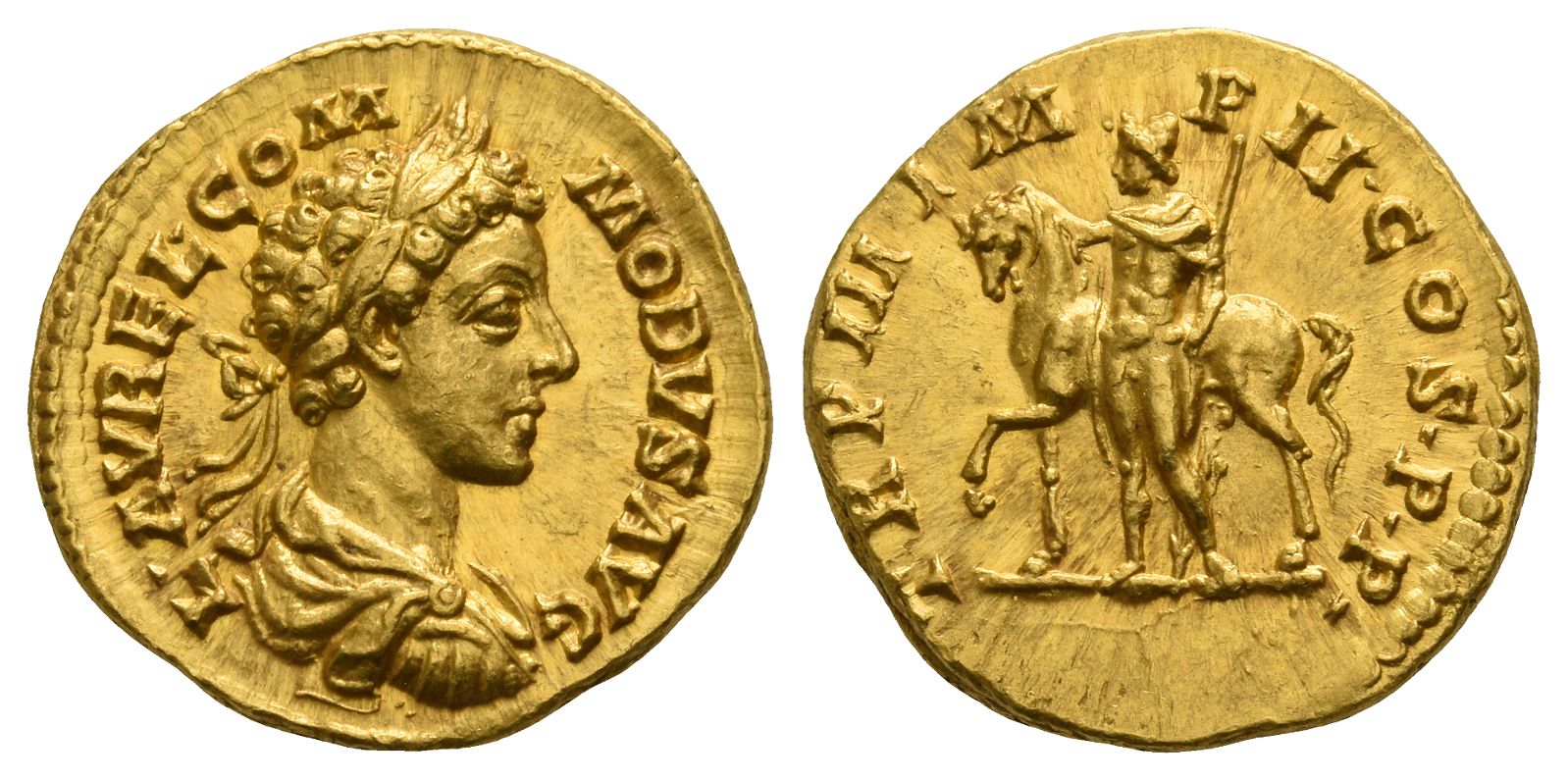
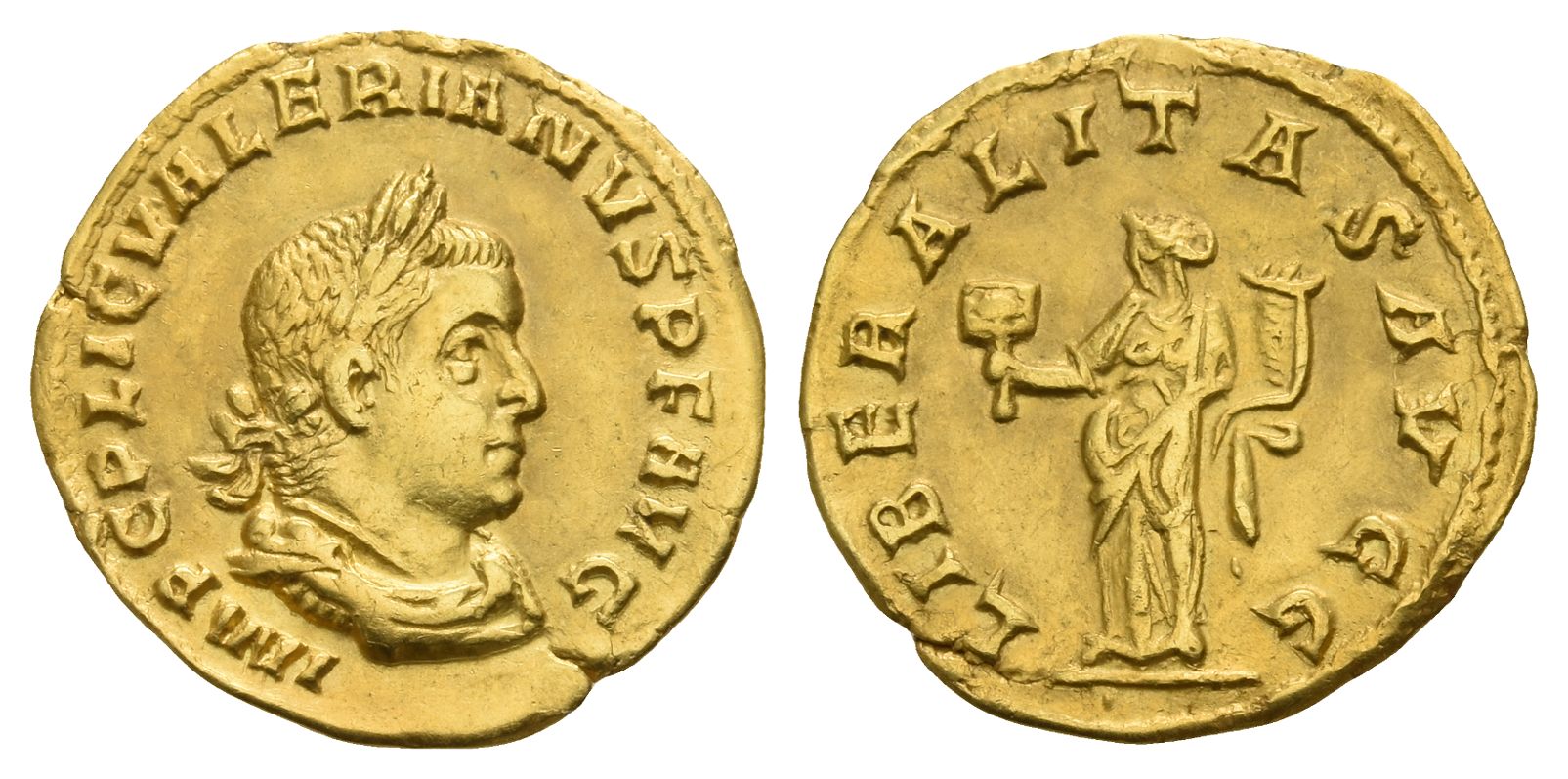
The aureus of Commodus struck at Rome in 178 weighs 7.31 grams, and on its reverse Castor, one of the divine twins, holds his horse by the bridle. Seventy-seven years later the same mint struck an aureus for Valerian that weighs 2.27 grams. At 20 and 18 millimetres across the two could pass for a pair in a photograph, but the Valerian is much thinner and carries 31 per cent of the Commodus's gold.
The aureus was Rome's gold coin for three and a half centuries, until Constantine replaced it with the solidus. It held a steady weight for 150 years, and then in the sixty years after 215 it lost half its gold and was alloyed with silver and copper, until Aurelian restored it. Sixteen gold coins from the collection of a West London gentleman, struck between 76 and 281, show the whole sequence, and two of them are plugged where holes once were.
How much did a Roman gold coin weigh?
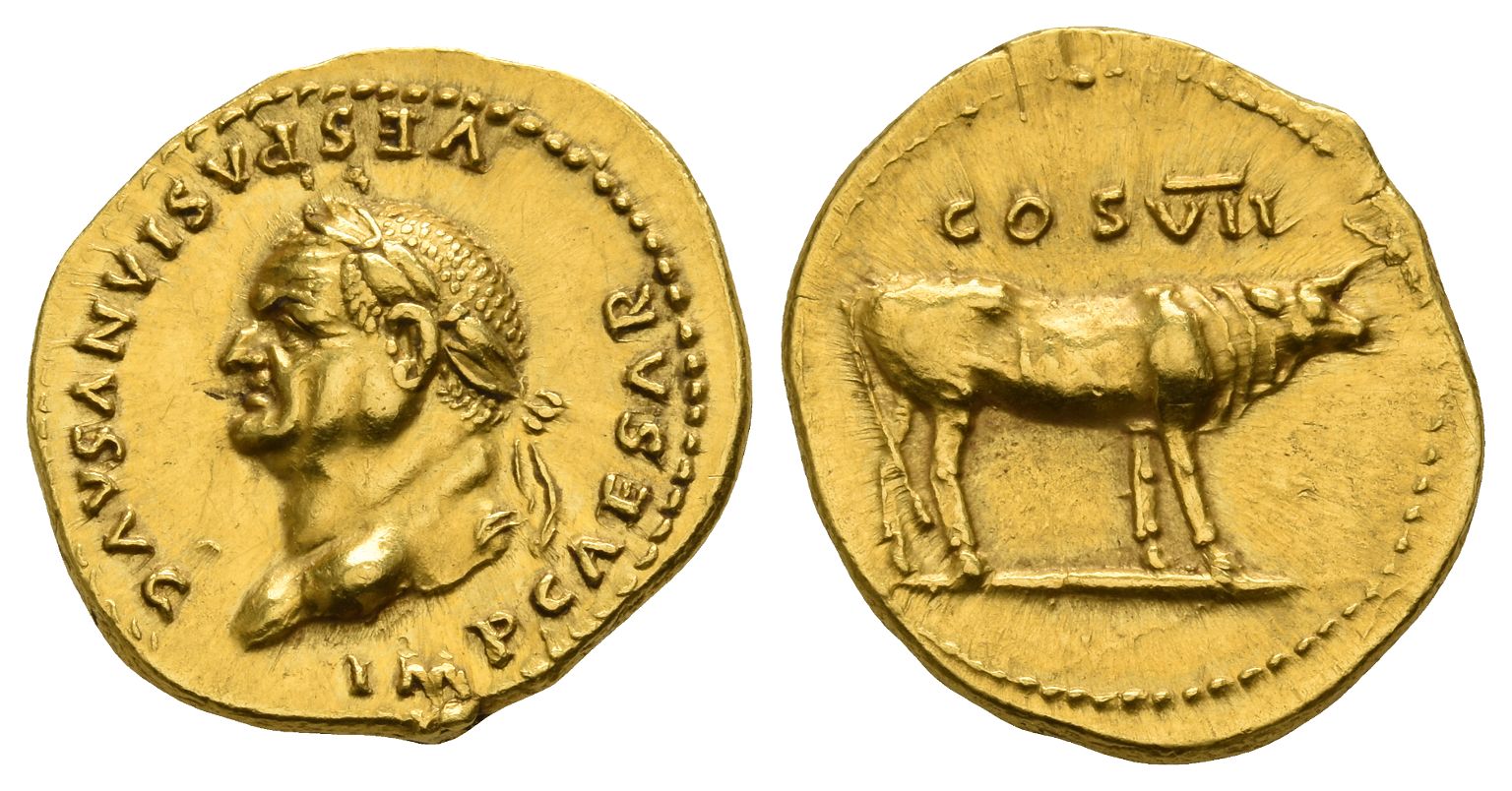
Rome measured gold by the pound, about 327 grams, and after Nero's reform of 64 struck forty-five aurei to it, an average of 7.25 grams that held until 215. Vespasian's aureus of 76 weighs exactly that, sharply struck on a broad flan, with a heifer on the reverse.
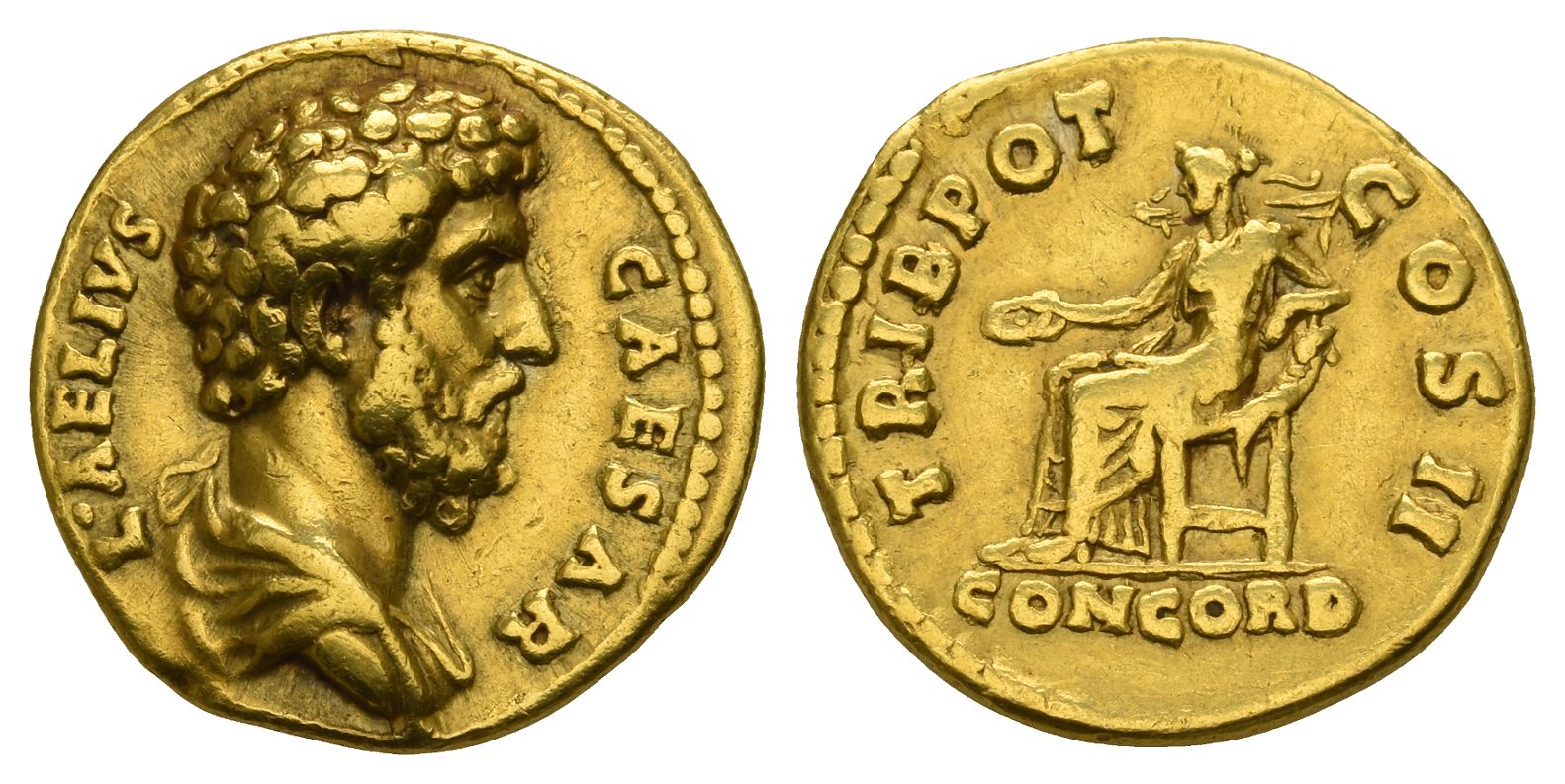
When Hadrian adopted Lucius Aelius Caesar as his heir in 136, three hundred million sesterces went to the soldiers, according to the Historia Augusta, a late and not very reliable collection of imperial lives, or some 22 tonnes of gold. Aelius died on 1 January 138, and the same source has Hadrian lament that "we have leaned against a tottering wall". Aelius's aureus of 137, very rare with this portrait, weighs 7.01 grams, with Concordia on the reverse.
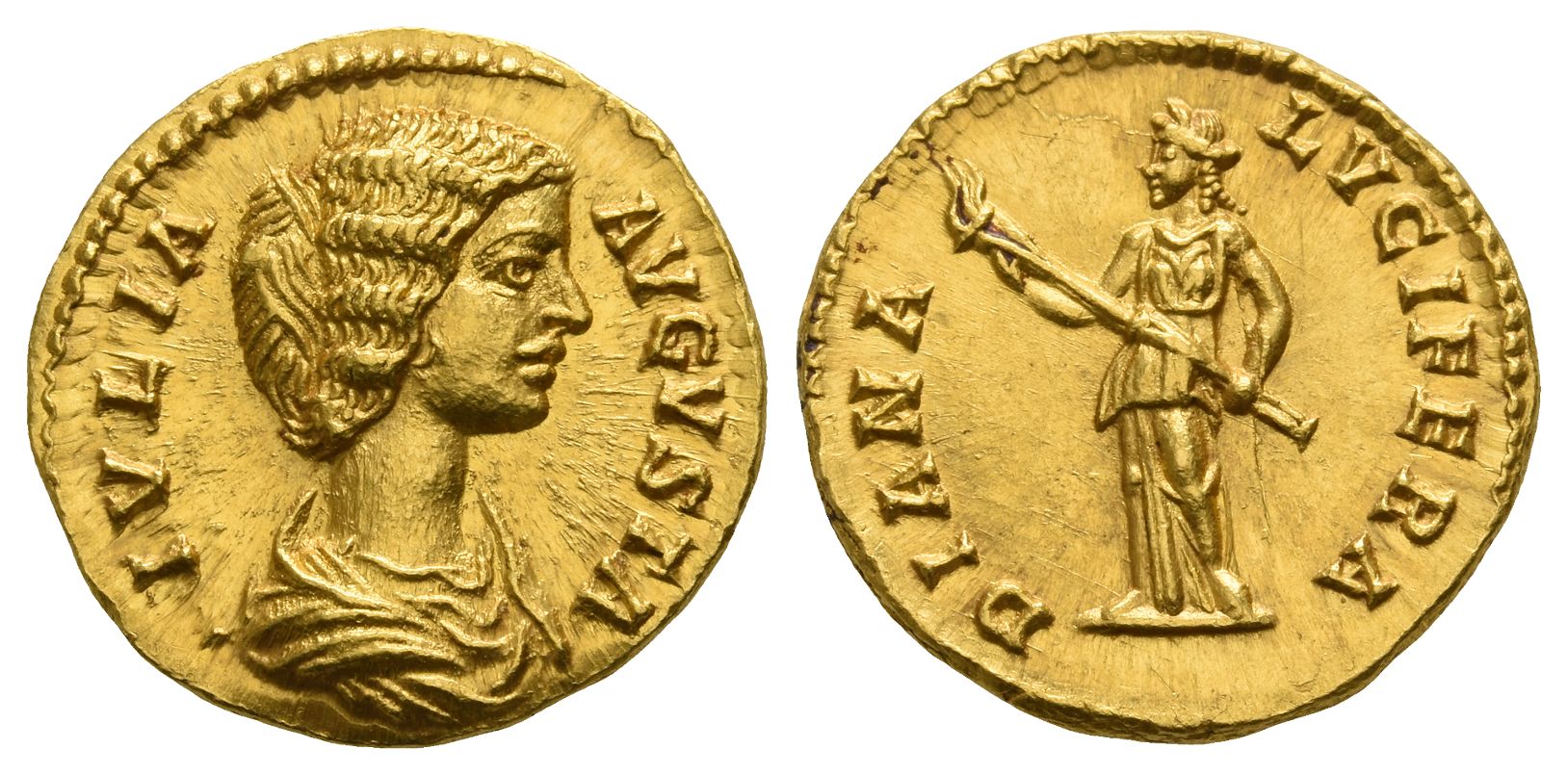
Julia Domna's aureus of 196, in Fleur de Coin condition, the trade's top grade, is the last coin in the group struck to the old weight, at 7.08 grams, with Diana Lucifera holding a torch. Nineteen years later her son Caracalla cut the aureus to fifty to the pound, about 6.5 grams.
When the aureus lost its fixed weight
Under Severus Alexander, between 222 and 235, the mint at Rome stopped striking to a set weight, and his aurei range from 5.38 to 7.25 grams, apparently because the mint divided whatever bullion it had by the number of coins an occasion needed. An aureus of Gordian III of 239 weighs 4.99 grams.
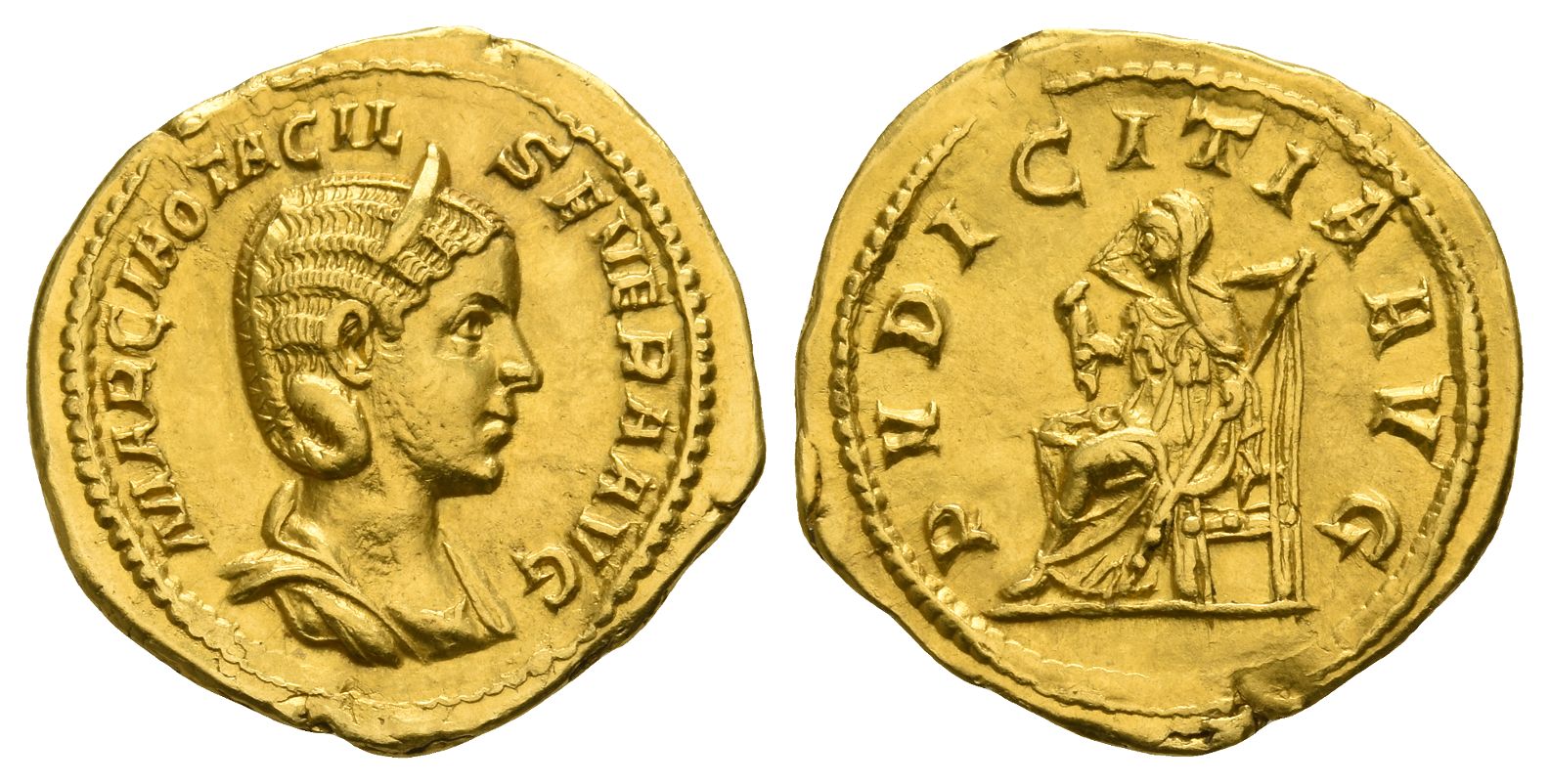
Philip the Arab came to power in 244 during a war with Persia and bought peace from Shapur I, whose own victory inscription put the price at 500,000 aurei. His family's coins in the group were all struck at Rome within four years and still differ by almost a gram, from 4.79 grams for his wife Otacilia Severa's Pudicitia aureus and their son Philip II's coin, through 4.55 for her CONCORDIA AVGG aureus, to 3.84 for Philip's own ANNONA aureus. On the Pudicitia coin, the finest of its type to come to auction, the figure of wifely modesty draws the veil from her face.
The numismatist Roger Bland, counting dies, estimates that the mint struck as many coins for Philip as for Hadrian, yet in the western provinces Hadrian's turn up as stray finds at about six for each year of his reign and Philip's at fewer than one. He suggests the rest left the empire as plunder, subsidy and pay, or were melted into jewellery or restruck as lighter coins by the state.
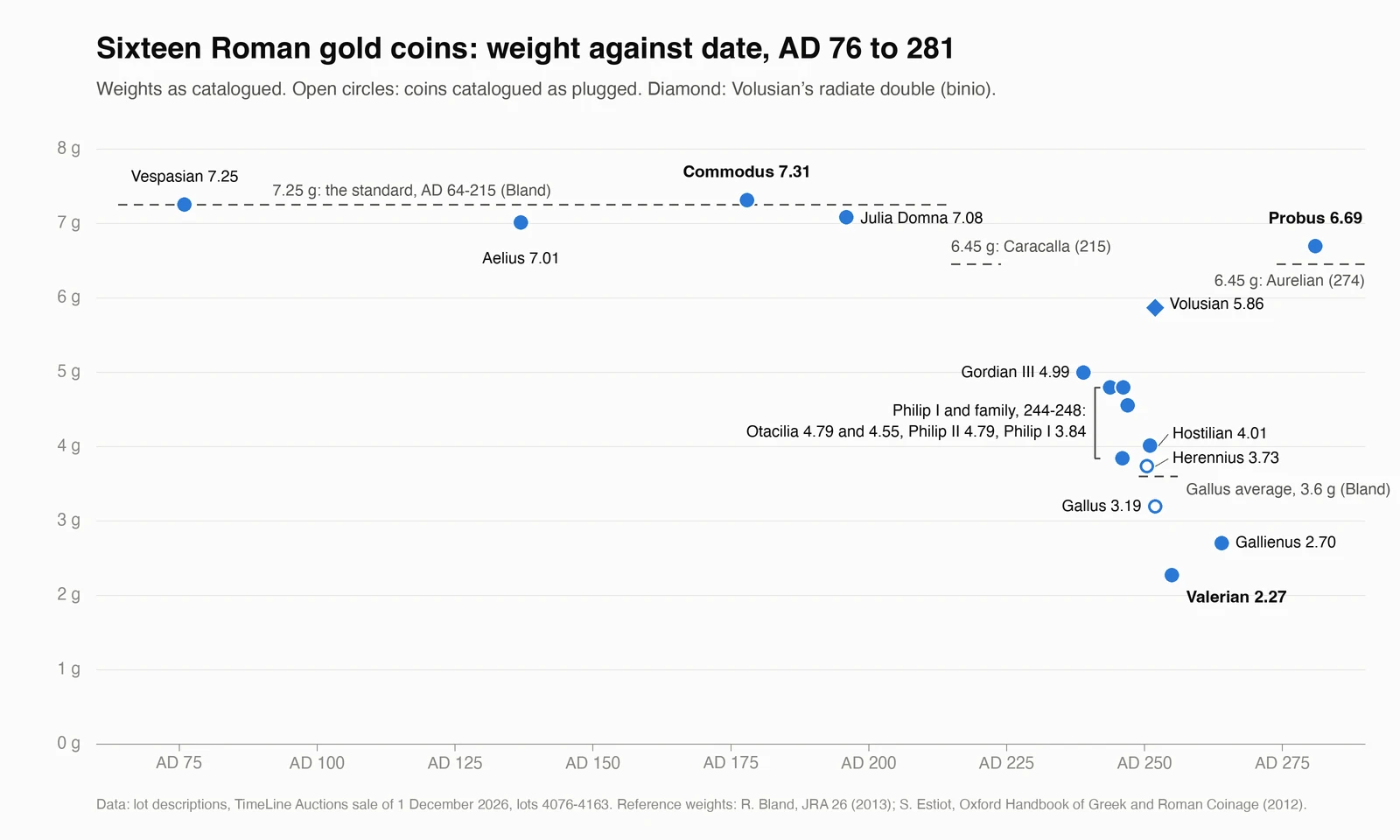 The sixteen coins by date and weight, against the 7.25-gram standard of AD 64-215, Caracalla's and Aurelian's 6.45 grams, and the 3.6-gram average for Trebonianus Gallus. Chart: TimeLine Auctions, with data from R. Bland (2013) and S. Estiot (2012).
The princes of youth
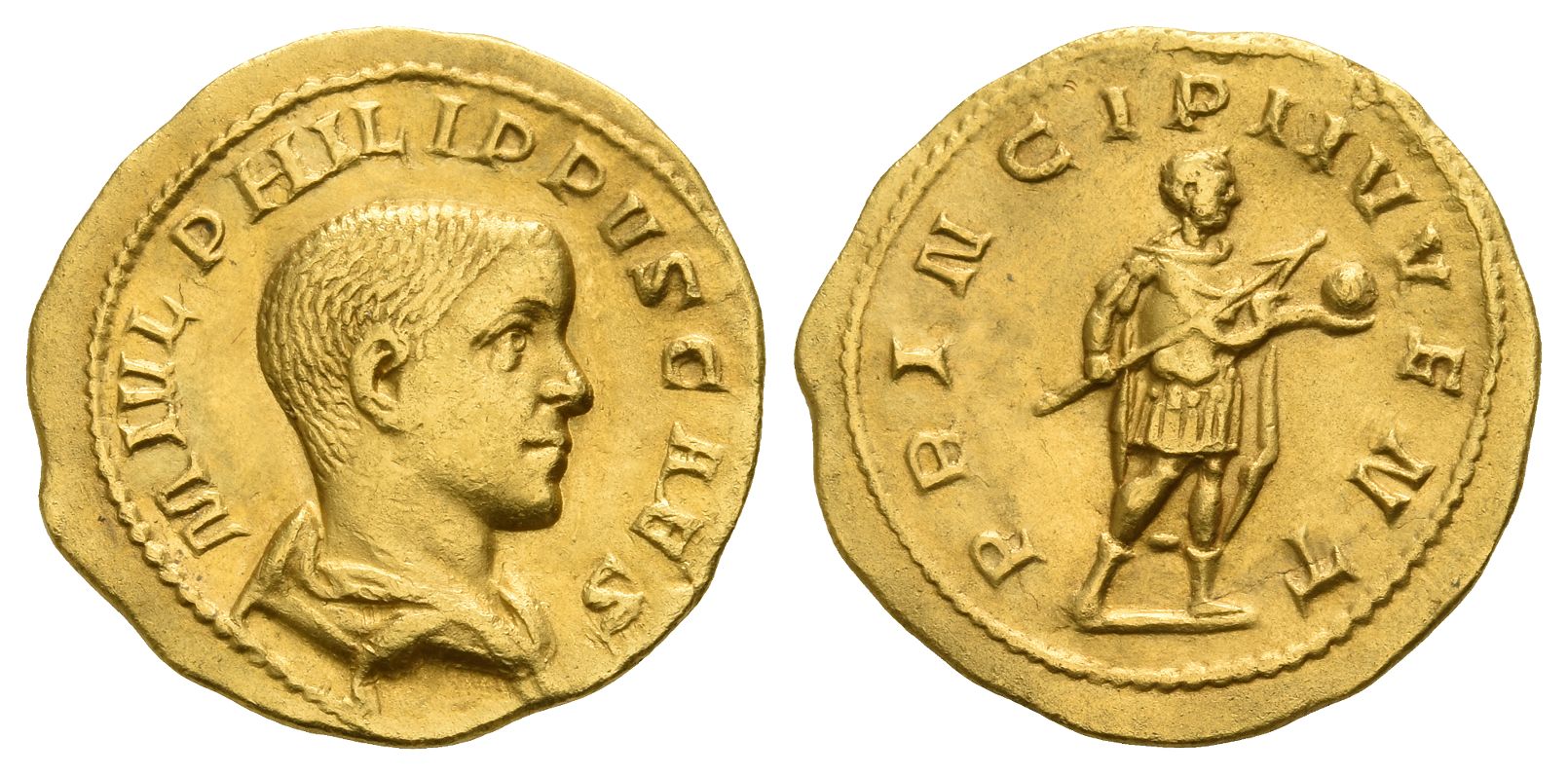
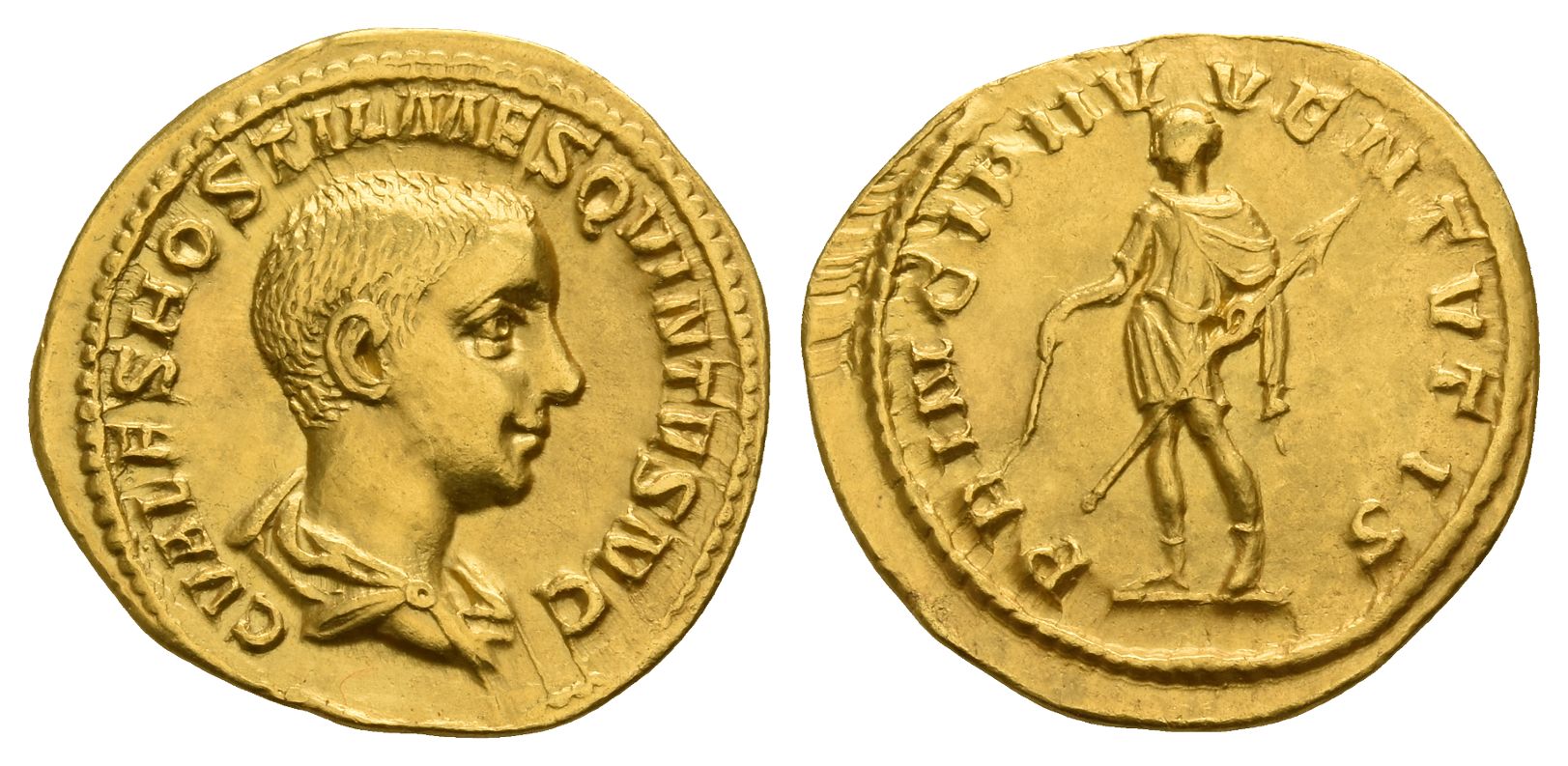
Philip II's reverse names him PRINCIPI IVVENT, "to the prince of youth", the title of the emperor's heirs, whom the Castor on the Commodus had also stood for. The group has two more, Herennius Etruscus and Hostilian, the sons of Decius, and none of the three outlived his father by more than a few months. Philip II, made Caesar at about seven, was said to be so grave that nobody could make him laugh, and he was killed at Rome in 249, aged eleven, after Decius had defeated his father.
Herennius died with Decius fighting the Goths at Abritus, in what is now north-east Bulgaria, in July 251, and Hostilian, left behind in Rome, died of plague within months. His aureus of 251, extremely rare with this form of his name, weighs 4.01 grams. The archaeologists Aleksander Bursche and Kyrylo Myzgin argue that Decius had his treasury with him at Abritus and that its loss may have pushed the aureus down so sharply that under his successor Trebonianus Gallus the coins average 3.6 grams.
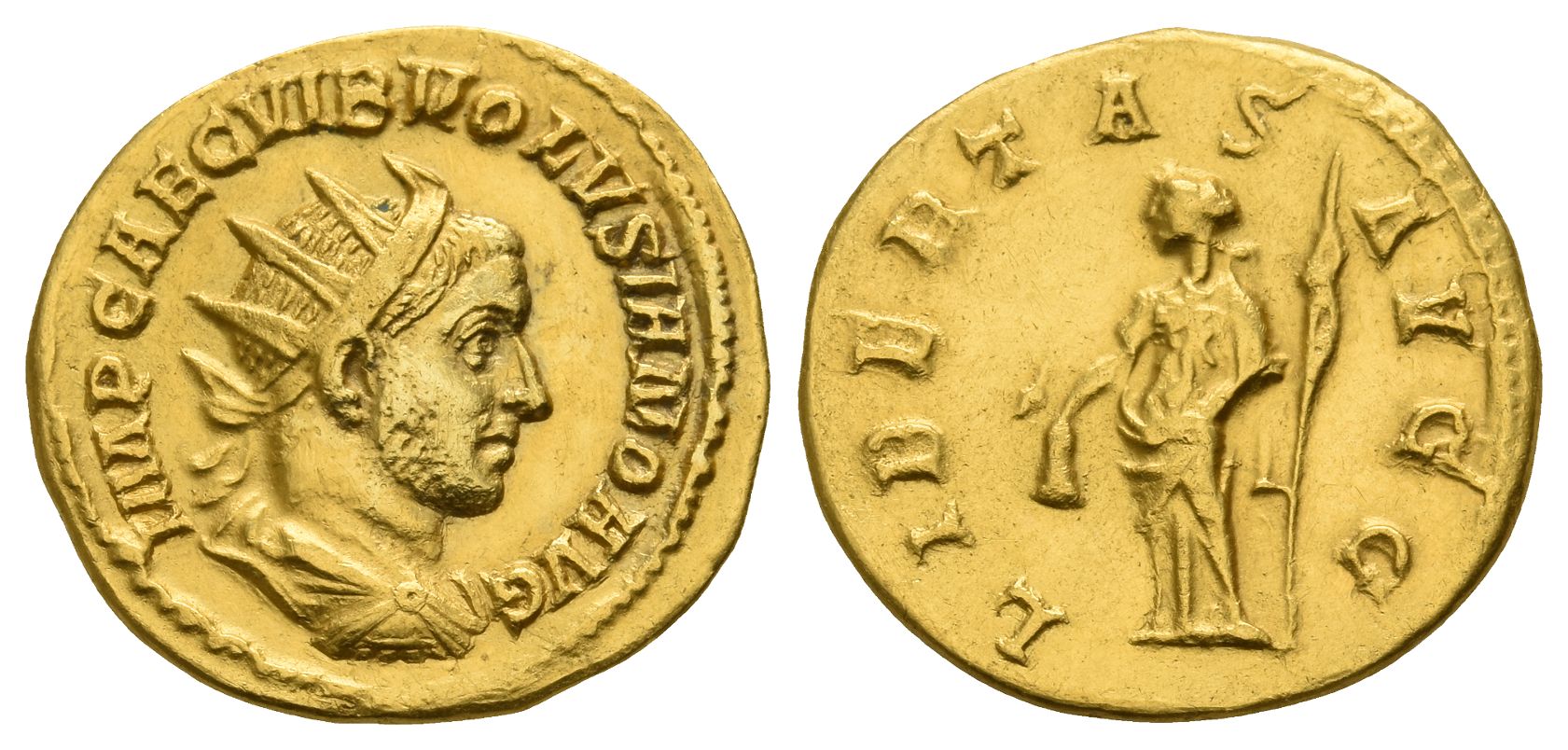
Gallus's son Volusian appears on a very rare binio of 252, a double aureus marked by his spiked radiate crown, which at 5.86 grams is only about 1.6 times the average aureus of its day. The British Museum has the same type set in a gold pendant.
Gold by weight
Under Valerian and his son Gallienus, from 253, the aurei fall so far and so unevenly that the mint may not have been aiming at any standard, and on Valerian's 2.27-gram coin of 255 Liberalitas holds the token of a cash hand-out of the kind Hadrian had paid in coins with three times the gold. In 260 Valerian was captured by Shapur, who had the victory carved in the cliff at Naqsh-e Rostam with two Romans before his horse, usually identified as Philip and Valerian.
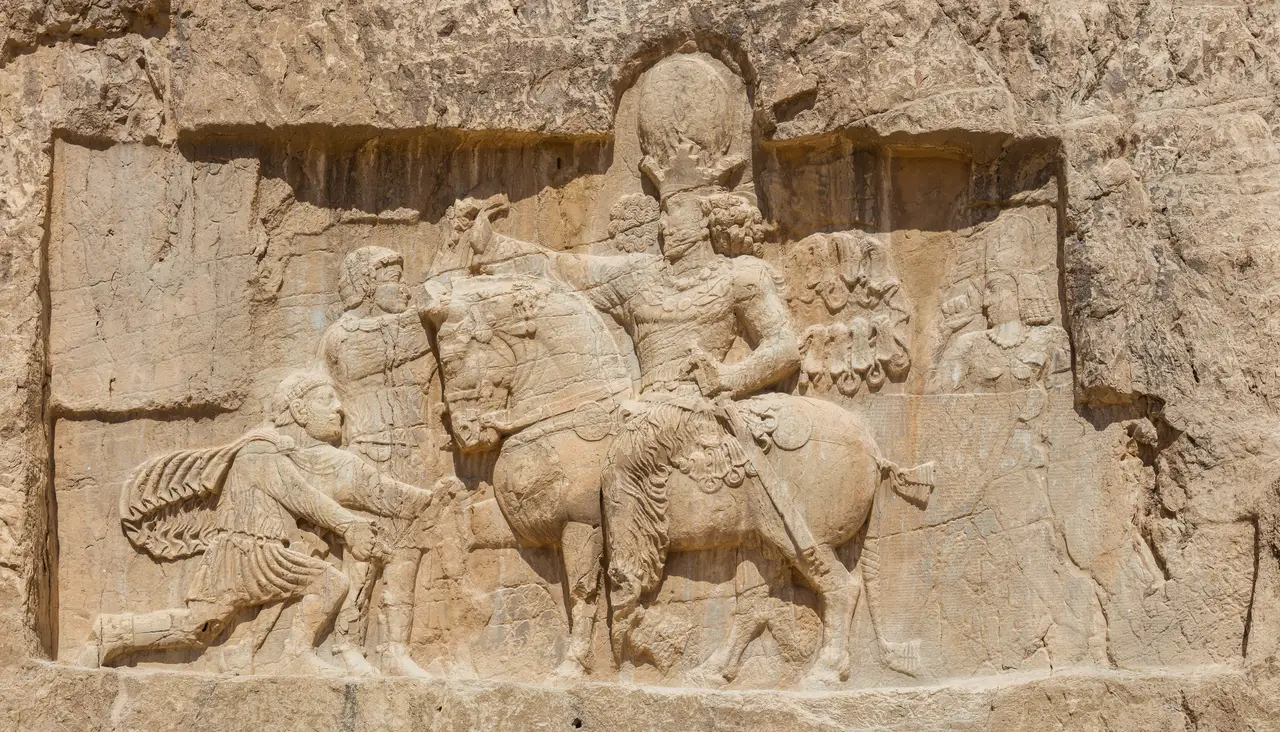 Shapur I's triumph relief at Naqsh-e Rostam, near Persepolis in southern Iran, third century AD. Photo: Diego Delso, delso.photo, CC BY-SA 4.0, via Wikimedia Commons.
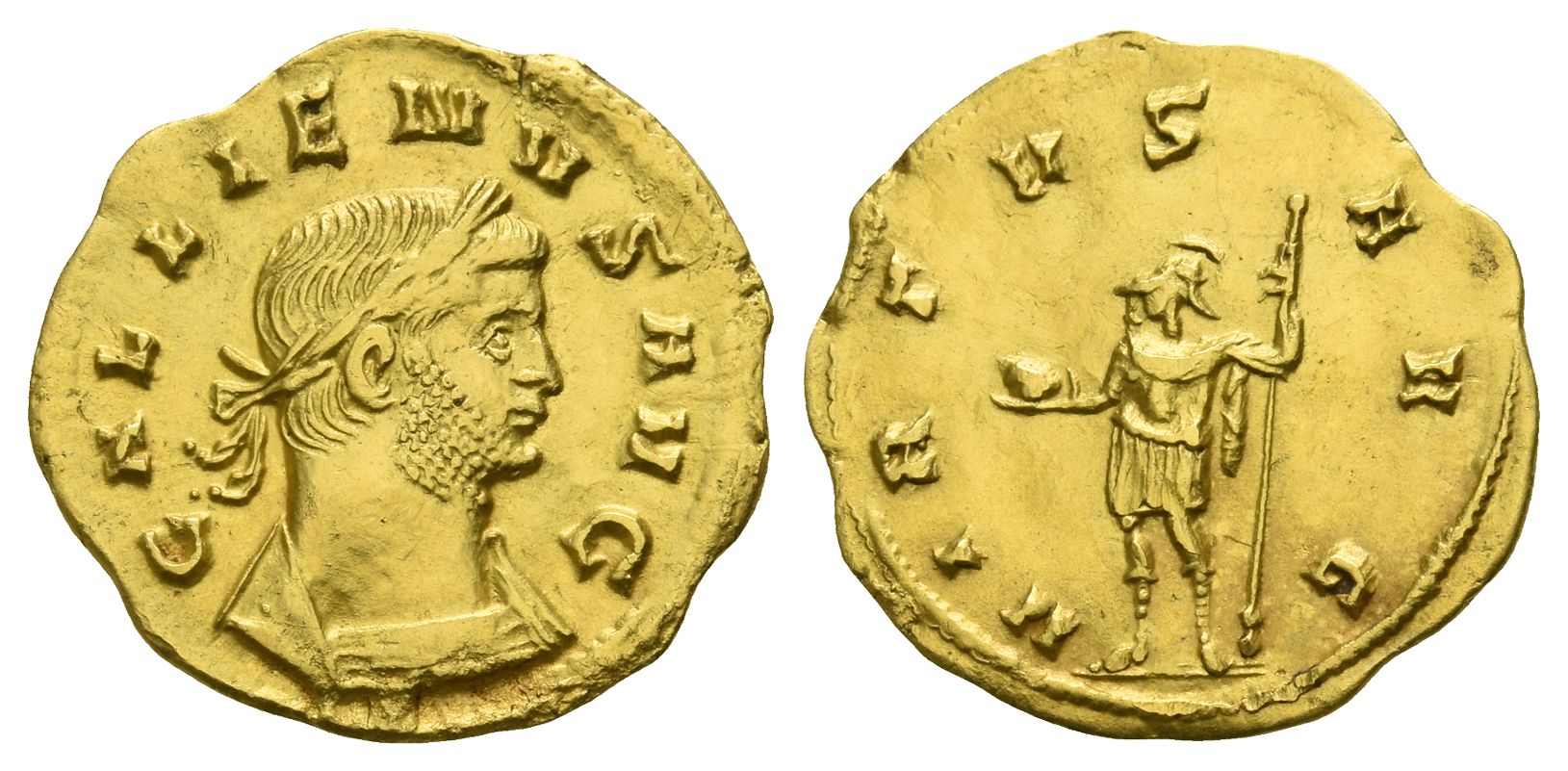
When a French team published proton-beam analyses of 164 Roman gold coins in 1985, they found aurei of Valerian and Gallienus ranging from 99 per cent pure down to 84, and one from Gallienus's sole reign as low as 66, the silver and copper probably from melted tableware. Gallienus's sole-reign aureus in the group weighs 2.70 grams, with Mars under VIRTVS AVG, and no other example has come to auction in at least twenty years.
Why are so many Roman gold coins holed?
Of the aurei Bland counted, five of 110 coins of Commodus are pierced and 51 of 186 of Decius. Inside the empire people preferred to set an aureus in a gold frame, as in a necklace in the Metropolitan Museum that hangs two coins of Severus Alexander on a triple chain.
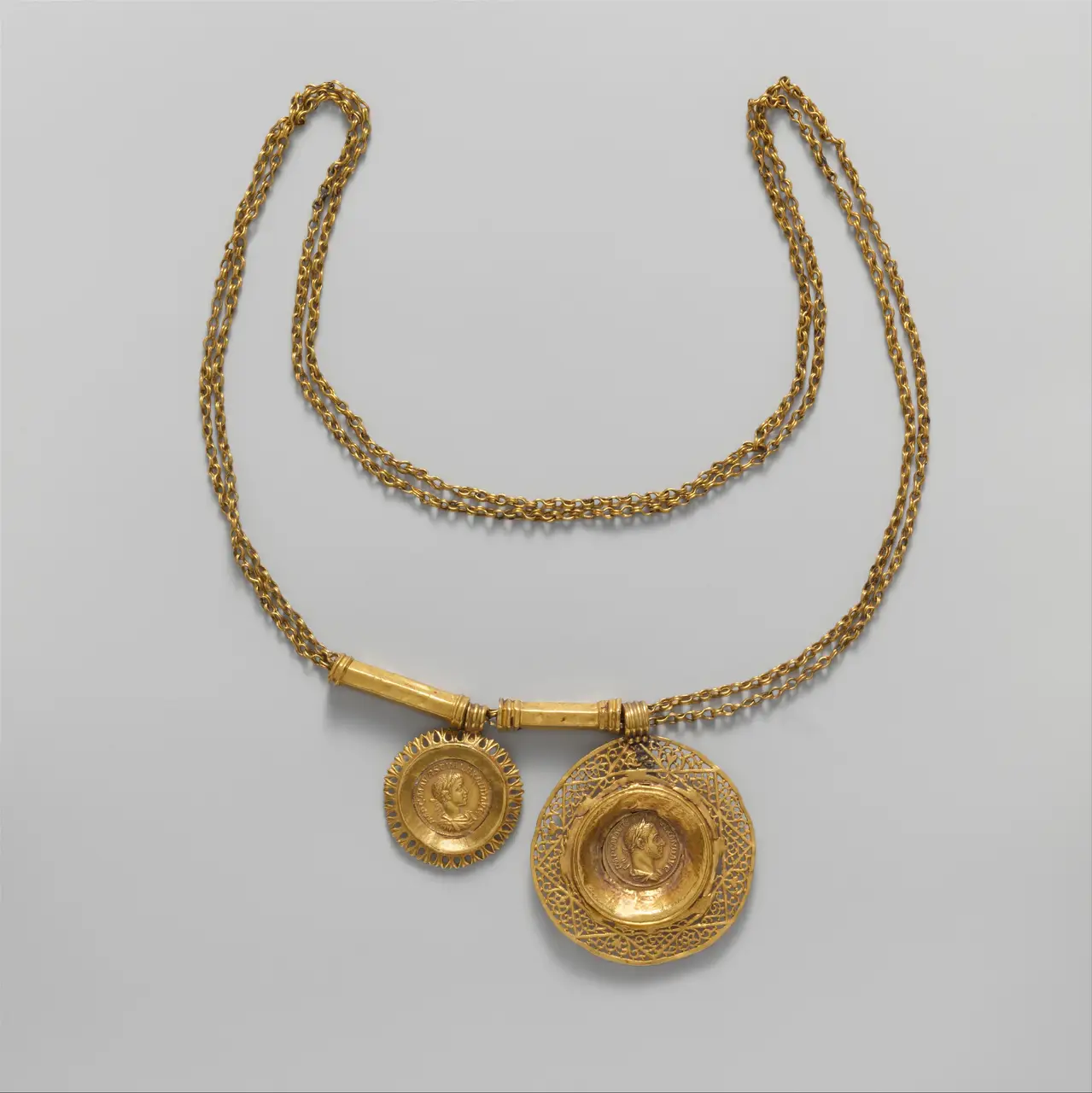 Gold necklace with two coins of Severus Alexander set as pendants, third century AD. Metropolitan Museum of Art, New York, 17.190.1655, gift of J. Pierpont Morgan, 1917. Public domain (CC0), via Wikimedia Commons.
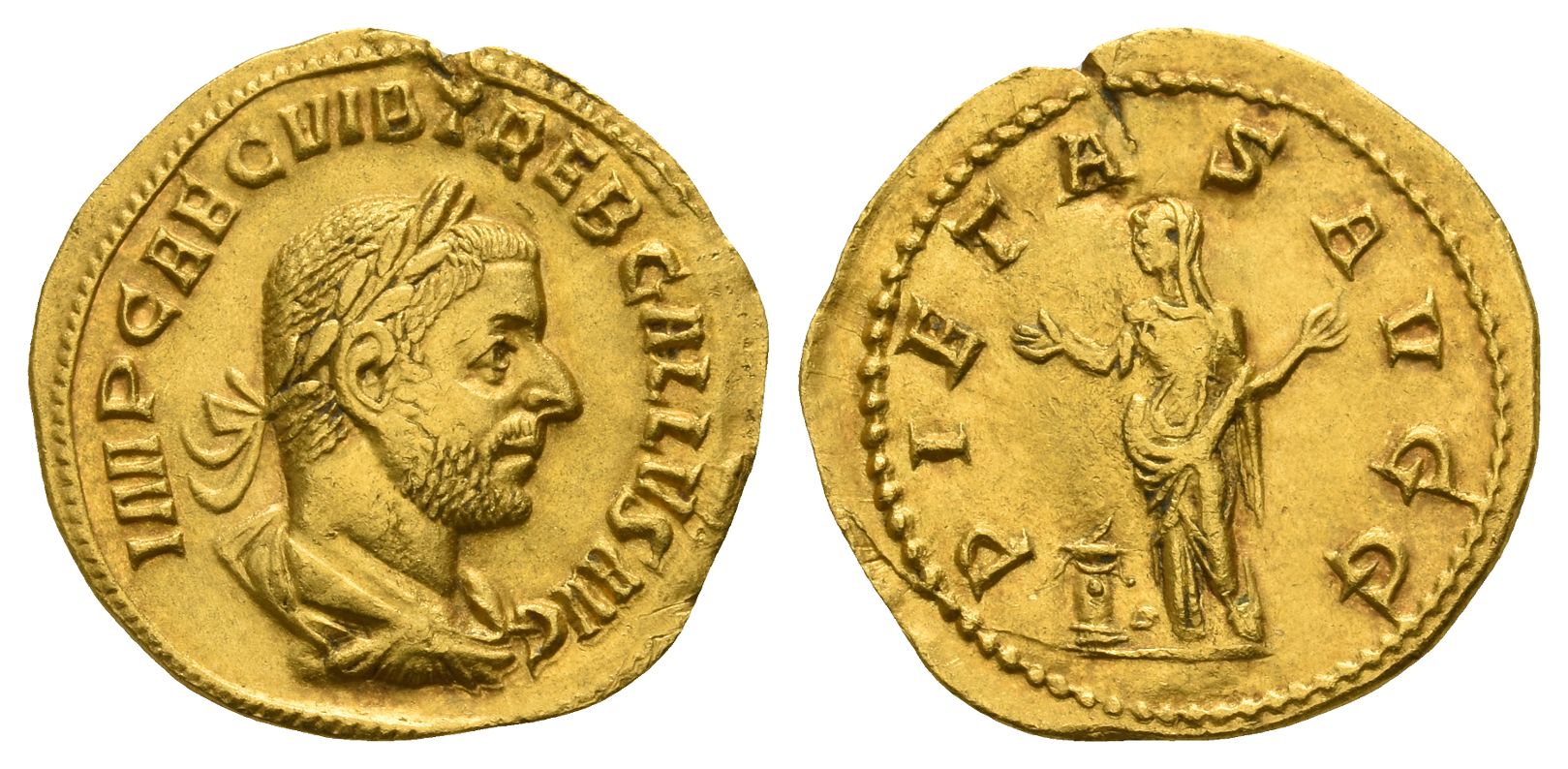
Beyond the frontier, in Gothic lands in what are now Poland and Ukraine, Bursche and Myzgin found that 83 per cent of recovered aurei have a hole, punched above the emperor's head so that the portrait hung upright, perhaps as a badge of the victory at Abritus. Both plugged coins in the group date from the early 250s, the extremely rare aureus of Herennius Etruscus as Caesar and a Gallus of 3.19 grams repaired above the emperor's head, an exceptionally rare variety with an altar at the feet of Pietas.
The heavy aureus of 281
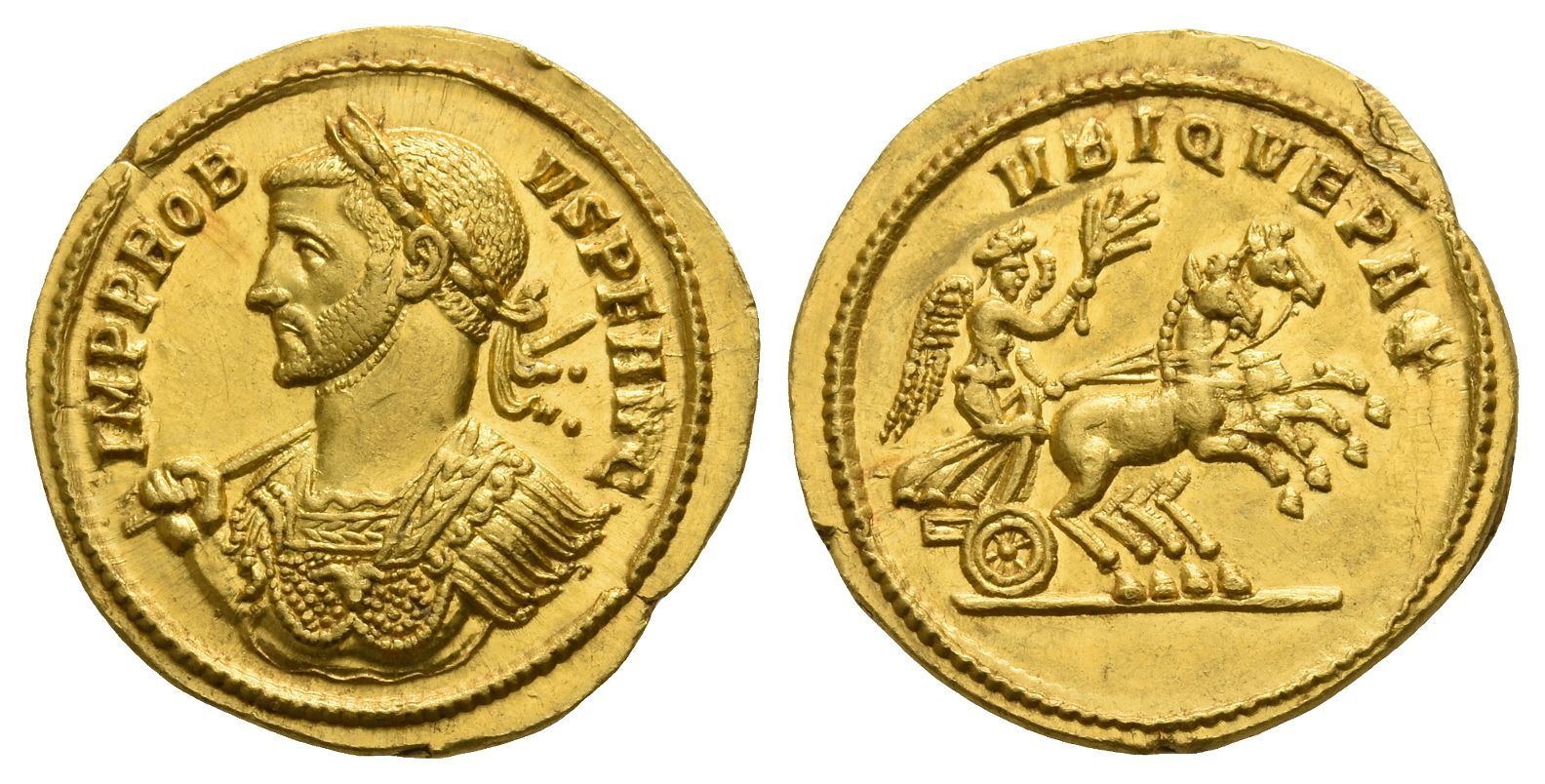
Aurelian brought the aureus back in 274 to about 6.45 grams and 98 or 99 per cent gold, and his successors kept the heaviest coins for special distributions. Probus's 6.69-gram aureus in the group was struck for his triumph at Rome at the end of 281, and on its reverse Victory drives a galloping chariot under VBIQVE PAX, "peace everywhere". Very few are known, and in 282 his troops killed him at Sirmium, the city of his birth, where he had set them to drain the marshes.
What is a Roman gold coin worth?
At about £95 a gram, the spot price in early November 2026, the Commodus holds just under £700 of gold and the Valerian about £215, a small part of their estimates, which reflect the Commodus's Mint State and the Valerian's rarity. All sixteen sell in the Numismatic Sale on 8 and 9 December with the rest of the collection, which runs on into the solidi Constantine fixed at seventy-two to the pound around 310. A solidus of Honorius struck at Milan around 400 weighs 4.40 grams, one of Zeno from Thessalonica 4.39, and one struck for the Ostrogothic king Athalaric in the 530s 4.40. Solidi survive in quantity, 569 of them in the Hoxne hoard alone, so the Honorius, with nearly twice the Valerian's gold, costs far less.
