
How to Tell If an Ancient Coin Is Fake, and Why Romans Paid Extra for One
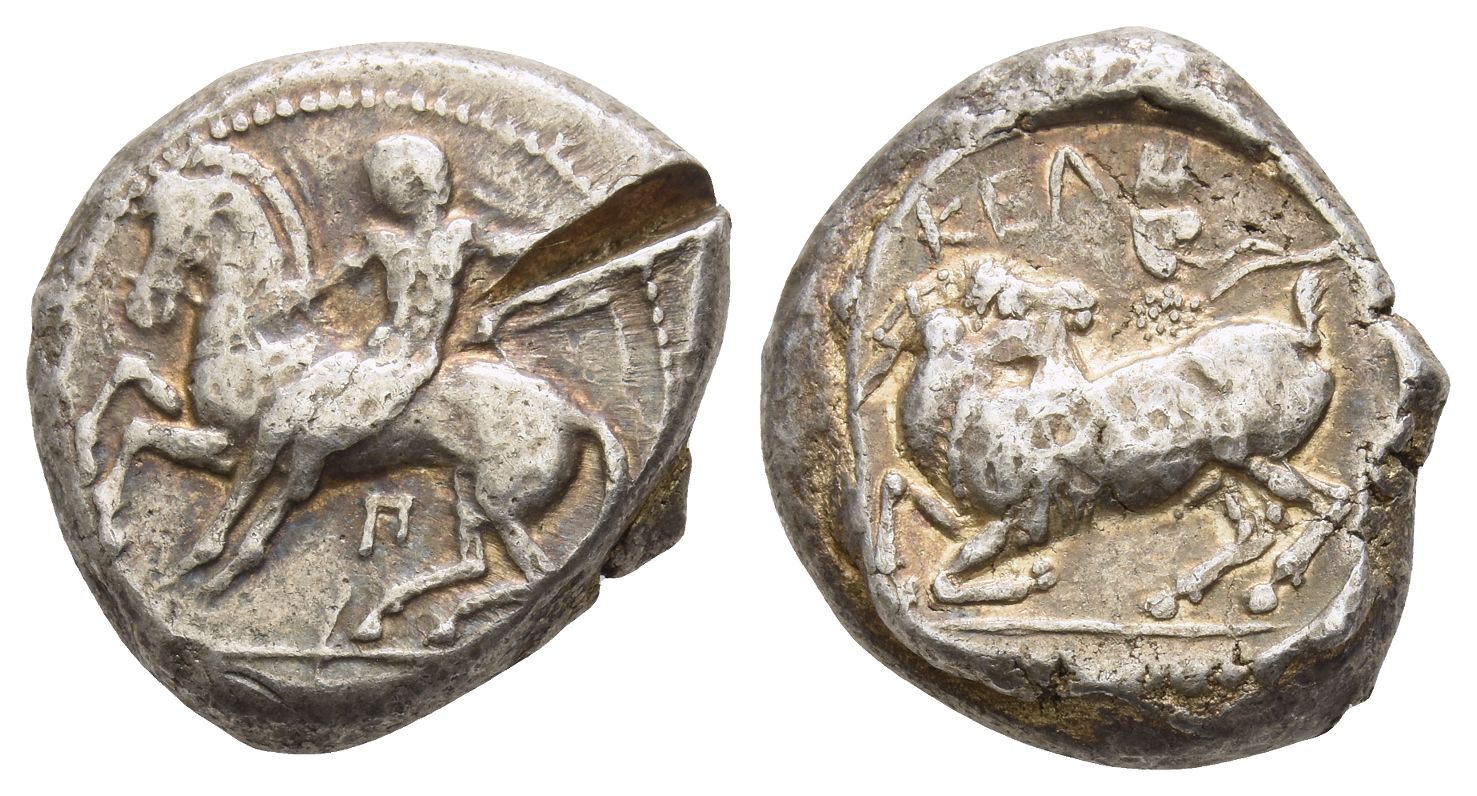
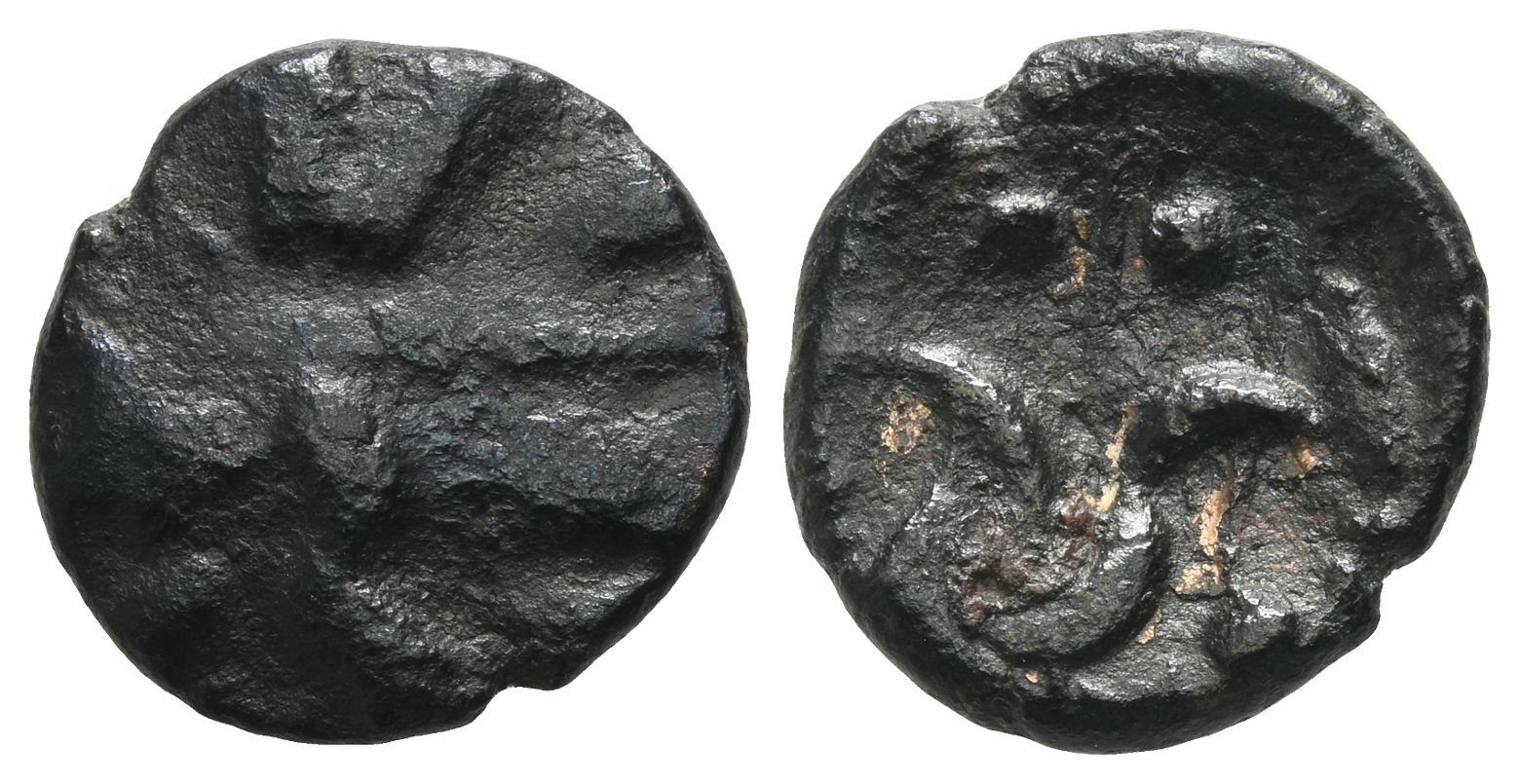
Someone in antiquity put a chisel to the edge of this silver stater and drove it in until the cut showed what lay underneath. The coin was struck around 430–420 BC at Kelenderis, a harbour town on the Cilician coast of southern Turkey. A naked youth slides off a rearing horse on one side, and on the other a goat kneels under the letters KEΛE. The cut found silver all the way in, and the stater has since taken on the dark tone of a coin long kept in collectors' cabinets.
A chisel is one of the oldest ways of testing whether an ancient coin was fake or genuine. A genuine coin weighs what its issue should, is the right metal all the way through, and was struck between dies unless it belongs to one of the few coinages that were always cast. Its dies match those of known coins, and ideally its history can be followed back through earlier sales. Athens wrote two of those checks into law in 375/4 BC, and by the first century AD Romans were paying more for a well-made forgery than for the coin it copied.
How Athens tested its coins in 375 BC
The law is known to us from a stone slab recovered from the Great Drain of the Athenian Agora. It ordered a public slave, the approver, to sit among the money-changers tables every day and accept Attic coin when it was silver and bore the public stamp. The work was open to briberyy, which is probably why it went to a slave, who could be whipped: "If the approver does not sit, or if he does not approve in accordance with the law, let the conveners of the People flog him with fifty lashes of the whip."
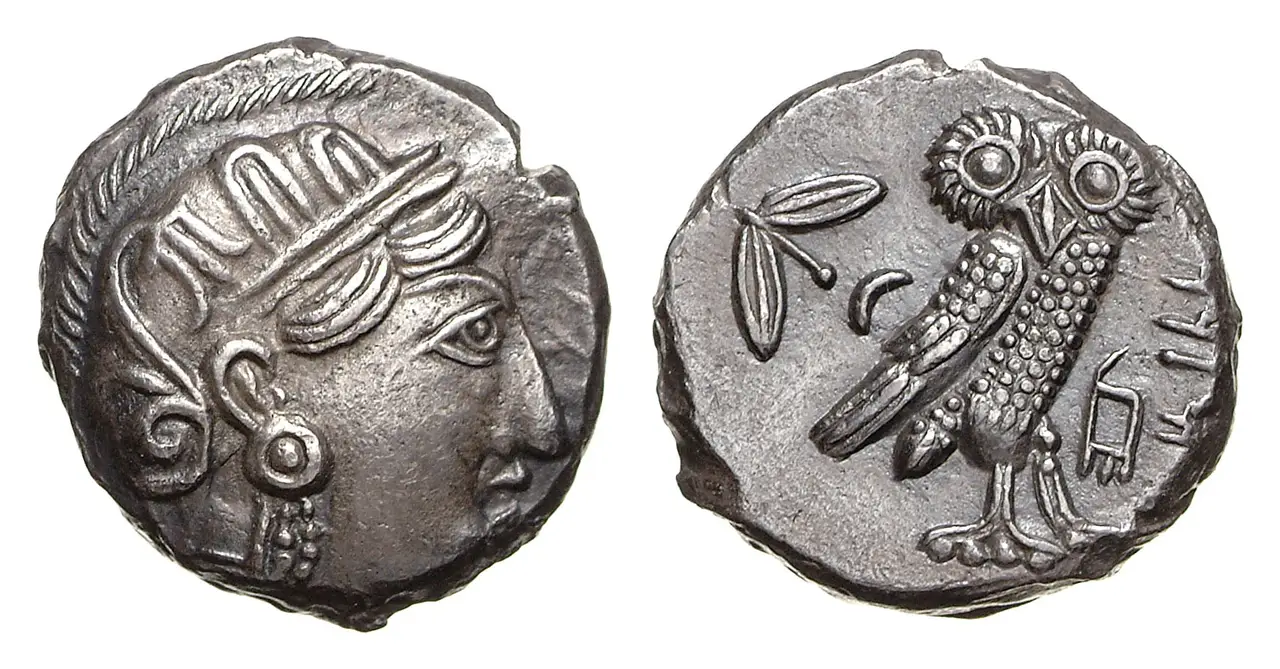 An imitation of the Athenian owl tetradrachm, struck about 350–300 BC, with Aramaic letters in the field beside the owl; 16.91 g. Münzkabinett der Staatlichen Museen zu Berlin, 18215050. Photo: Dirk Sonnenwald, Public Domain Mark 1.0.
Other states struck coins of the Athenian type, and the law dealt with those too. Foreign coins that proved to be good silver were test cut and handed back to their owner, with the kind of mark the Kelenderis stater carries. "But if it has a bronze or a lead core or is debased, let him cut it through immediately and let it be sacred property of the Mother of the Gods."
The law says nothing of how the approver found a bronze core under a silver skin. The fullest picture of a tester at work comes five centuries later, from the Stoic philosopher Epictetus, whose tester uses "sight, touch, smell, finally hearing; he throws the denarius down and then listens to the sound … as a result of his constant attention to the matter, he catches the tune, like a musician."
What does a real Athenian owl look like?
The standard Athenian silver coin was the tetradrachm, a four-drachm piece of about 17.4 g. The December sale has four of the classical type, struck between about 454 and 404 BC, three of them in good extremely fine condition and the fourth extremely fine (lots 3798, 3799, 3800 and 3801).
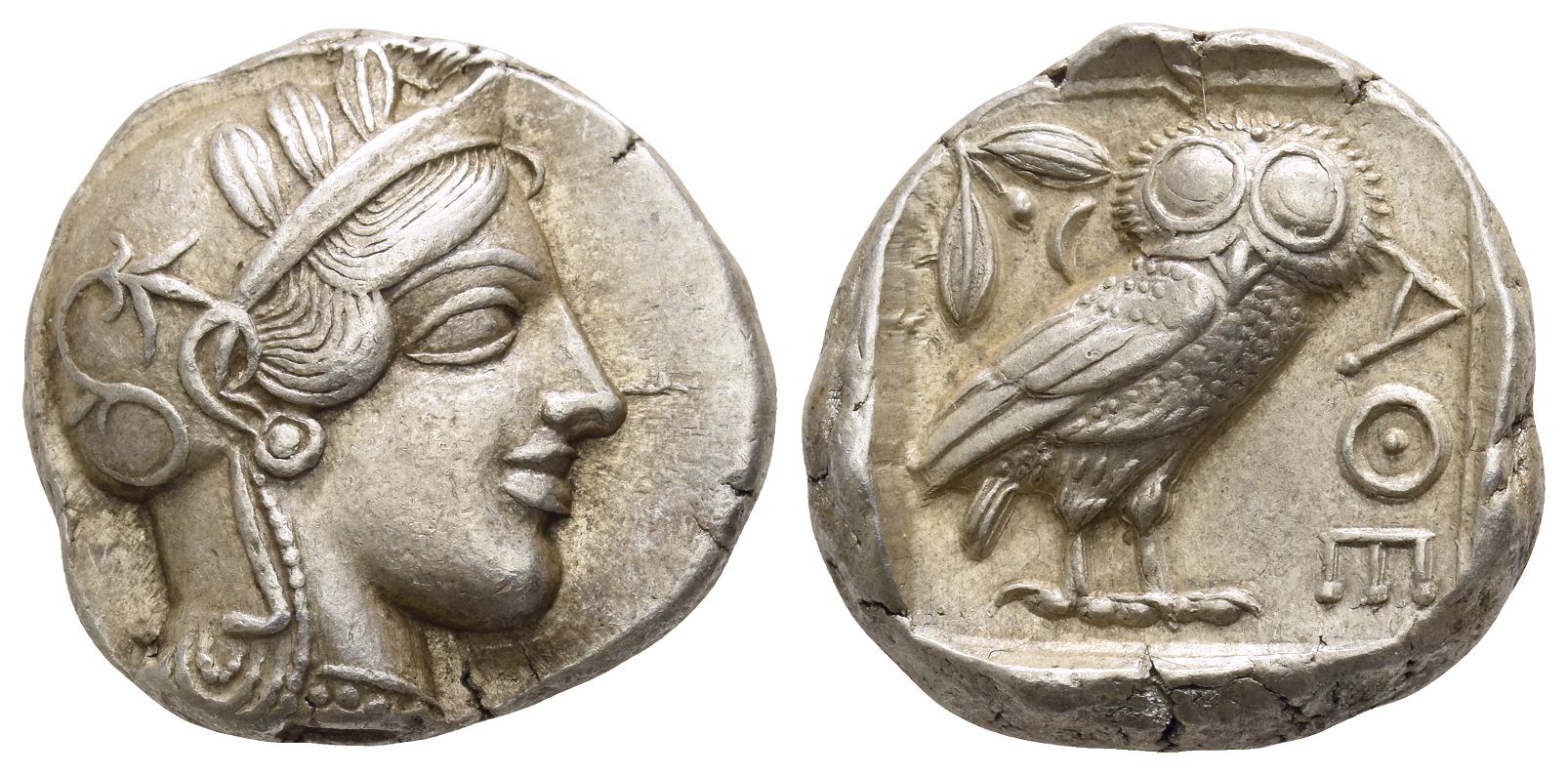
Athena wears a crested helmet with olive leaves above the visor, and her eye is drawn whole and almond-shaped, as if seen from the front, though her face is in profile. The owl stands beside an olive sprig, a crescent moon and the letters ΑΘΕ, inside a square sunk into the metal. On lot 3801 small cracks run in from the edge where the silver spread under the hammer, as it does on a coin struck between two dies. Turn the four over and the owl sits at 9, 1, 5 and 1 o'clock to Athena, because the Athenian reverse die was a punch held by hand, so this angle, the die axis, tells you something only once you know a mint's habits.
Some twenty hoards from Sicily to Iran hold about 20,000 of these coins between them, and many more hoards were never reported. A coin that travelled so far was widely copied, in versions that the numismatist John Kroll ranges "from the atrociously crude copies produced in the Arabian Peninsula to sophisticated imitations that can be hard to distinguish from authentic Athenian strikings".
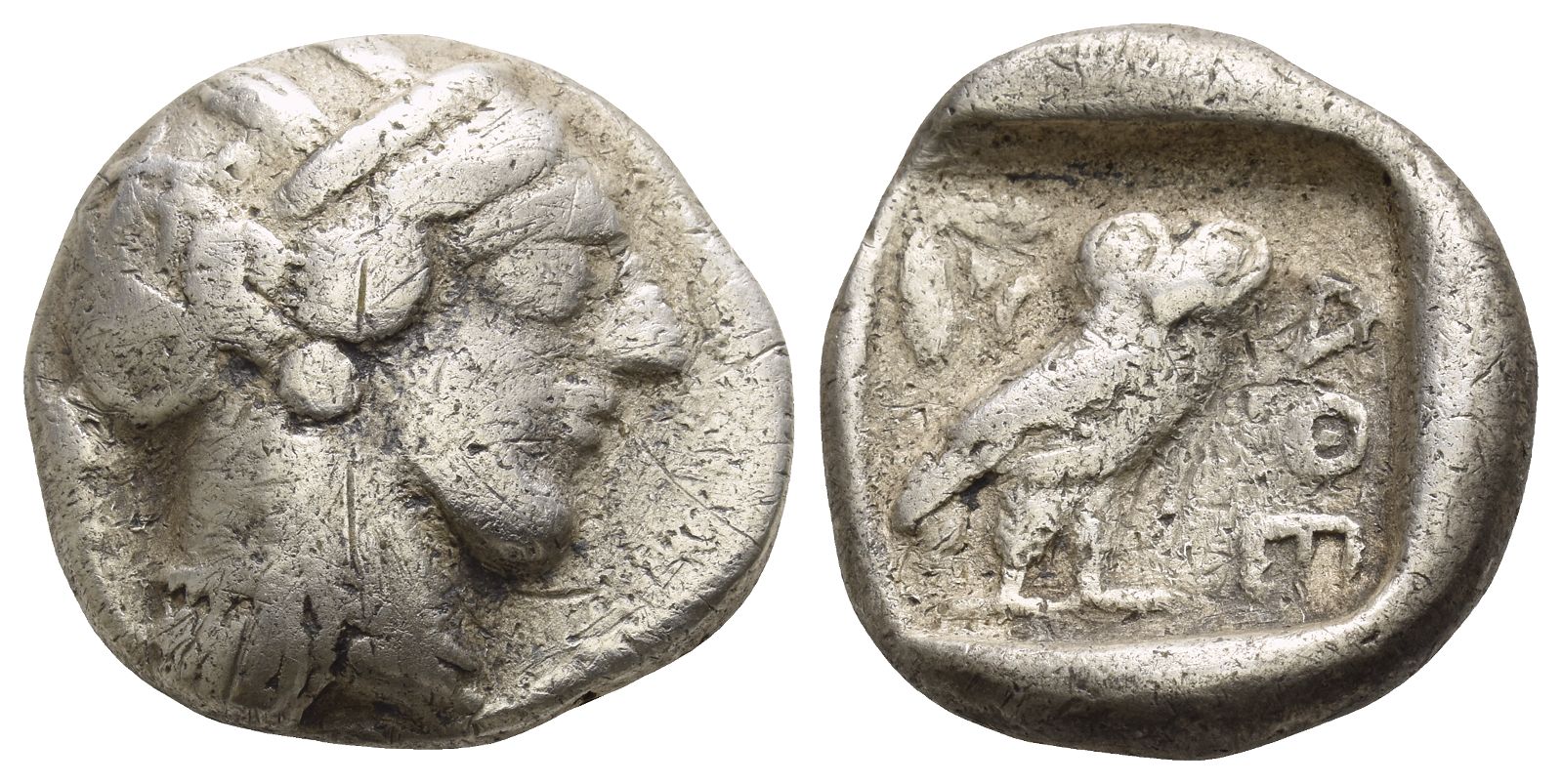
The sale's fifth owl, lot 3802, may be one of those copies. Athena's eye is drawn in profile and her helmet carries the palmette numismatists call pi-style, and the coin is an ancient owl whether it came from Athens or from one of the many mints that imitated her. Philistia, on the southern coast of what is now Israel and Gaza, made small silver of the same design on its own weight system, and lot 3921 is one of its imitations of Athens: an obol of about 353–333 BC with Athena and her owl on a coin nine millimetres across.
How to tell if an ancient coin is fake from its weight and metal
The Athenian law never mentions a balance, but weight is where a modern check usually begins. The old rule is that a coin noticeably too heavy cannot be genuine, while one that is too light may only be worn. The four classical owls weigh between 17.13 and 17.19 g, a shade under the 17.4 g standard and on the side of the line the rule forgives. Every mint kept its own standard, and Rome's changed over the centuries, so a weight means little until it sits beside the right figure in a reference work.
The law's "bronze or a lead core" describes a plated coin, a slug of base metal wrapped in silver foil, which can show a perfect face. Athens is generally thought to have struck some itself in the last emergency of the Peloponnesian War: in the Frogs of 405 BC Aristophanes set the city's old coins, "the only ones rightly struck and tested by ringing among Greeks and barbarians", against "these wretched bronze pieces" then in use.
The approver's tool was the chisel, and surviving Greek coins were quite commonly scored through to the core to see whether they were silver all through. The Kelenderis stater's cut is one of these, and another runs deep down the reverse of lot 3920, an extremely rare Philistian drachm of Gaza with the facing head of the god Bes.
Collectors, for obvious reasons, no longer take a chisel to a coin, and the stand-in is specific gravity, a measure of density found by weighing the coin in air and again suspended in a liquid. It does no damage, and it suits gold best, since silver and copper are too close in density to be told apart this way.
Lot 3720 is an uninscribed stater of the North-Eastern series, the Iron Age British coinage associated with the Corieltauvi, of about 50–20 BC, with a devolved head of Apollo and a disjointed horse. It is a fourrée, the collectors' word for an ancient plated coin, here gold over a base-metal core, and it weighs 4.10 g. Solid staters of its type in the British Museum weigh about 5.3 to 5.6 g, while two ancient forgeries found at South Ferriby in Lincolnshire weigh 4.67 and 4.68 g and are markedly less dense, as a base core under gold foil makes them.
X-ray fluorescence, the other common test, analyzes only the surface, so it cannot be used to determine whether a coin is genuine. Pottery has thermoluminescence to date its firing, but metal carries no such natural clock.
Struck or cast? Reading the surface of an ancient coin
Almost every Greek and Roman coin was struck, its design hammered into a blank between two dies. A forger without dies could press a real coin into clay and pour metal into the hollow, and casting leaves marks of its own. Air bubbles in the mould leave small beads of metal on the coin, which cannot appear on one stamped out of solid metal, and every coin from the same mould repeats them. Excavators at a Roman settlement near Doncaster picked out three ancient counterfeits by signs like these: a join line where the halves of the mould met, plating chipped around the edges, and two sides that never belonged on the same coin.
Some ancient money was always cast, and Olbia, the Greek city on the northern shore of the Black Sea, made its bronze in the shape of dolphins, generally produced in the form of a tree and joined at the tail. Lot 3809 is one of them, 40 mm long and in good very fine condition, with the letters APIXO on its flat side. Iron Age Britain and Gaul cast their potin units in high-tin bronze (lots 3708 and 3722). A seam or a soft surface tells you how a coin was made, and the question then is whether that was the right way for the coinage it belongs to.

Modern fake ancient coins, and why the die matters more than the surface
Carl Wilhelm Becker (1772–1830) would have satisfied the Athenian approver on both counts, since his copies of silver coins were struck in silver and bore the stamp. He cut his own dies and struck with a hammer as the ancient mints did, so no seam or bubble gives him away. To take the newness off, he shut the coins in a box of iron filings fixed to the axle of his carriage, which he called "taking his old gentlemen for a drive", and his diary records the habit again and again. The wear that excuses a light coin could be put on along the road from Homburg to Bonames and back, and his fakes can be told from originals only by close comparison with impressions taken from his own dies, 586 of which now belong to the Münzkabinett in Berlin.
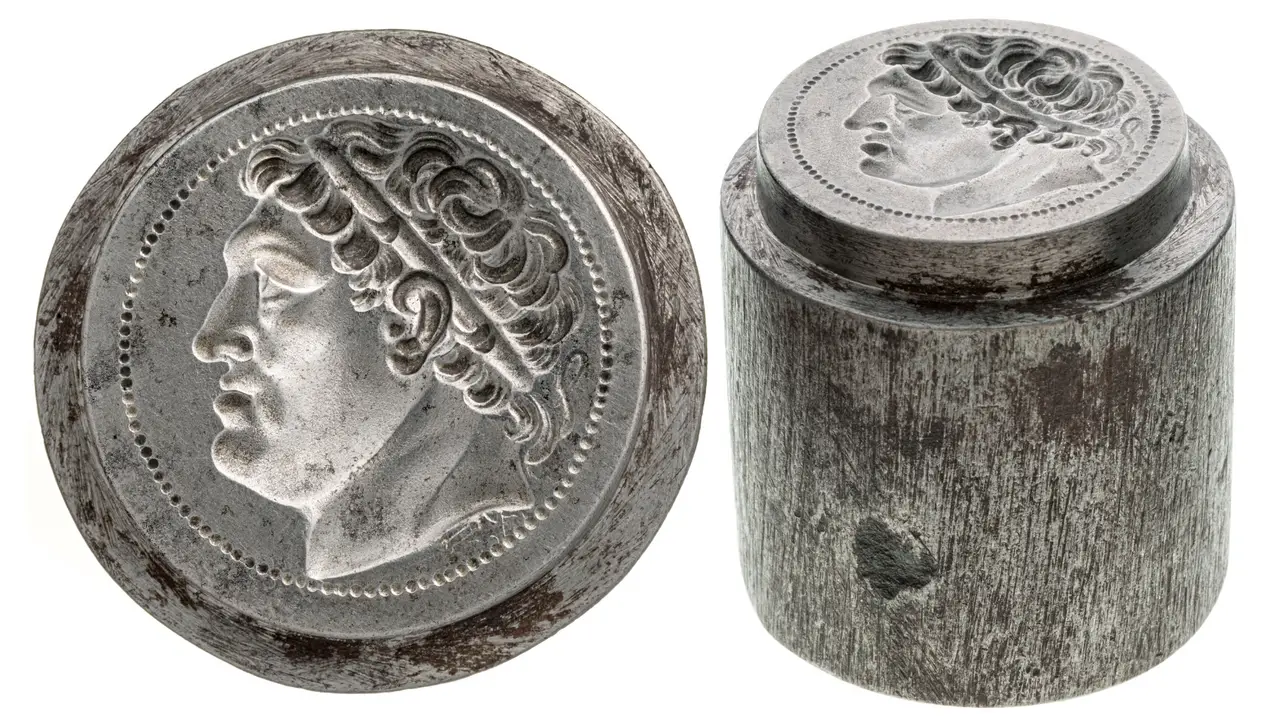 Becker's iron lower die for a coin of Eumenes I of Pergamon, its head of Philetairos cut in mirror image, begun on 25 August 1827 and finished on 1 September, by his diary. Münzkabinett der Staatlichen Museen zu Berlin, 18310715. Photo: Franziska Vu, Public Domain Mark 1.0, via Wikimedia Commons.
Ancient dies were cut by hand, so every die was individual, and a die study can tie a coin to the dies of known genuine coins or to those of a known forger. That is mostly specialists' work, and what any buyer can read is a coin's history: the Kelenderis stater comes from the Michael Higley Collection by way of a Roma Numismatics sale in November 2020, and the four classical owls were all in Roma sales of 2022.
Why Romans paid more for a fake: fourrées and plated denarii
Pliny the Elder, writing in the first century AD, recorded an oddity of the forger's art, that in this field alone "spurious methods are objects of study, and a sample of a forged denarius is carefully examined and the adulterated coin is bought for more than genuine ones". A forgery had become a specimen, and collectors would give several good denarii for one.
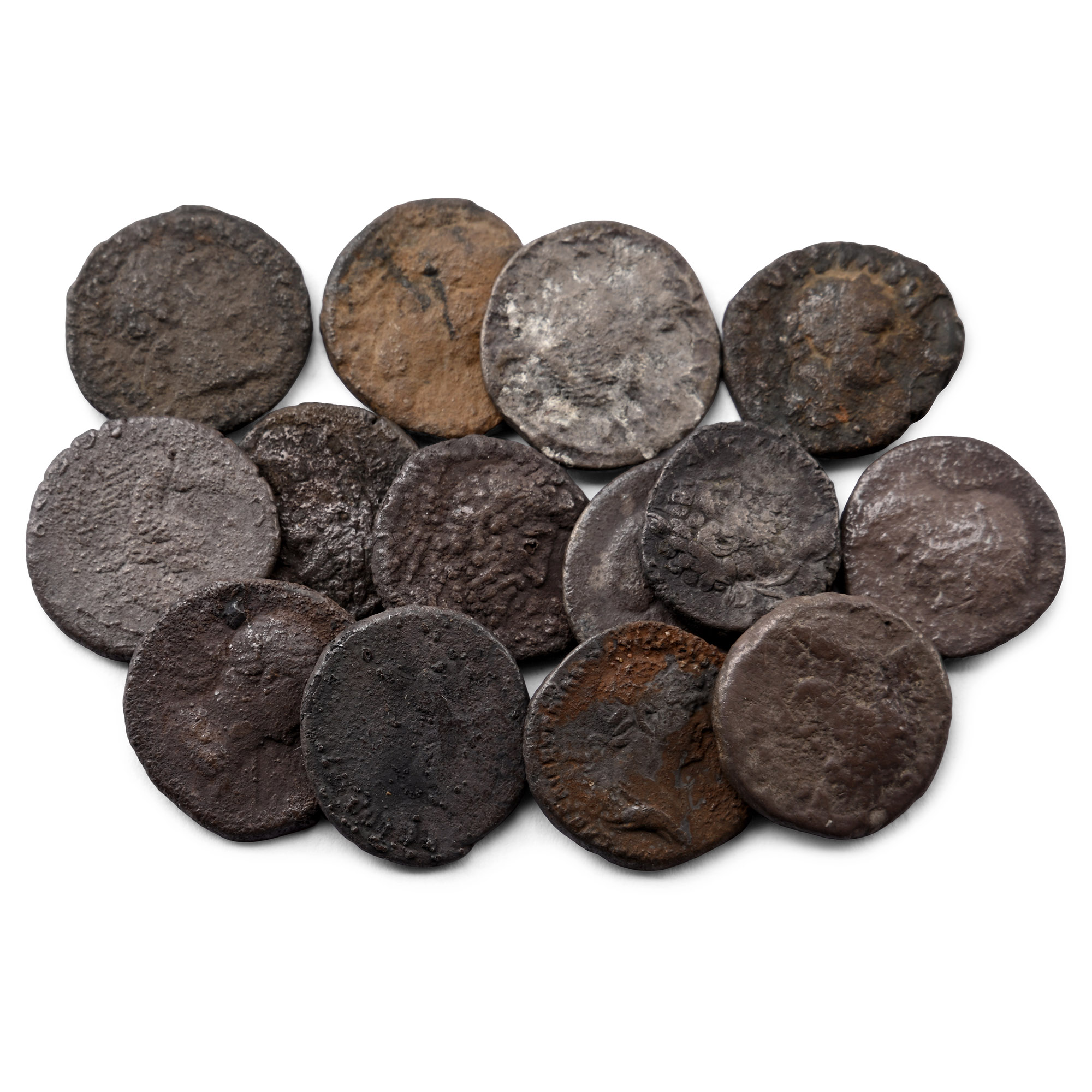
Lot 4567 is a group of fourteen denarii of various emperors, silver and plated together and left in the condition in which they were found. It is the mixture that made Trimalchio, in Petronius' Satyricon, rank the money-changer's among the hardest trades in the world, "because he sees the copper under the silver", and it gives a buyer fourteen coins to practise on.
Coins made to pass for something better are now genuine antiquities in their own right, and they sell as what they are, at prices within a modest budget. At TimeLine in 2026 a fourrée denarius of Nero Claudius Drusus, possibly a British imitation, made £312, and a Romano-British imitation of a denarius of Claudius made £598.
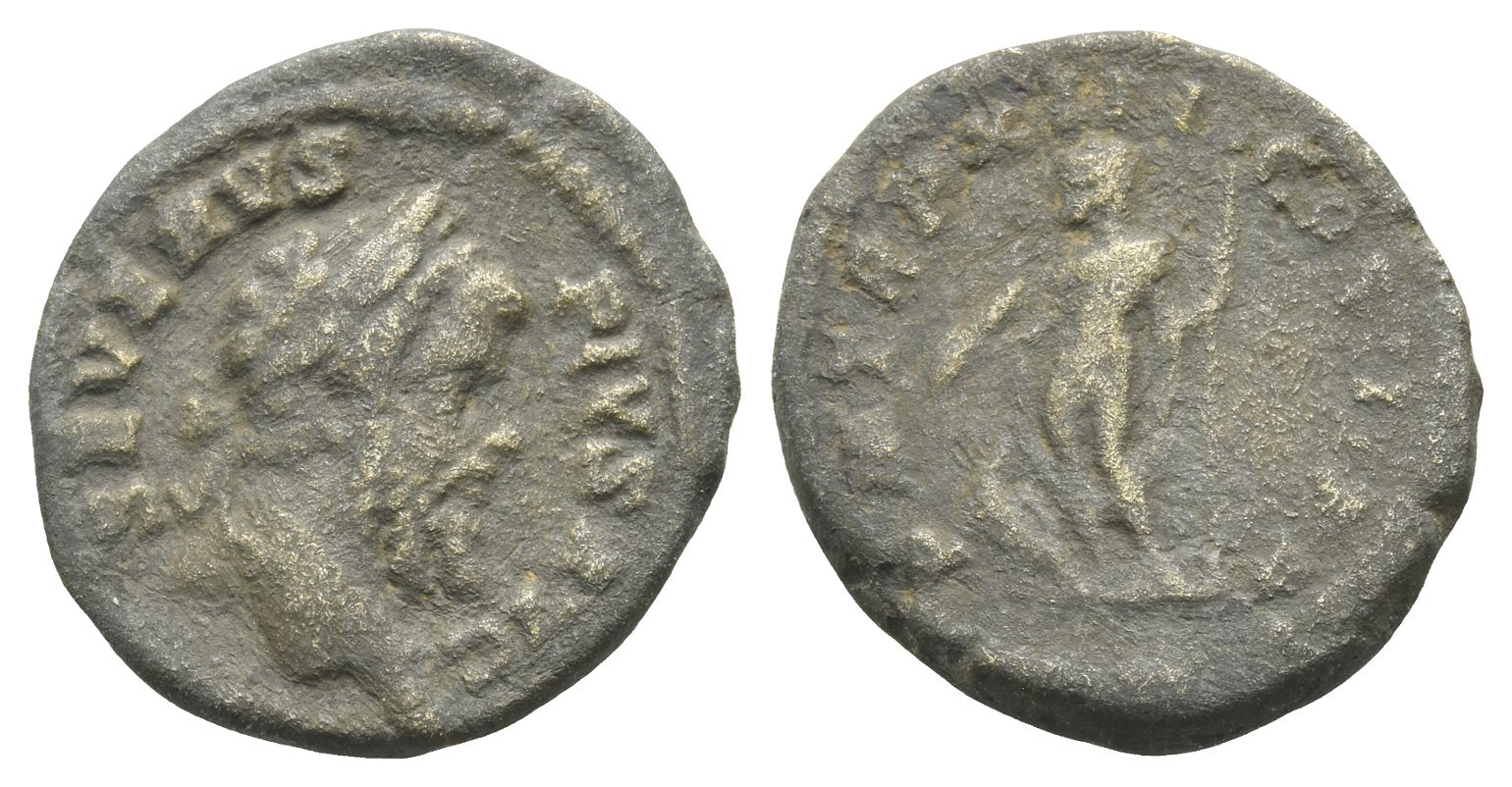
Lot 4101 is a "limes denarius" of Septimius Severus, named for the limes, the Roman frontier: a bronze copy of his silver denarius of AD 205, with Jupiter holding thunderbolt and sceptre and an eagle at his feet. Such copies were minted on the fringes of the empire out of necessity, and they may have been officially sanctioned for regions where unrest made it hazardous to ship silver, a kind of military scrip that kept precious metal out of enemy hands if a battle was lost.
Roman coin forgers' moulds
When Rome stopped striking bronze in the old quantities at the end of the second century, the need for small change remained and forgers supplied it, casting copies in clay moulds that have been found from Shropshire to the Ardennes, several thousand of them at Trier alone.
Lot 1023, one of twenty-two forgers' moulds in the sale, is a disc of clay 28 mm across, of the third or fourth century AD, with the impression of a coin on each face. On one, a bust in a radiate crown, the spiked headdress of the third-century double denarius, sits inside a raised rim with its legend running backwards around it. Everything on a forger's mould is in mirror image, so that whatever was poured into it came out the right way round.
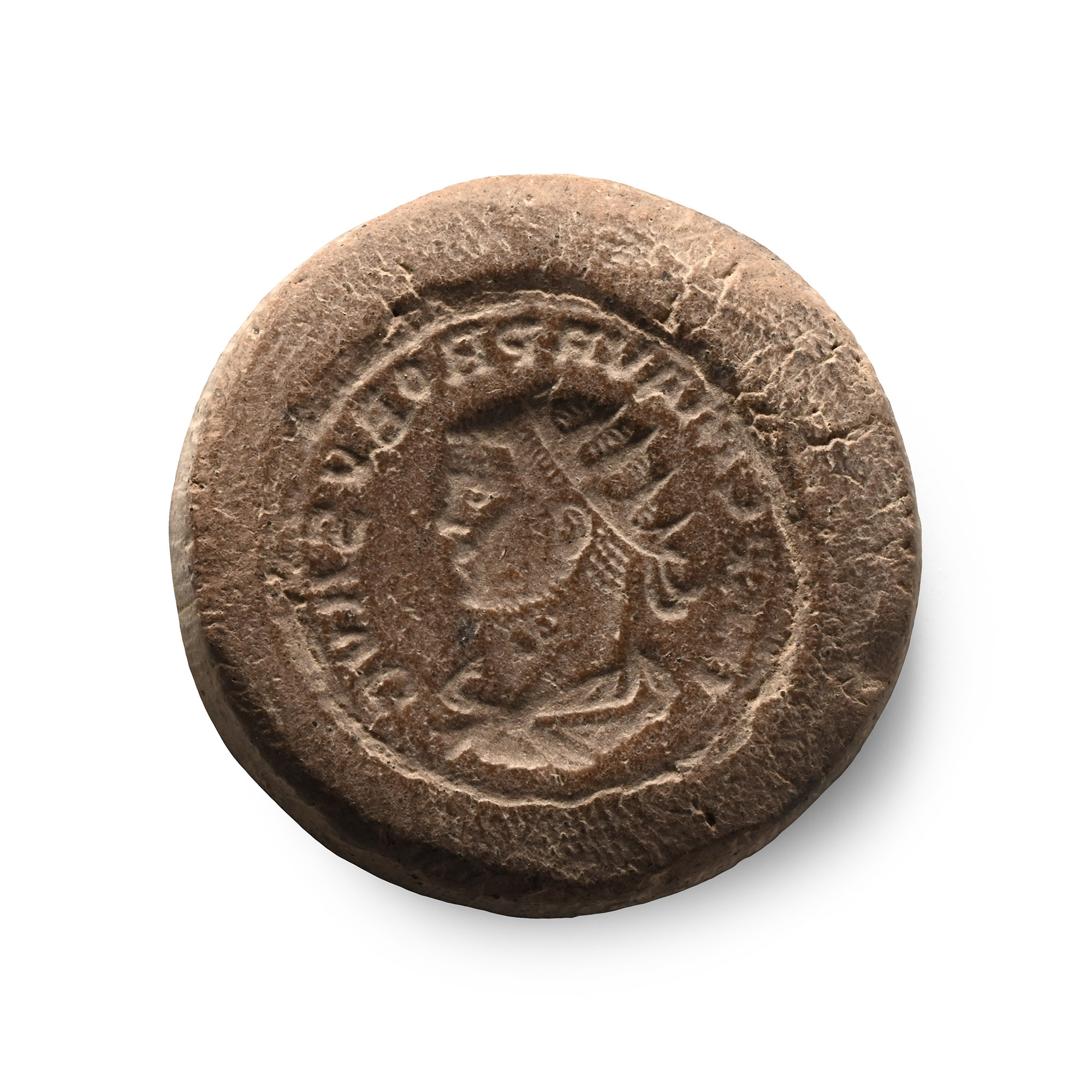
Real coins were pressed between discs of soft clay, so that each disc took one coin's face on one side and the next coin's on the other. The discs were stacked and packed in a clay casing, and metal poured down a central channel ran into each pair of impressions through a notch in the edge, ten to twelve coins to a stack. Among lot 1023's neighbours in the sale, lot 1115 took its impressions from a coin of Constantine, which carries the practice into the fourth century.
On 4 June 1747 Henry Baker, a Fellow of the Royal Society, showed the Society five clay moulds of Roman coins, thinking the Fellows would like "to see Specimens of so great a Curiosity". Four had been dug out of sand at Ryton, five miles from the Roman town of Wroxeter in Shropshire, each "of the Size of a Roman Denarius, and little more than the Thickness of our Halfpenny", with impressions of Septimius Severus, his wife Julia Domna and their son Caracalla.
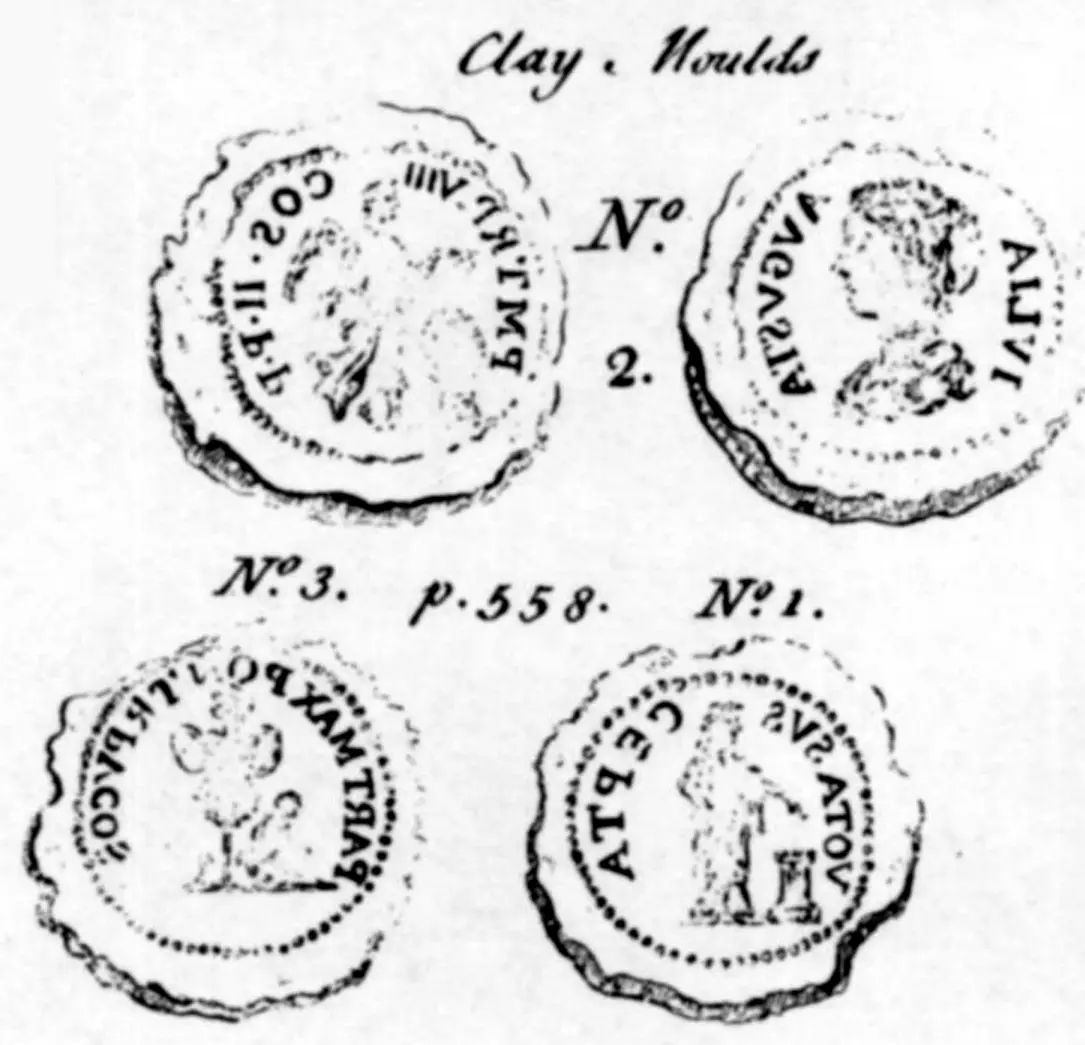 Henry Baker's engravings of three of his Shropshire moulds, one shown on both faces, with the legends of Septimius Severus, Julia Domna and Caracalla in mirror image; Philosophical Transactions of the Royal Society, 1747. Public domain, via Wikimedia Commons.
Baker also recorded what had become of the rest: "Great Numbers of these were found, but, for want of Care, most of them were broke in Pieces." Each of the twenty-two in the December sale still carries the impression of a coin on both faces.
TimeLine Auctions
