
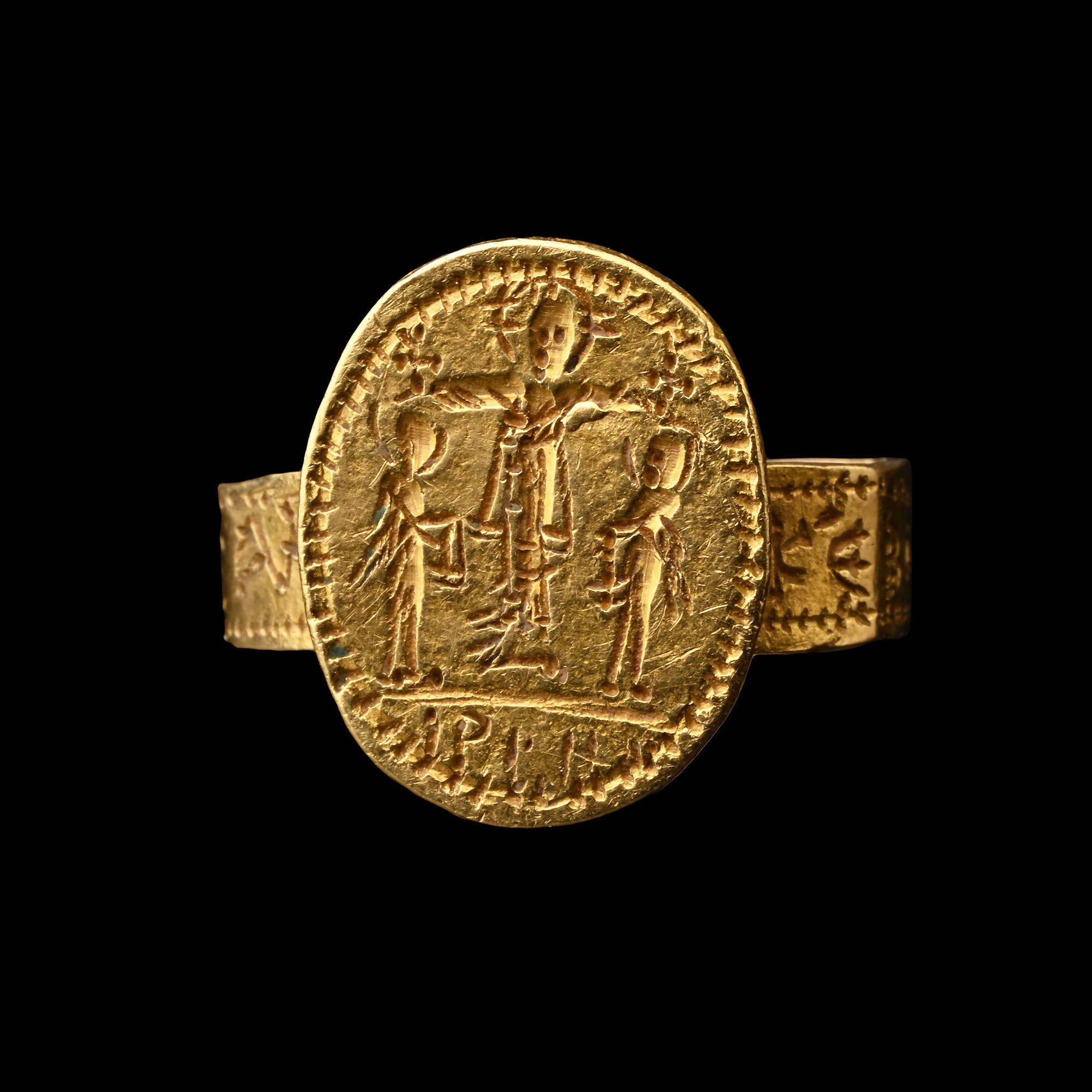
At the top of the bezel is a bearded Christ, a cross set in his halo. Two small winged angels kneel in the lobes to either side, below him a cross stands between a man and a woman in beaded caps, and in the bottom lobe are four letters: ΥΓΙΑ, hygia, "good health". The ring is seventh-century gold, weighs 22.45 grams, about as much as five solidi, the gold coin of the Byzantine state, and is lot 207 in TimeLine's December sale.
It leads seventy-seven Byzantine lots in the sale (lots 197-221 and 1396-1447) from the collection of Kal Noselson, a New York collector who passed away in 2014, most of them rings and many carrying a name, a prayer or a wish for the wearer.
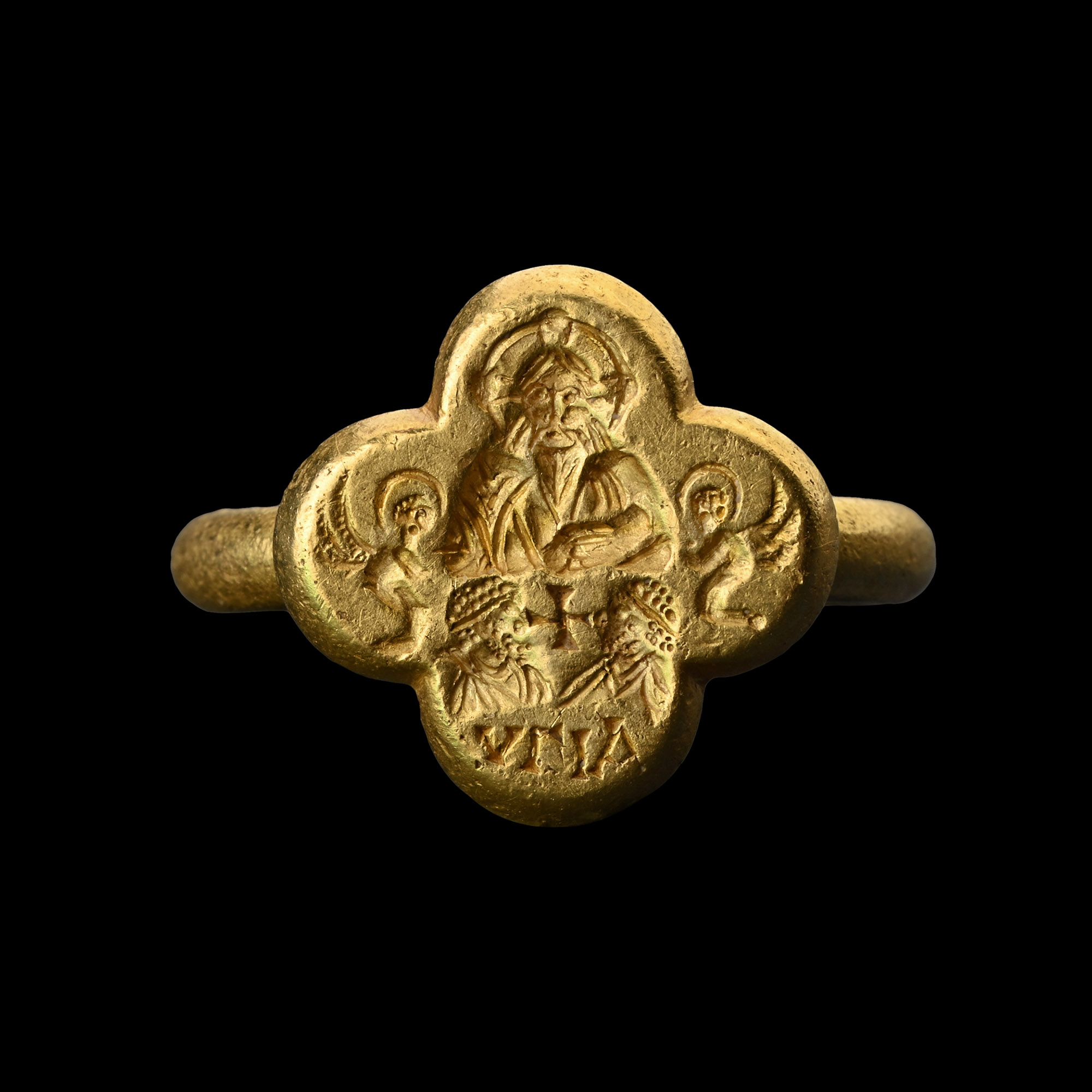
A bride and groom blessed by God is the usual Byzantine marriage scene, but kneeling angels are rare on marriage rings, and the word beneath the couple is usually ΟΜΟΝΟΙΑ, homonoia, "harmony", as on lot 226 in the same sale.
Why would a Byzantine marriage ring wish the couple health?
Under Justinian's laws a marriage left childless by impotence or disease could be ended by divorce, and Dioscorus of Aphrodito, a sixth-century poet in Upper Egypt, closed a wedding song for a couple called Paul and Patricia by asking for "a life quite without illness" and picturing the pair "as they hold children on their laps". The art historian Gary Vikan read hygia and homonoia as two requests for a marriage with children, so either word could go beneath the couple.
The gold jewellery found at Mersin in southern Turkey, now in the Hermitage, seems to have belonged to one family. Its largest necklace hangs on twenty gold discs, each with a couple either side of a cross and ΥΓΙΑ beneath, and a belt buckle carries the monogram ΚΥΡΙΕ ΒΟΗΘΕΙ, "Lord, help", both of which turn up again on the Noselson rings.
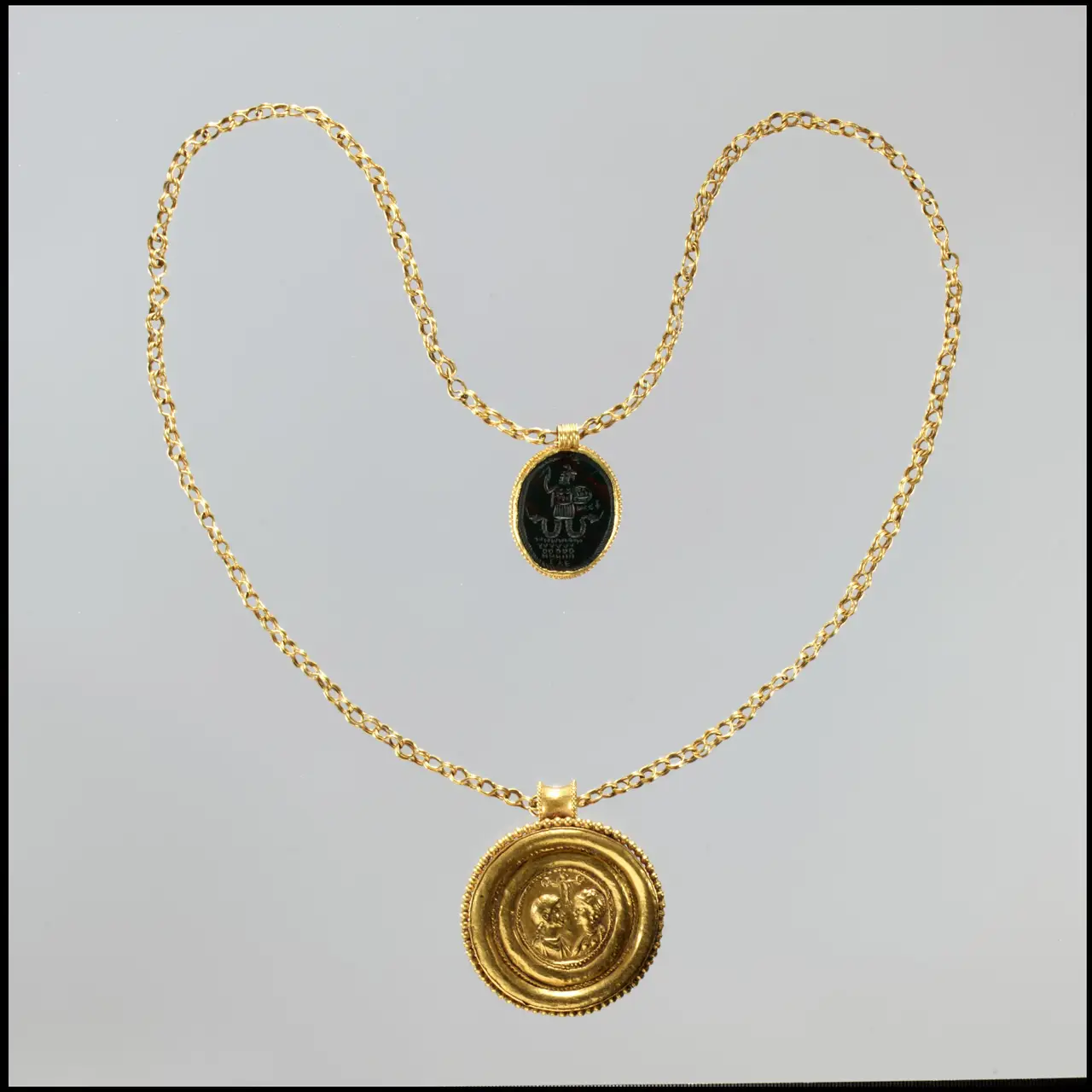 A Byzantine necklace in the Metropolitan Museum of Art, New York (58.12): a gold marriage medallion of about 400-450, found in Rome, with a second-century hematite amulet perhaps added for its healing powers. Public domain, via Wikimedia Commons.
Rings, crowns and the Byzantine wedding
On the Metropolitan Museum's medallion a small Christ holds a wreath over each head of the couple, in the place the goddess Concordia had once taken between a Roman husband and wife. The preacher John Chrysostom called wedding crowns "a symbol of victory, betokening that they approach the marriage bed unconquered by pleasure", and by the tenth century a crown could be a plain metal band like the pair in Athens, one inscribed ΚΕ ΒΟΗΘΗ, "Lord, help". On the marriage rings of the sixth and seventh centuries Christ blesses without crowning, and lot 207 has no crowns at all.
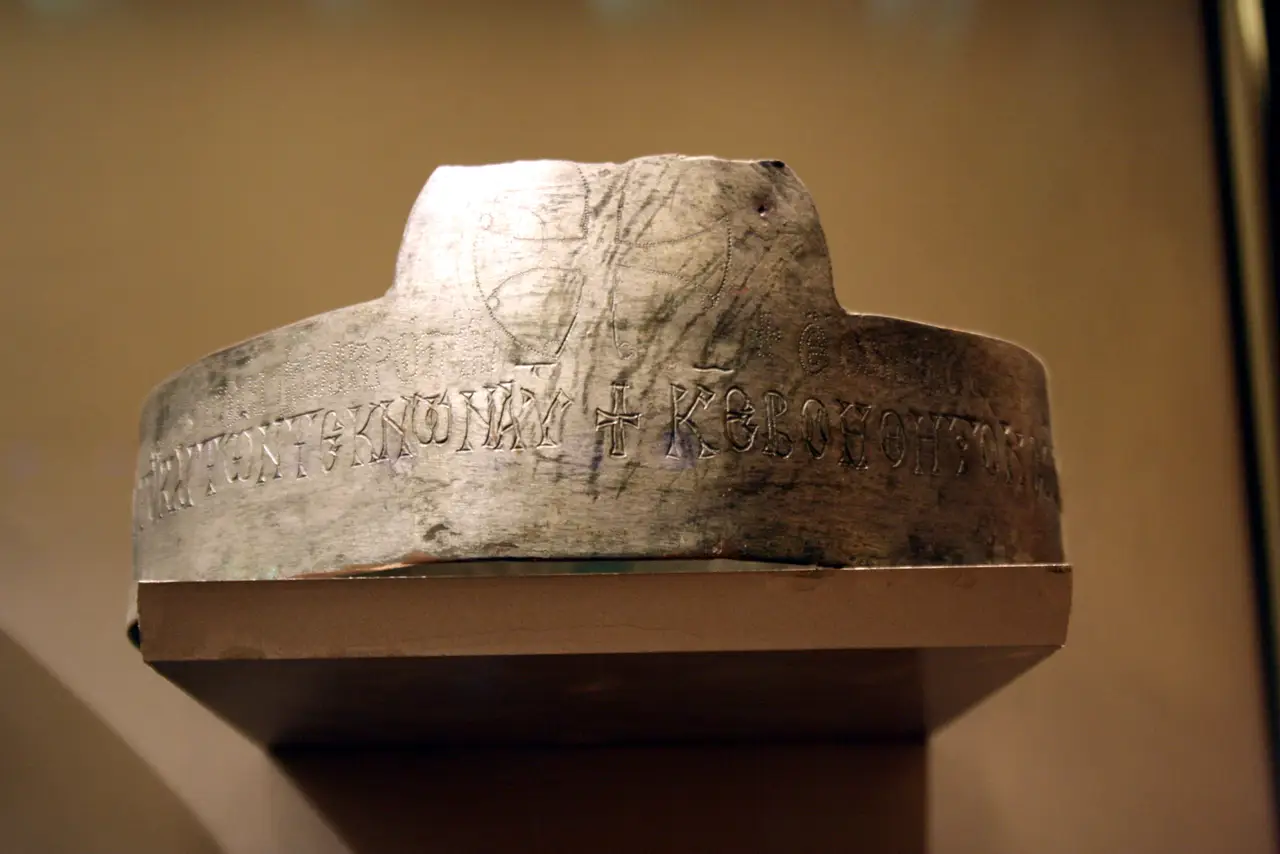 One of a pair of tenth-century wedding crowns in the Byzantine and Christian Museum, Athens. Photo: Giovanni Dall'Orto, via Wikimedia Commons.
A betrothal ring in the collection Eleni Stathatos formed in Athens names both parties, "I, Goudeles, give the betrothal ring to Maria", but no known ring with the couple and the cross names them, and the few rings that name a husband and wife together are prayers: "Lord, help Basil and Anna".
How to read the name on a Byzantine ring
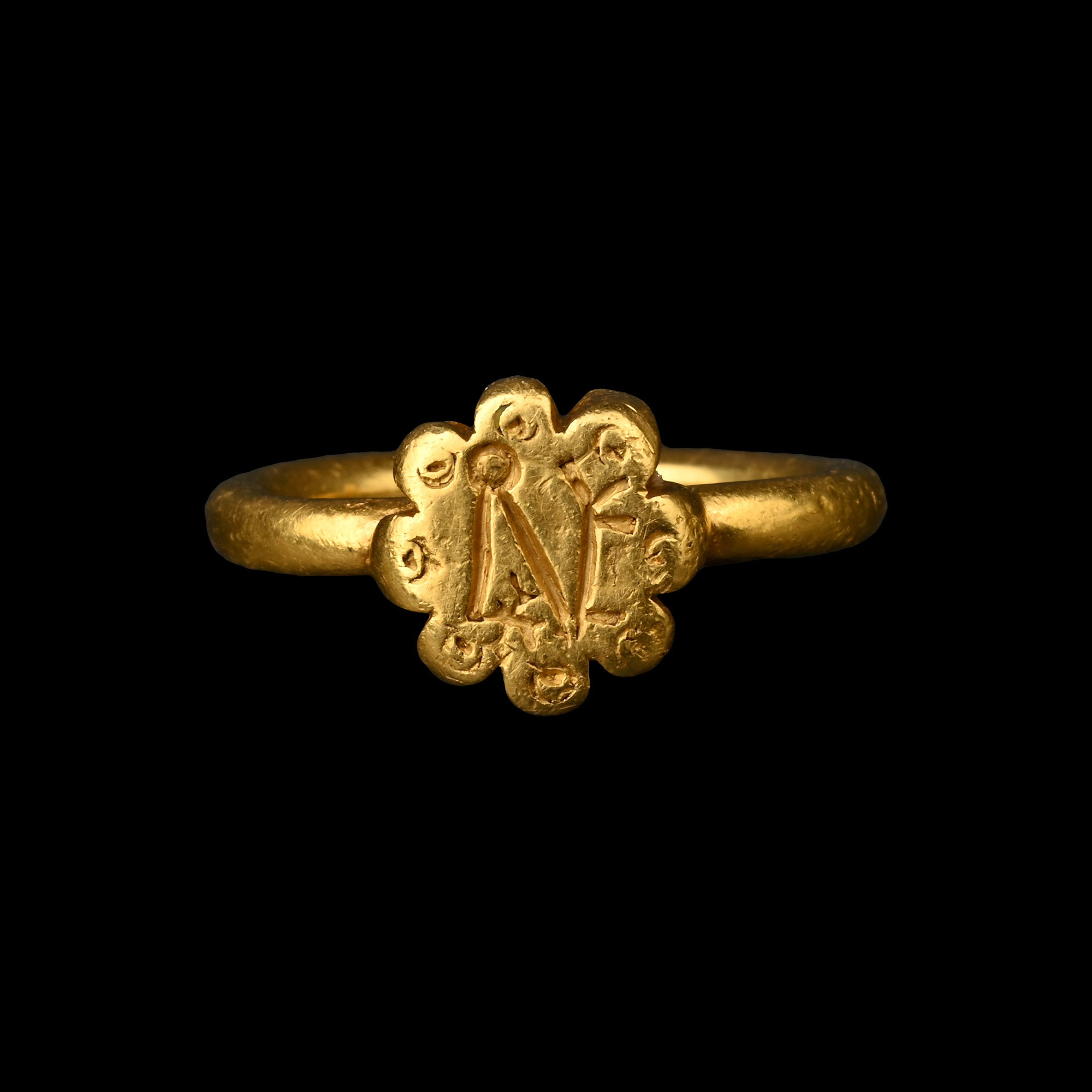
Most of the names on the Noselson rings are in the genitive, the case of possession, so a ring says "of Nikos" as a seal says "[the seal] of Nikos". Lot 200, at 14.74 grams one of the heaviest gold rings in the collection, sets the monogram ΝΙΚΟΥ, "of Nikos", in a rosette-shaped bezel, its letters hung on one or two strokes for the reader to find.
Lot 214 reads "of Iohannes" and probably belonged to the consul of that name, a high imperial official, and lot 199 has ΕΛΙϹϹΕΟΥ, "belonging to Elisseus", inside a border of black niello waves. Byzantine lead seals named their owners the same way until the early eighth century, when the wording became a prayer, "Mother of God, help your servant N.", and the Noselson rings have both.
"Lord, help": the Byzantine rings that pray
Κύριε βοήθει, "Lord, help", is found almost everywhere in Byzantine inscriptions, even over the doors of Syrian houses, and on lot 203, a slender gold ring of 2.08 grams, it fills the bezel in three lines, spelled as it sounded: "Lord, help Anastasius".
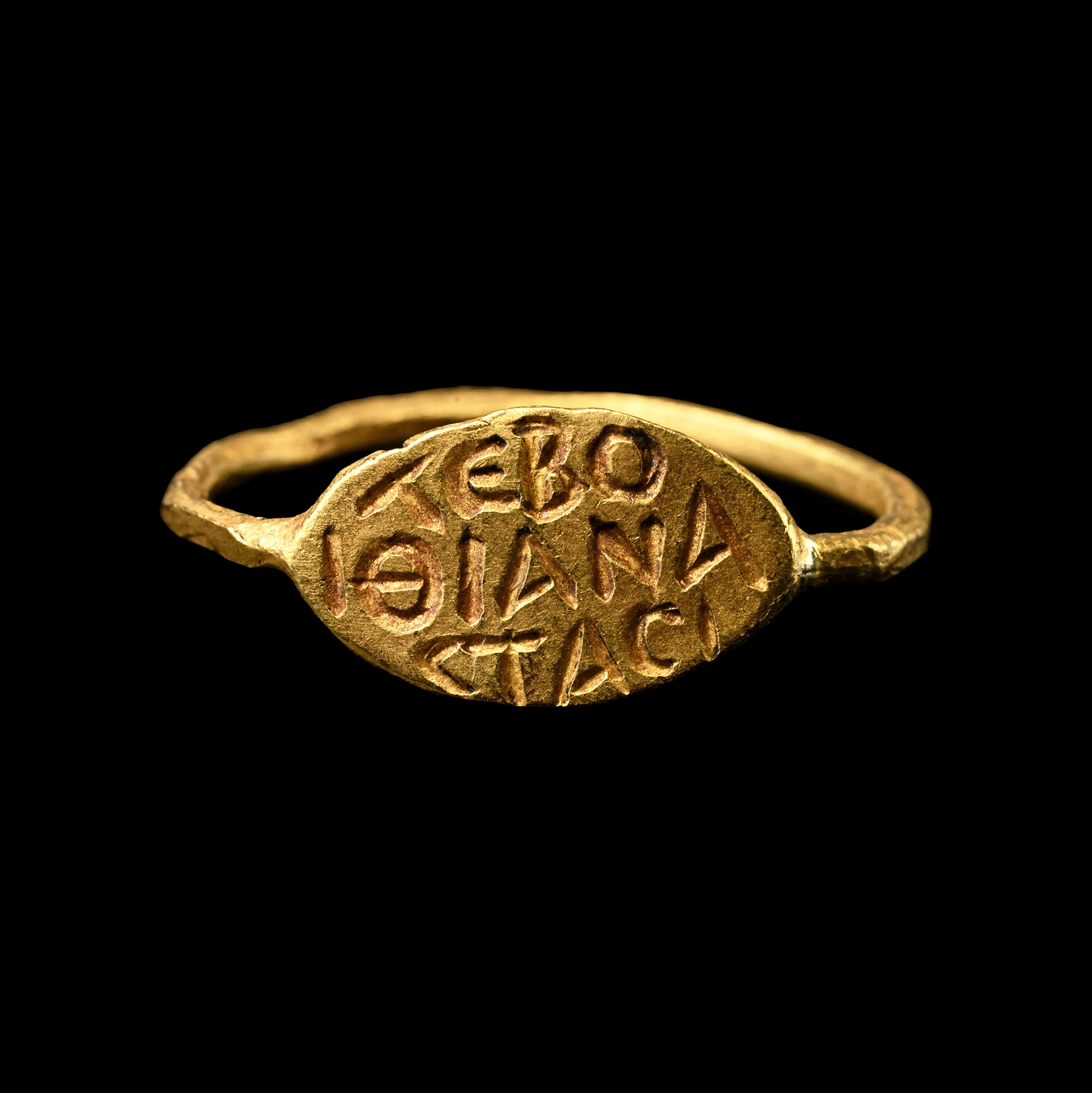
Lot 216, silver with a gold cap on its bezel, asks the Virgin instead, "Holy Mary, help your servant Iohannes", and lot 201 sets out Βοήθησον, Κύριε, "Help, Lord", as a tetragram, an invocation used at baptism and in war.
Gold rings were mostly worn by aristocrats, but bronze rings, as one study of the inscribed rings in Turkish museums puts it, "were worn by almost everybody". Noselson's twenty-six bronze rings and bezels show the Virgin and Child, the Nativity and St George on horseback, and include the heaviest ring in the collection, a "glove ring" of 33.33 grams sized to go over a glove (lot 1433).
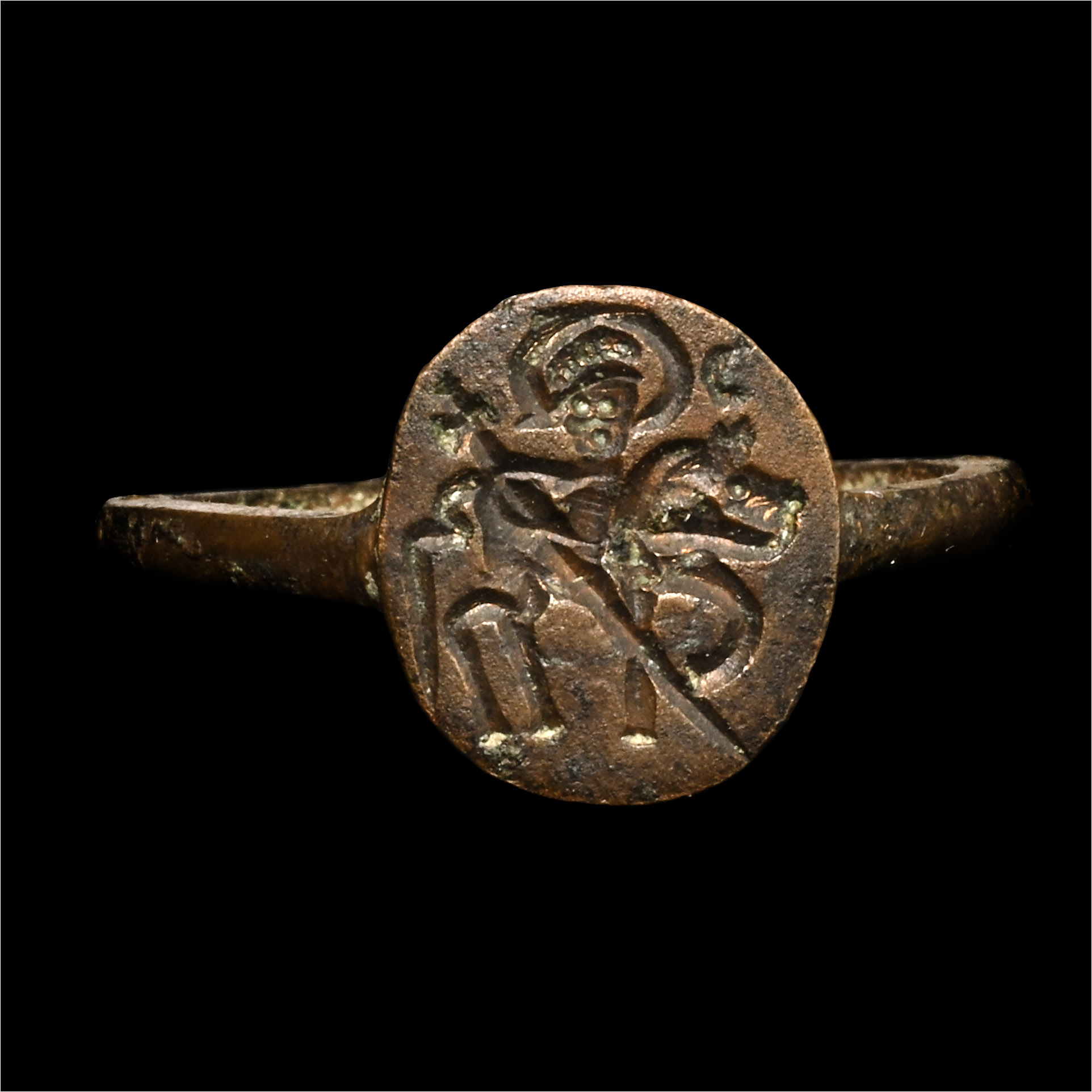
Lot 208, a Veneto-Byzantine gold signet of 16.55 grams, speaks for itself round a heraldic lion, "I save from danger", and like the tetragram ring and the ring for Iohannes it came to Noselson from one man, whose invoices are still with all three.
Kal Noselson and the invoices from Houlton, Maine
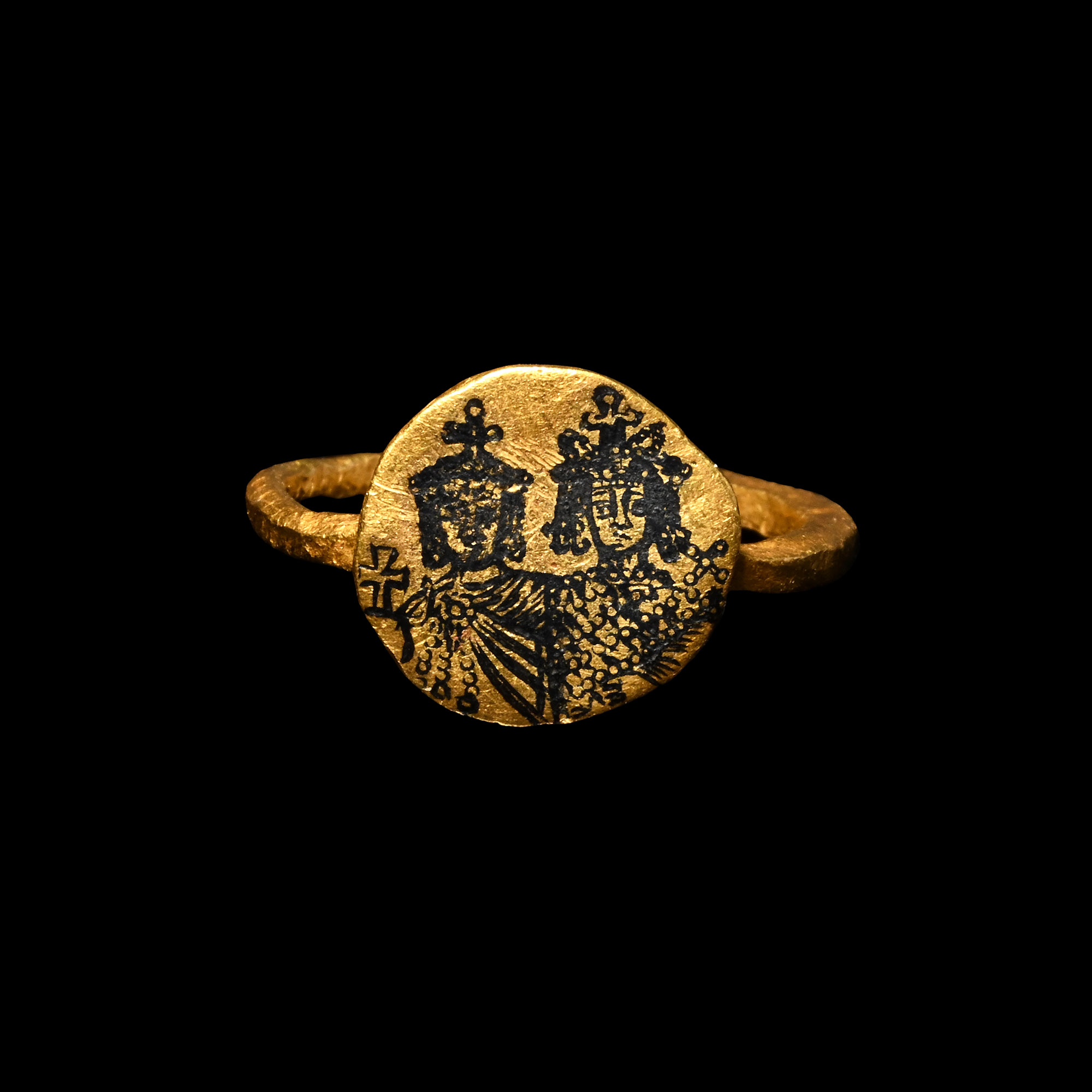
On 8 May 1976 Derek Content, of Houlton, Maine, wrote Noselson an invoice by hand for two Byzantine gold rings, the tetragram ring and lot 197, which has niello portraits of the Empress Eirene and her son Constantine VI in matching cross-topped crowns. In 797 Eirene had her son blinded and took the throne herself, the first woman to rule the empire in her own right.
Content's invoices run to the late 1990s, and Noselson kept more than the bills: inked images of his scarabs, typed notes on what he had bought and, with a large bronze ring (lot 1440), a page on a similar ring from the Koch collection catalogue.
Kal Noselson married Judith Lesnow in 1957 and was given a Calder mobile as a wedding present by his sister Abby and her husband B.H. Friedman, Jackson Pollock's first biographer. The couple went on to own works by de Kooning, Kline and Lee Krasner, and when works from their collection were sold in 2015 the catalogue said "they took to collecting as eagerly and avidly as they did to each other." The rings, seals and scarabs have stayed in the family until this sale.
A prayer for whoever wears it
Lot 211 belonged to Martine de Béhague (1870-1939) in Paris, whose antiquities were sold from her heir's estate at Sotheby's in Monaco in 1987, and Noselson kept the catalogue pages of the Zurich sale where it appeared two years later. This Veneto-Byzantine gold ring of the fourteenth or fifteenth century asks God to help "the wearer", so the prayer covers whoever has it on.
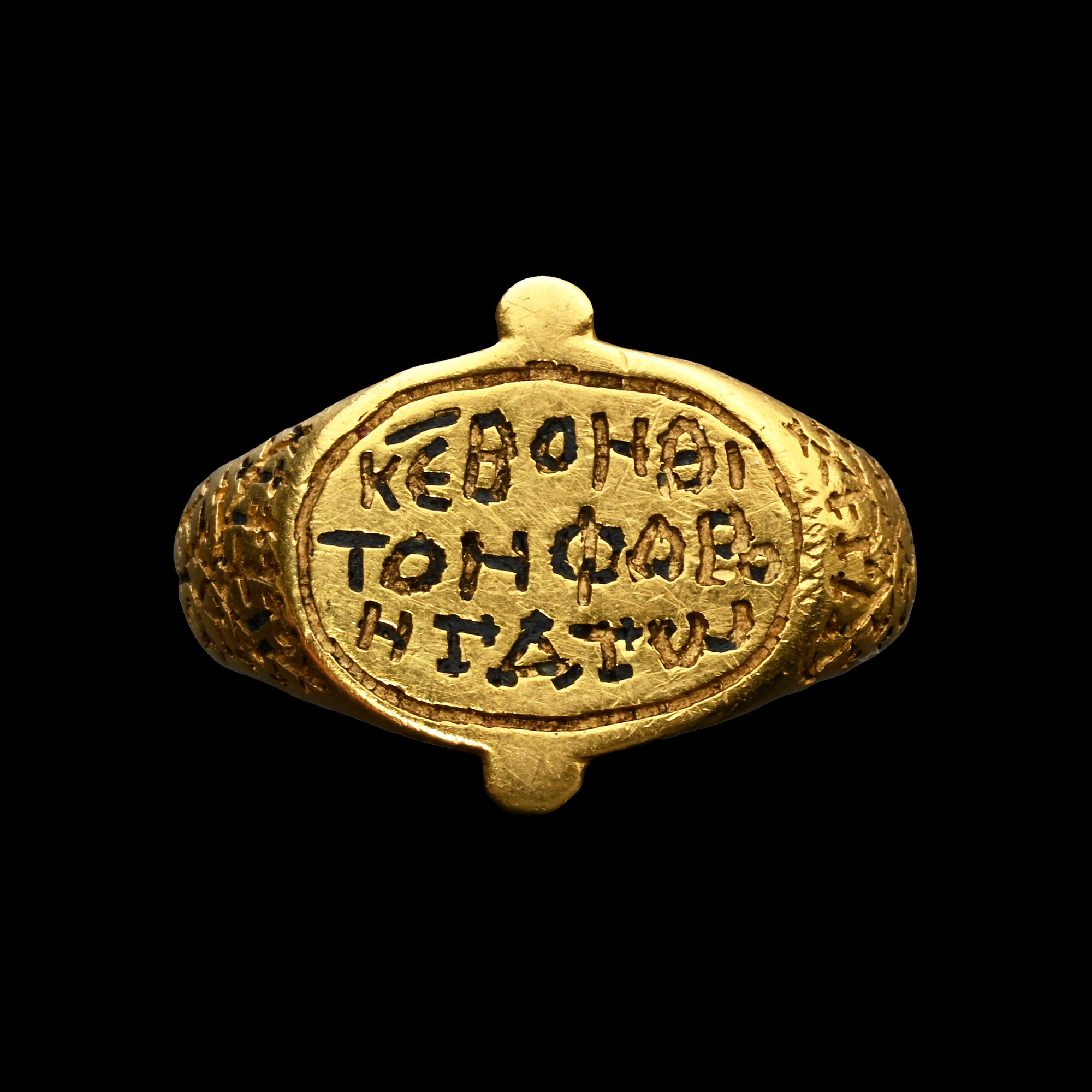
Lot 209, a ninth-century gold ring, makes the same offer five or six hundred years earlier, with "Lord helps the wearer of this" on its hoop and Christ crucified between Mary and St John on its bezel. At the foot of the cross is ΙΡΙΝΗ, eirene, "peace", after John 14:27, "Peace I leave with you; my peace I give you."
The verse also appears on seventh-century marriage rings as a wish for peace between husband and wife. Dioscorus closed his song for Paul and Patricia with both wishes, "a life quite without illness" and "a bright and peaceful life", and the Noselson collection has each of them in gold: ΥΓΙΑ beneath the couple on lot 207, and ΙΡΙΝΗ at the foot of the cross on lot 209.
