Loading, please wait...
LOT 0309
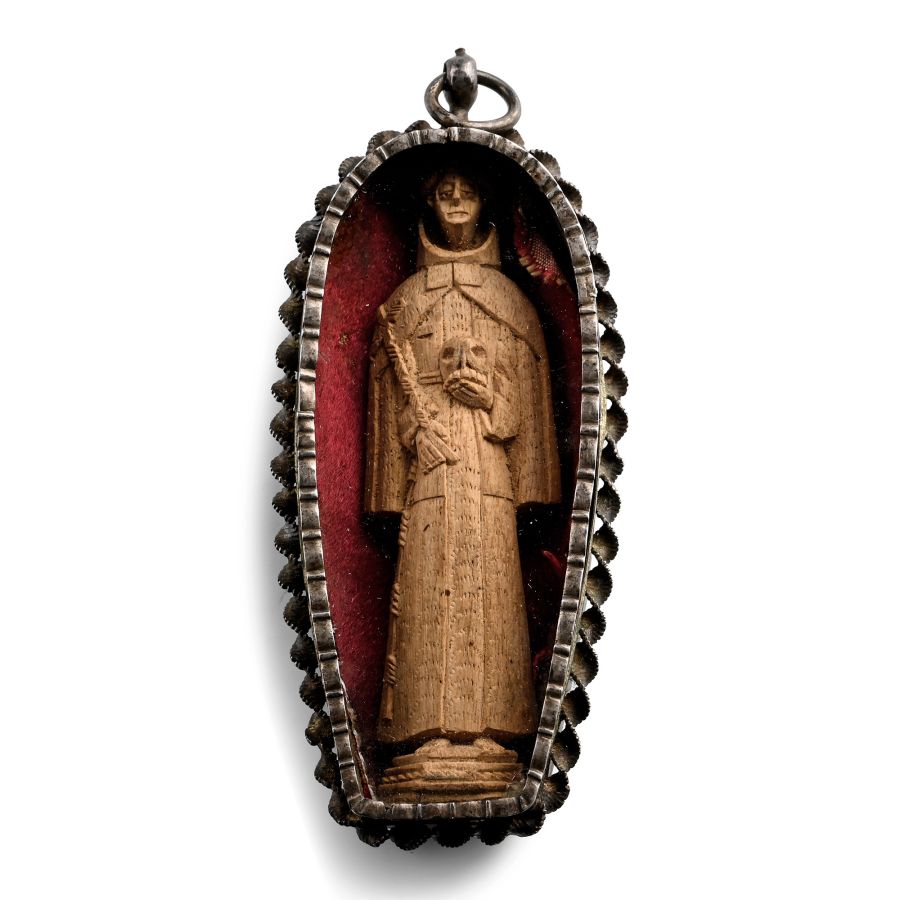
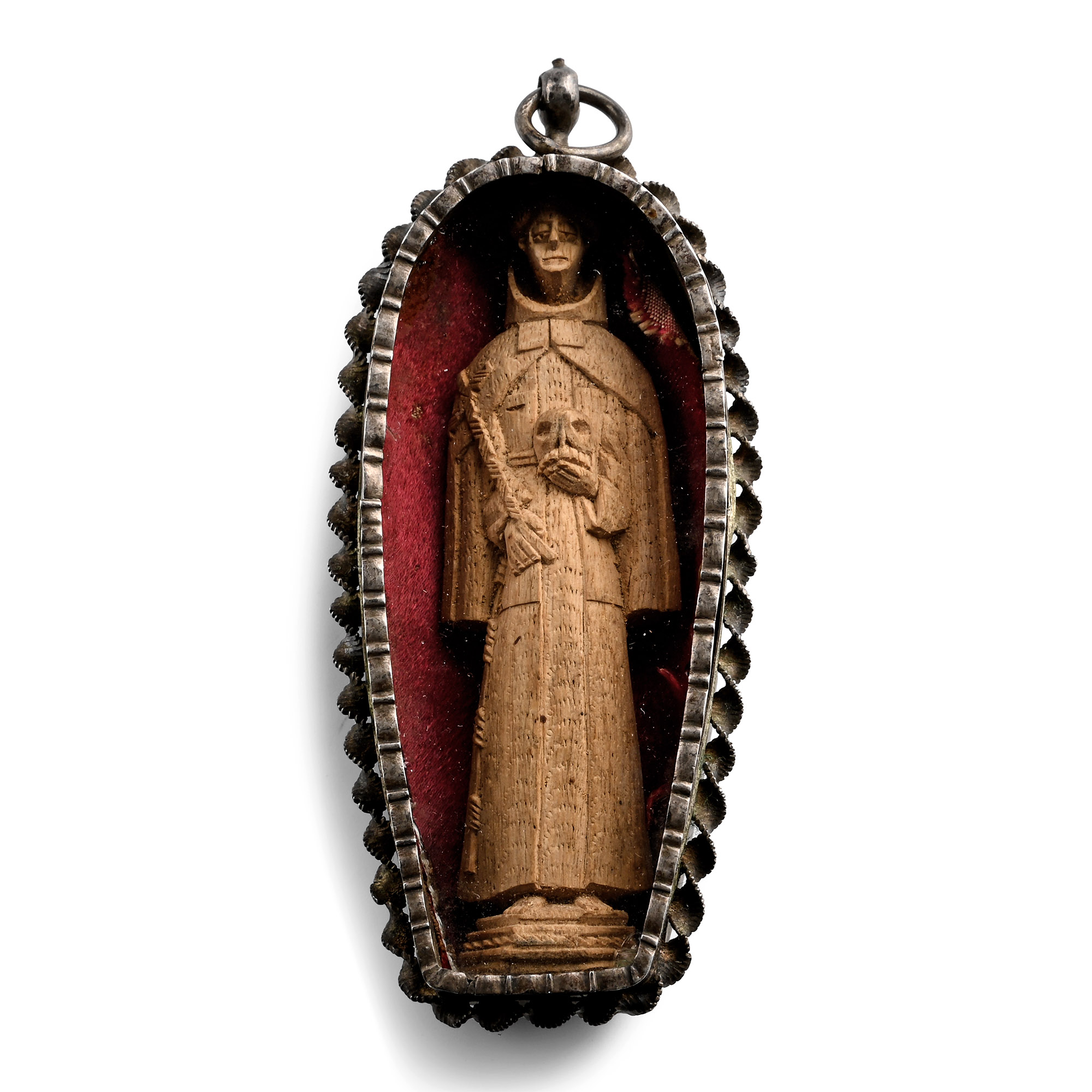
Wooden Sculpture of Saint Francis of Assisi in Silver Pendant
SPANISH COLONIES, 17TH-18TH CENTURY A.D.
4 3/8 in. (48.1 grams, 11 cm).
A carved wooden figure of Saint Francis of Assisi holding a skull in his left hand and a cross in his right hand, set on a red fabric inside a silver tongue-shaped case with applied twisted wire decoration to the outer rim; attachment loop with ring to the top.
ProvenancePrivate collection, Europe.
Acquired on the French art market.
TimeLine Auctions follows a vetting process to ensure the authenticity and legality of all items, reinforcing our commitment to integrity and responsible trading. Each antiquity, antique, and coin lot undergoes thorough examination by a vetting committee of at least ten external specialists, professional trade association members, scientists, and archaeologists: Our Vetting Process
AUCTIONS:
TimeLine is a leading auction house specialising in antiquities, ancient art, collectables, natural history, coins, medals, and books. Our auctions offer museums, collectors, historians, and enthusiasts the opportunity to acquire unique and historically significant pieces.
LOT 0309
Wooden Sculpture of Saint Francis of Assisi in Silver Pendant
Sold for (Inc. bp): £390
-
Renaissance Gold Ring with Toadstone
Western Europe, 16th century A.D.Estimate: £8,000 - 10,000 (+bp*)
Opening Bid: £4,000
Featuring a round-section large hoop expanding towards the shoulders, a large circular bezel with a Greek key motif encircling the outer rim and set with a brown 'toadstone'. 13.01 grams, 32.42 mm overall, 23.12 x 19.25 mm internal diameter (approximate size British V 1/2, USA 10 3/4, Europe 24.4, Japan 23)
Acquired on the European art market. This lot has been checked against the Interpol Database of stolen works of art and is accompanied by search certificate number no.13398-257996.
William Shakespeare’s As You Like It, circa 1599: 'Sweet are the uses of adversity, Which, like the toad, ugly and venomous, Wears yet a precious jewel in his head.' Toadstones are mythical stones that were thought to be found inside the head of a toad. They were believed to sweat, change colour or even heat up in the presence of poison. It was thought that a toadstone placed on bites from snakes, insects, spiders and shrews would extract poison from the wound. They were thought to bring good luck and ward off evil, whether in the present life or in the afterlife. The Book of Secrets from the 13th century recommends swallowing the stone to 'cleanse the bowels of filth and excrements'. The stone could then be retrieved and used again. They were often set as amulets and talismans, a practice that continued in Europe until the 18th century. Toadstones are actually the button-like fossilised teeth of Lepidotes, an extinct genus of fish common in the Jurassic and Cretaceous Periods, 200 to 100 million years ago. -
Marble Fountain Sculpture of a Putto Wrestling a Fish
Baroque, 17th century A.D.Sold for (Inc. bp): £598
Standing on an angular base resting his left knee on the open jaws of a fish, his left arm holding the jaws open, the body and tail held upright be the raised right hand (partly absent); with heavy sulphured patina. 20.75 kg, 48 cm
Acquired prior to 1970. From the estate of a Swiss gentleman, Ticino. Private collection, Zurich, Switzerland. This lot has been checked against the Interpol Database of stolen works of art and is accompanied by a search certificate number no.12790-240308.
In ancient Roman art and architecture, fountains were often decorated with sculptures of young boys or putti holding fish. These sculptures were known as 'putti with fish' or 'boy with fish' and were a popular motif in the decoration of fountains. The young boy or putto was shown holding a fish or a shell, which would spout water into the fountain basin below. The fish was a particularly popular motif because it symbolised abundance, fertility, and prosperity, which were all important values in ancient Roman society. Overall, the putti with fish sculptures are a notable example of the art and architecture of ancient Rome and have continued to be an enduring symbol of beauty, abundance, and prosperity throughout the centuries. Archaeological excavations in Pompeii have revealed many examples of sculptures of putti with fish. The putti with fish sculptures from Pompeii were usually made of bronze, marble, or terracotta. They were often placed in the centre of the fountain, surrounded by other decorative elements such as flowers, plants, and other sculptures. Many of these putti with fish sculptures are now on display in the National Archaeological Museum of Naples. The museum also houses a famous mosaic of a putto with a fish, which was discovered in the House of the Faun in Pompeii. The putti with fish sculptures from Pompeii and those in the Naples Museum provide valuable insights into the art and culture of ancient Rome. They demonstrate the importance of beauty and abundance in ancient Roman society and offer a glimpse into the everyday life of the people who lived in Pompeii over two thousand years ago. In the 17th and 18th centuries these sculptures were imitated and used to decorate the fountains of royal palaces and palaces. -
Renaissance Sardonyx Cameo of a Young Woman
Italy, 16th century A.D.Sold for (Inc. bp): £1,170
High-relief bust of a young lady facing right, her curly hair neatly pulled back to a chignon at the nape of her neck, jewelled diadem resting on top of the head; mounted in an unmarked high-carat gold brooch setting dating to the 19th century. 9.59 grams, 30 mm
Acquired on the European art market.