
Loading, please wait...
LOT 1231
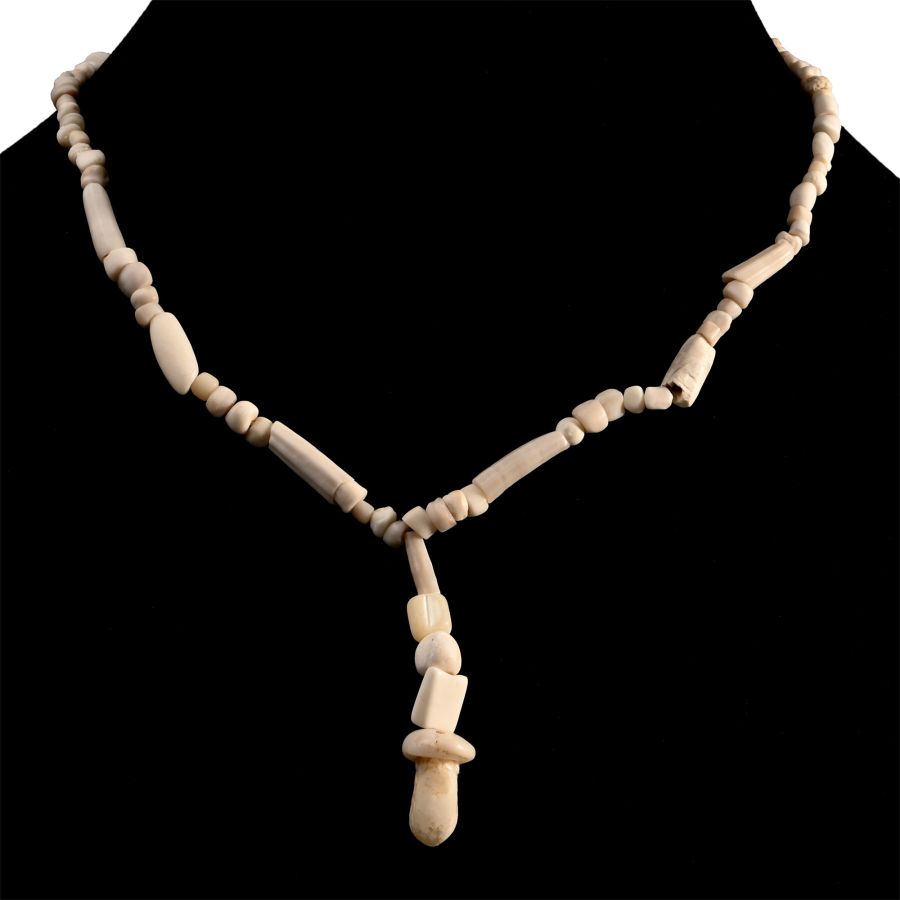
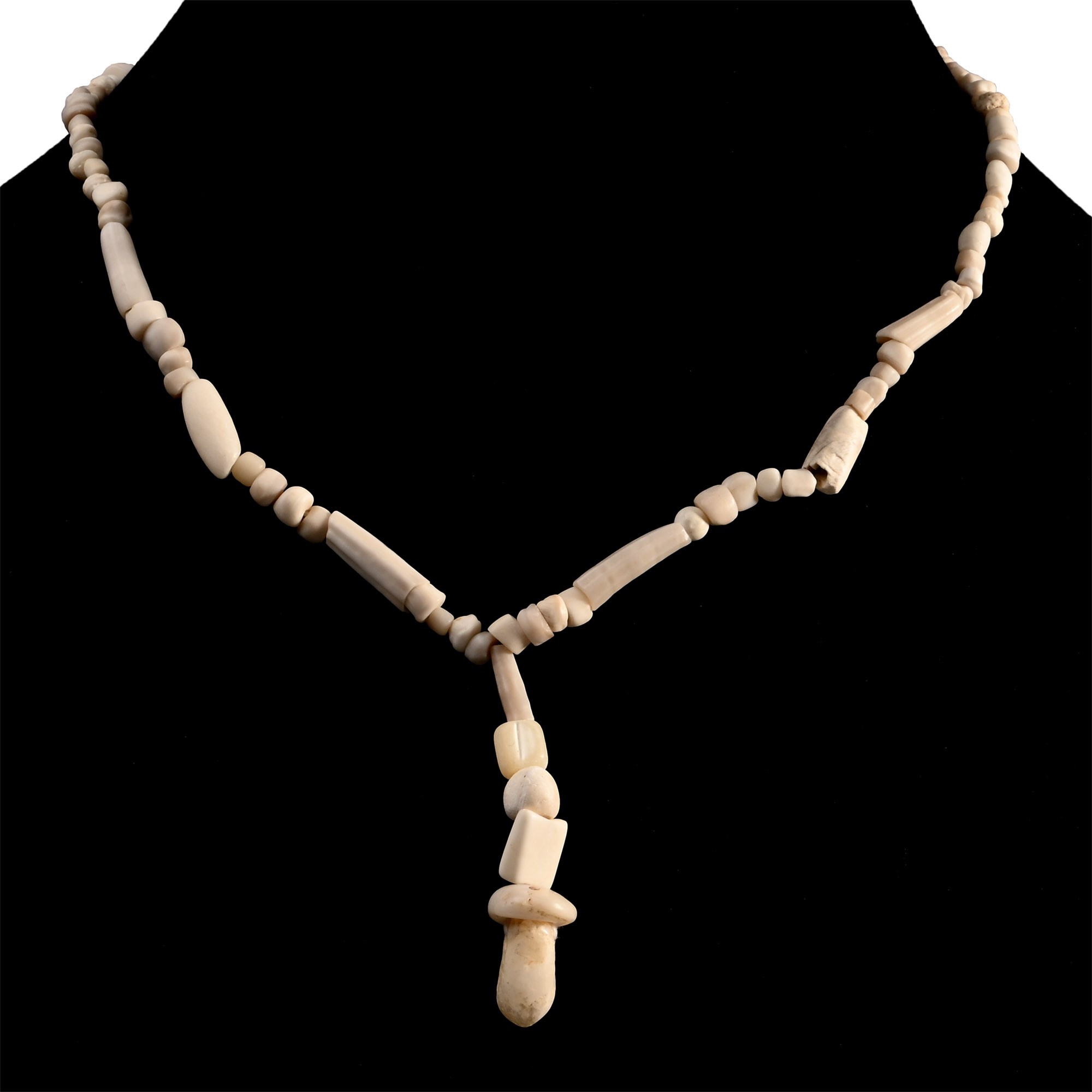
Western Asiatic White Stone and Shell Bead Necklace String
1ST MILLENNIUM B.C. AND LATER
11 3/4 in. (14.7 grams, 30 cm).
Composed of tubular beads interspersed with smaller oblate and other beads; restrung to a Y-shape with a drop-shaped pendant. [No Reserve]
ProvenanceFrom the London, UK, art market in the 1990s.
This lot has been cleared against the Art Loss Register database, and is accompanied by an illustrated lot declaration signed by the Head of the Antiquities Department, Dr Raffaele D'Amato.
TimeLine Auctions follows a vetting process to ensure the authenticity and legality of all items, reinforcing our commitment to integrity and responsible trading. Each antiquity, antique, and coin lot undergoes thorough examination by a vetting committee of at least ten external specialists, professional trade association members, scientists, and archaeologists: Our Vetting Process
AUCTIONS:
TimeLine is a leading auction house specialising in antiquities, ancient art, collectables, natural history, coins, medals, and books. Our auctions offer museums, collectors, historians, and enthusiasts the opportunity to acquire unique and historically significant pieces.
LOT 1231
Western Asiatic White Stone and Shell Bead Necklace String
Sold for (Inc. bp): £20
-
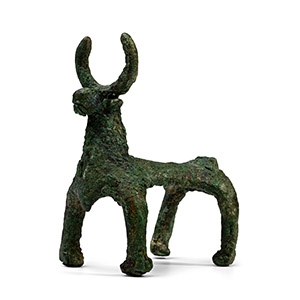
Western Asiatic Bronze Figure of a Bull
Circa 1000-600 B.C.Sold for (Inc. bp): £293
Modelled in a powerful stance with its legs spread, erect head with large curving horns. 151 grams, 88 mm
Nicolas Koutoulakis (1910-1996), thence by descent. Ex Galerie Khnoum, Geneva, Switzerland. Private collection of Mr K.A. This lot has been cleared against the Art Loss Register database, and is accompanied by an illustrated lot declaration signed by the Head of the Antiquities Department, Dr Raffaele D'Amato. -
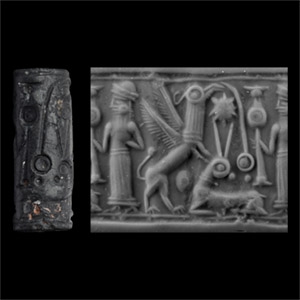
Mitanni Hematite Cylinder Seal with Standing Deity Opposing Sphinx
1500-1200 B.C.Sold for (Inc. bp): £910
With standing figure, sphinx and horned animal, restrung pair of red stone beads, old handwritten label '1629'; accompanied by a copy of an old scholarly note, typed and signed by W.G. Lambert, late Professor of Assyriology, University of Birmingham, 1970-1993, which states: 'Cylinder Seal of Hematite, 19 x 7.5 mm. On the right stands a human figure in a hat with broad brim and wearing a robe to the feet. In one hand he holds an elaborate mace, no doubt the symbol of a deity. On the left is a reared up sphynx with raised wings and resting its front paws on the head of a recumbent horned animal. between the tops of the horns is a star. Two other filling motifs are: a dot and something like the horned animal's head with a long line rising above it. The design is put between upper and lower rules. This is a Mitanni 'elaborate style' seal, c. 1500-1200 B.C. It is in fine condition and is an interesting specimen of its type.'; accompanied by a museum-quality impression. 4.6 grams, 19 mm
UK private collection, acquired 1980-1983. Accompanied by a copy of a scholarly note, typed and signed by Professor Wilfrid George Lambert in 1992. This lot has been cleared against the Art Loss Register database, and is accompanied by an illustrated lot declaration signed by the Head of the Antiquities Department, Dr Raffaele D'Amato. -
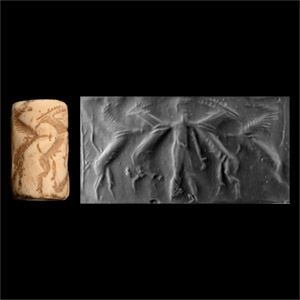
Early Akkadian Shell Cylinder Seal with Divine Hero
Circa 2300 B.C.Sold for (Inc. bp): £182
Cylinder with standing male figure with a pair of animals to each side, restrung pair of red stone beads, old handwritten label '1647'; accompanied by a copy of an old scholarly note, typed and signed by W.G. Lambert, late Professor of Assyriology, University of Birmingham, 1970-1993, which states: 'Cylinder Seal of Cream Fossil Shell, 37 x 22 mm. In the centre stands a divine hero, nude, and gripping the neck of a horned animal on either side, each of which is being attacked by a lion with erect tail. For a terminal there stands a tall tree. This is an early Akkadian seal from Mesopotamia or West Iran, c. 2300 B.C. The symbolism comes from temple herds, which were liable to be attacked by lions at this time. They believed that certain gods and divine heroes could rescue their animals from such attacks, and by showing such scene on their seals they hoped to achieve the result be sympathetic magic.'; accompanied by a museum-quality impression. 37.6 grams, 37 mm
Armand Trampitsch, Glyptique Archéologie, Paris, Hôtel Drouot, 13-14 May 1992, no.23 [Part]. Accompanied by a copy of a scholarly note, typed and signed by Professor Wilfrid George Lambert in 1992. This lot has been cleared against the Art Loss Register database, and is accompanied by an illustrated lot declaration signed by the Head of the Antiquities Department, Dr Raffaele D'Amato.
