
Loading, please wait...
LOT 1400
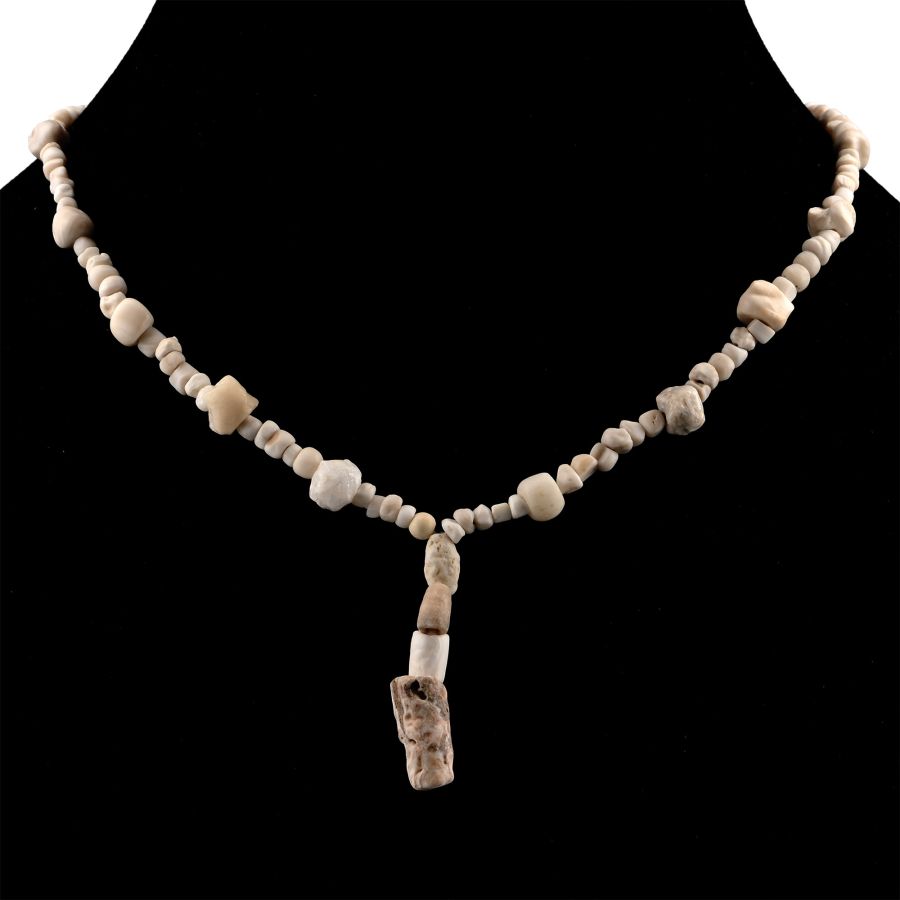
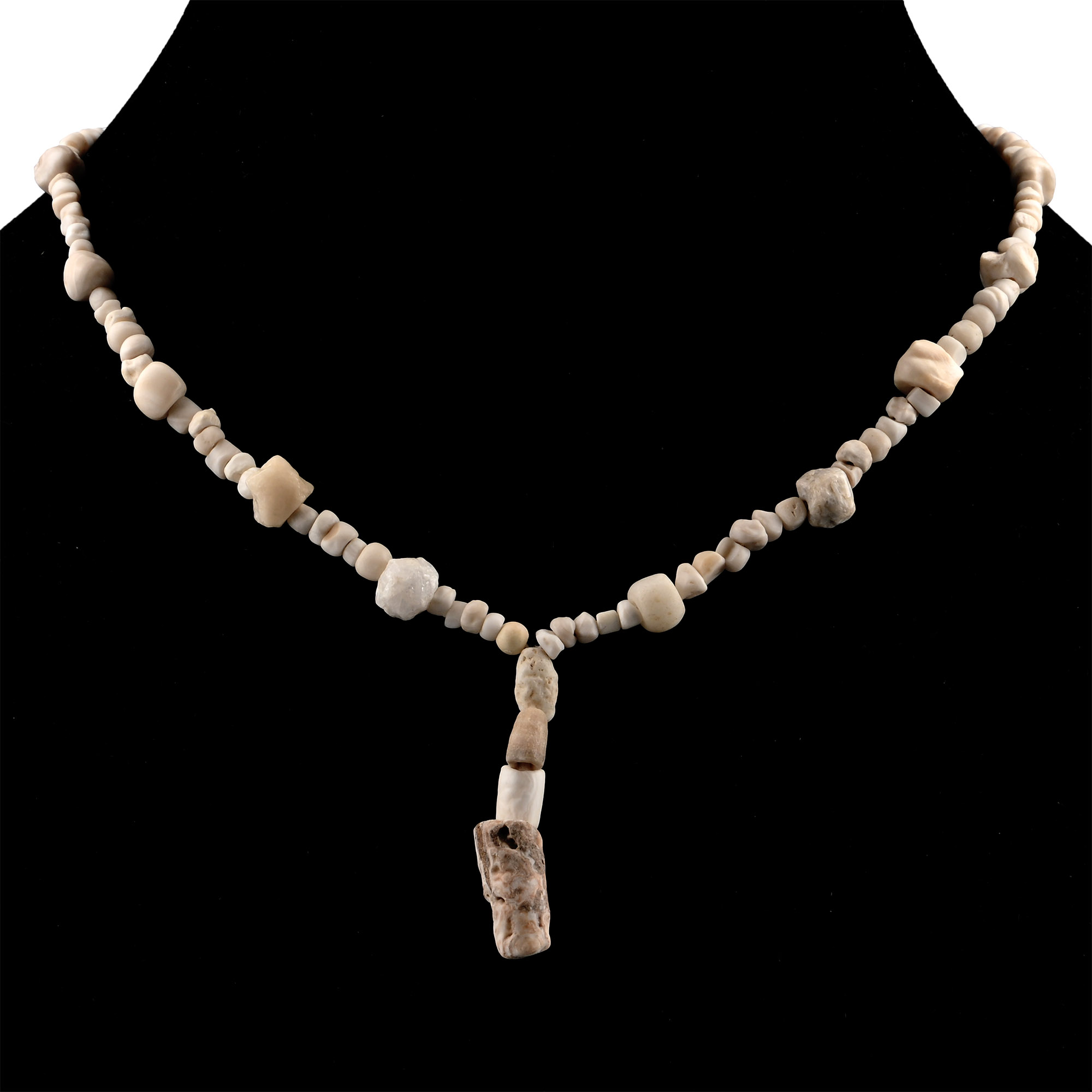
Western Asiatic White and Beige Stone Bead Necklace String
1ST MILLENNIUM B.C. AND LATER
12 5/8 in. (14.49 grams, 32 cm).
Mixed group of beads in alternating sizes, restrung to a Y-shape. [No Reserve]
ProvenanceFrom London, UK, gallery collection, 1990s.
CONDITIONTimeLine Auctions follows a vetting process to ensure the authenticity and legality of all items, reinforcing our commitment to integrity and responsible trading. Each antiquity, antique, and coin lot undergoes thorough examination by a vetting committee of at least ten external specialists, professional trade association members, scientists, and archaeologists: Our Vetting Process
AUCTIONS:
TimeLine is a leading auction house specialising in antiquities, ancient art, collectables, natural history, coins, medals, and books. Our auctions offer museums, collectors, historians, and enthusiasts the opportunity to acquire unique and historically significant pieces.
LOT 1400
Western Asiatic White and Beige Stone Bead Necklace String
Sold for (Inc. bp): £46
-
.jpg)
Western Asiatic Stone Libation Bowl
1st millennium B.C.Sold for (Inc. bp): £46
With a biconical body and flared foot set off-centre, large U-shaped spout and flat rim. 667 grams total, 11.9 cm
From a collection formed before 1988, London and Geneva. -
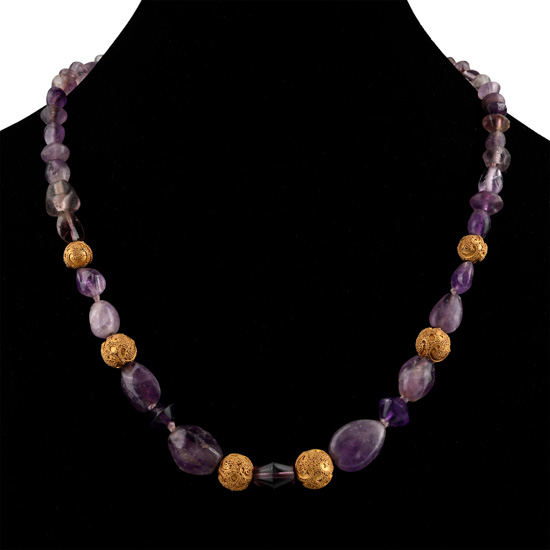
Western Asiatic Amethyst Bead Necklace with Gold Beads
Circa 4th-2nd century B.C.Estimate: £2,500 - 3,500 (+bp*)
Opening Bid: £1,250
A designer necklace composed of forty amethyst beads of various shapes and six gold spheres, decorated with granulation and spirals, forming opposed pelta patterns; with later openwork clasp. 69.6 grams, 52.5 cm
Acquired on European art market, 1990s. Private collection of Mr K.A., France. with Kallos Gallery, London. This lot has been checked against the Interpol Database of stolen works of art and is accompanied by a search certificate number no.13012-246749.
Amethyst was widely used in Graeco-Roman Egypt. We know that the amethyst mines of Abu Diyeiba, near Semna, were in use from the time of Ptolemy VI through to the Roman era. Pliny says that Indian amethysts were the best, but he also refers to amethysts from Egypt. The Egyptian amethysts are typically flawed and of a pale, almost pink, hue. They were seldom set in gold and were most usually made into beads. Ptolemaic and Roman inscriptions and artefacts have been found at amethyst mines in Egypt’s eastern deserts. -
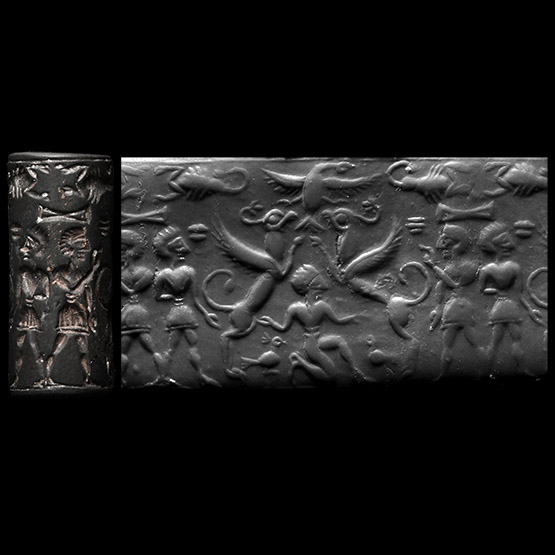
Mitanni Haematite Cylinder Seal with Figures and Animals
Circa 1500-1200 B.C.Sold for (Inc. bp): £1,690
With animals and figures; accompanied by a copy of an old scholarly note, typed and signed by W.G. Lambert, late Professor of Assyriology, University of Birmingham, 1970-1993, which states: 'Cylinder Seal of Hematite. 24 x 10 mm. The design is based on the principle of symetry. In the centre are two reared-up composite animals: bodies of quadrupeds, but wings and heads of birds. Beneath them is a human figure on one knee, nude save for belt around the waist, holding out both hands, each hand over a bird. To either side of this group is a standing man, in short kilt, the one on the right holding one hand at the waist, holding down the other. The one on the left is raising one hand but holding down the other. Above the scene is a vulture with wings spread, and to each side of it a scorpion above a 'flying saucer'. A geometrical figure (two triangles with points meeting) alone straddles the division of the scene. This is a Mitanni seal, c. 1500-1200 B.C., from any part of the area from the eastern Mediterranean to Kurdistan. It is an unusual design, and fine quality work. The piece is in good state of preservation.'; accompanied by a museum quality impression and a pair of red stone beads. 7.98 mm, 24 mm
Private collection, London, UK. Accompanied by a copy of an old scholarly note, typed and signed by W.G. Lambert, late Professor of Assyriology, University of Birmingham, 1970-1993.
