
Loading, please wait...
_900x900.jpg "Western Asiatic Turquoise Bead Necklace with Gold 'Pomegranate' Elements")
_200x200.jpg "Western Asiatic Turquoise Bead Necklace with Gold 'Pomegranate' Elements")


.jpg "Western Asiatic Turquoise Bead Necklace with Gold 'Pomegranate' Elements")
LOT 0312
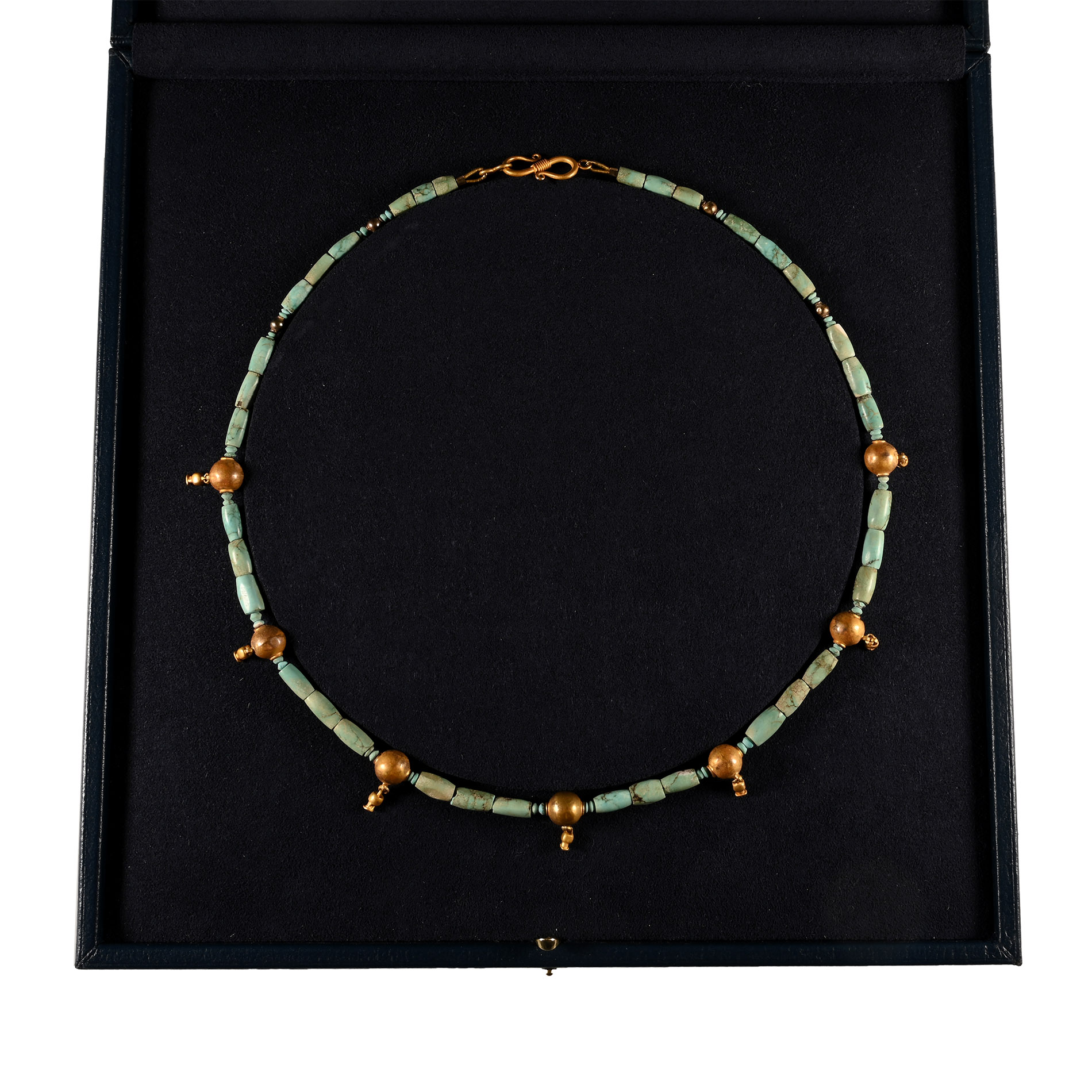
Western Asiatic Turquoise Bead Necklace with Gold 'Pomegranate' Elements
1ST CENTURY B.C.-1ST CENTURY A.D. AND LATER
18 3/8 in. (18.6 grams, 46.5 cm long).
Graduated group of restrung tubular and fusiform turquoise beads with later gilt-metal interstitial bulbs each with an attached dangle; S-hook and eye closure; with custom display box.
ProvenanceEx Swiss collection, kept in London since the 1980s.
CONDITIONTimeLine Auctions follows a vetting process to ensure the authenticity and legality of all items, reinforcing our commitment to integrity and responsible trading. Each antiquity, antique, and coin lot undergoes thorough examination by a vetting committee of at least ten external specialists, professional trade association members, scientists, and archaeologists: Our Vetting Process
AUCTIONS:
TimeLine is a leading auction house specialising in antiquities, ancient art, collectables, natural history, coins, medals, and books. Our auctions offer museums, collectors, historians, and enthusiasts the opportunity to acquire unique and historically significant pieces.
LOT 0312
Western Asiatic Turquoise Bead Necklace with Gold 'Pomegranate' Elements
Estimate £800 - 1,000€930 - 1,160 (for guidance only)$1,080 - 1,350 (for guidance only)
-
Phoenician Bronze Figure
Early 1st millennium B.C.Sold for (Inc. bp): £208
Modelled in the half-round, female in upright pose supporting her breasts in her hands. 61.3 grams, 76 mm
From the collection of a gentleman, acquired on the London art market in the 1990s. -
Early Urartu Bronze Spearhead
17th-16th century B.C.Estimate: £250 - 350 (+bp*)
Opening Bid: £130
With leaf-shaped blade, raised midrib extending to a tubular split socket with fastening holes. 165 grams, 29.7 cm
Acquired 1980-2015. Ex Abelita family collection.
With the introduction of the socketted spearhead in the Middle East in the second half of the 3rd millennium B.C., by the middle of the 2nd millennium, these kind of spearheads became predominant throughout the ancient Near East, and the design of the spearhead remained practically unchanged since then. -
Luristan Bronze Horse
13th-7th century B.C.Sold for (Inc. bp): £59
Amuletic figure of a standing beast with raised rump and curved tail; integral bridle and reins. 17.1 grams, 43 mm
Ex London collection of a deceased collector, 1990s.
