
Loading, please wait...
_900x900.jpg "Western Asiatic Style Millefiori Glass Bead Necklace")
_200x200.jpg "Western Asiatic Style Millefiori Glass Bead Necklace")
.jpg "Western Asiatic Style Millefiori Glass Bead Necklace")
LOT 2135
Western Asiatic Style Millefiori Glass Bead Necklace
20TH CENTURY A.D.
23 1/4 in. (139 grams, 59 cm).
Composed of spherical mosaic glass beads interspersed with small light blue beads, two pairs of biconical blue beads at the ends; restrung with loop-and-bead closure; likely Indonesian. [No Reserve]
ProvenanceFrom the family collection of a Hampstead gentleman; formerly acquired in the 1980s.
CONDITIONTimeLine Auctions follows a vetting process to ensure the authenticity and legality of all items, reinforcing our commitment to integrity and responsible trading. Each antiquity, antique, and coin lot undergoes thorough examination by a vetting committee of at least ten external specialists, professional trade association members, scientists, and archaeologists: Our Vetting Process
AUCTIONS:
TimeLine is a leading auction house specialising in antiquities, ancient art, collectables, natural history, coins, medals, and books. Our auctions offer museums, collectors, historians, and enthusiasts the opportunity to acquire unique and historically significant pieces.
-
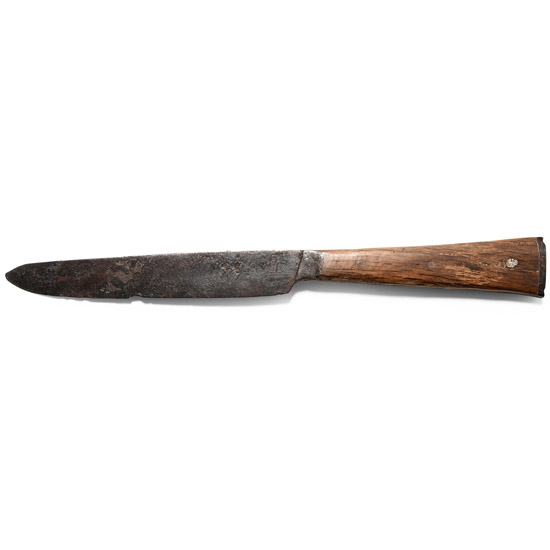
Stuart Period Iron Knife with Crown Maker's Mark
Circa 18th century A.D.Sold for (Inc. bp): £39
Forge-welded single-edged blade with rounded tip and integral baluster; wooden scales to both sides of the tang held in place with three peened studs on each side; punched crown maker's mark to one face. 28.9 grams, 19.5 cm
From a UK collection formed in the 1980s. Property of an Essex, UK, gentleman. -
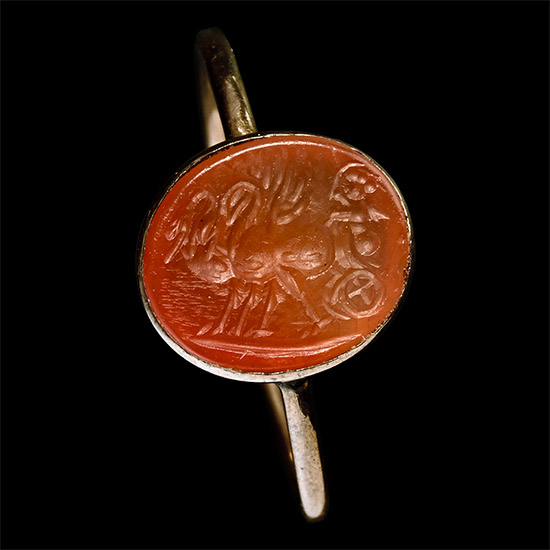
Sasanian Style Gold Ring with Cupid and Chariot
18th century A.D.Estimate: £400 - 600 (+bp*)
Opening Bid: £200
Slender hoop with cell set with a carnelian intaglio of Cupid driving a chariot pulled by two swans; supplied with a museum-quality impression. 1.62 grams, 22.03 mm overall, 18.31 x 16.45 mm internal diameter (approximate size British O, USA 7, Europe 14.98, Japan 14)
Private collection, Europe. Acquired on the English art market. -
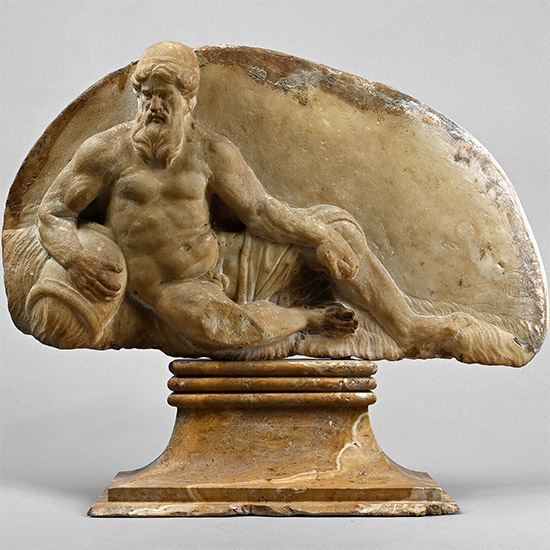
Baroque Period Marble Frieze Depicting a River God
17th-18th century A.D.Sold for (Inc. bp): £3,380
Depicted lying on a riverbed, leaning on his right side, his aged face framed by a rich, flowing beard, his wavy hair held back by a taenia; his body, naked and corpulent, is covered only by a light cloak wrapping his legs; his left hand is stretched forward, his right hand resting on a vase pouring water from the river; the figure stands out against a smooth, semicircular cut wall; mounted on an old collection marble base. 13 kg, 44.5 cm wide
With evidence of break along outer edges suggesting the fragment was once part of a larger composition or fountain. Areas of old glue remnants to the broken edge. The marble is stable, with age staining to the entire surface; minor chips throughout but generally in very good condition.
Previously in an old European collection, probably from the 18th/19th century, based on the old collection marble base and mounting technique. Private collection, France. This lot has been checked against the Interpol Database of stolen works of art and is accompanied by search certificate no. 13239-251810.
The representations of river or sea divinities usually depicted them in the same position, with naked torso wrapped only in a wide cloak, and usually bearded. The sculpture bears similarities with the sculpture of a river divinity, in the Archaeological Museum of Napoli (inv. 5977), from Rome and belonging to the Farnese Collection, from the second half of the 2nd century A.D.
