
Loading, please wait...
LOT 1337
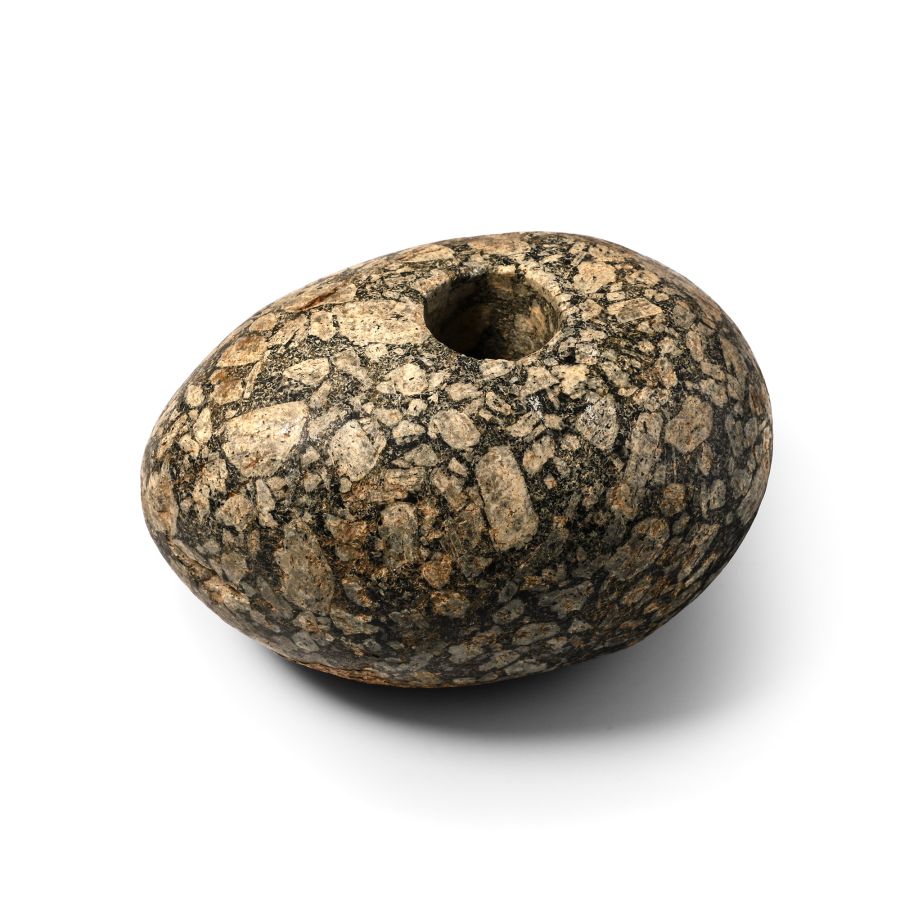
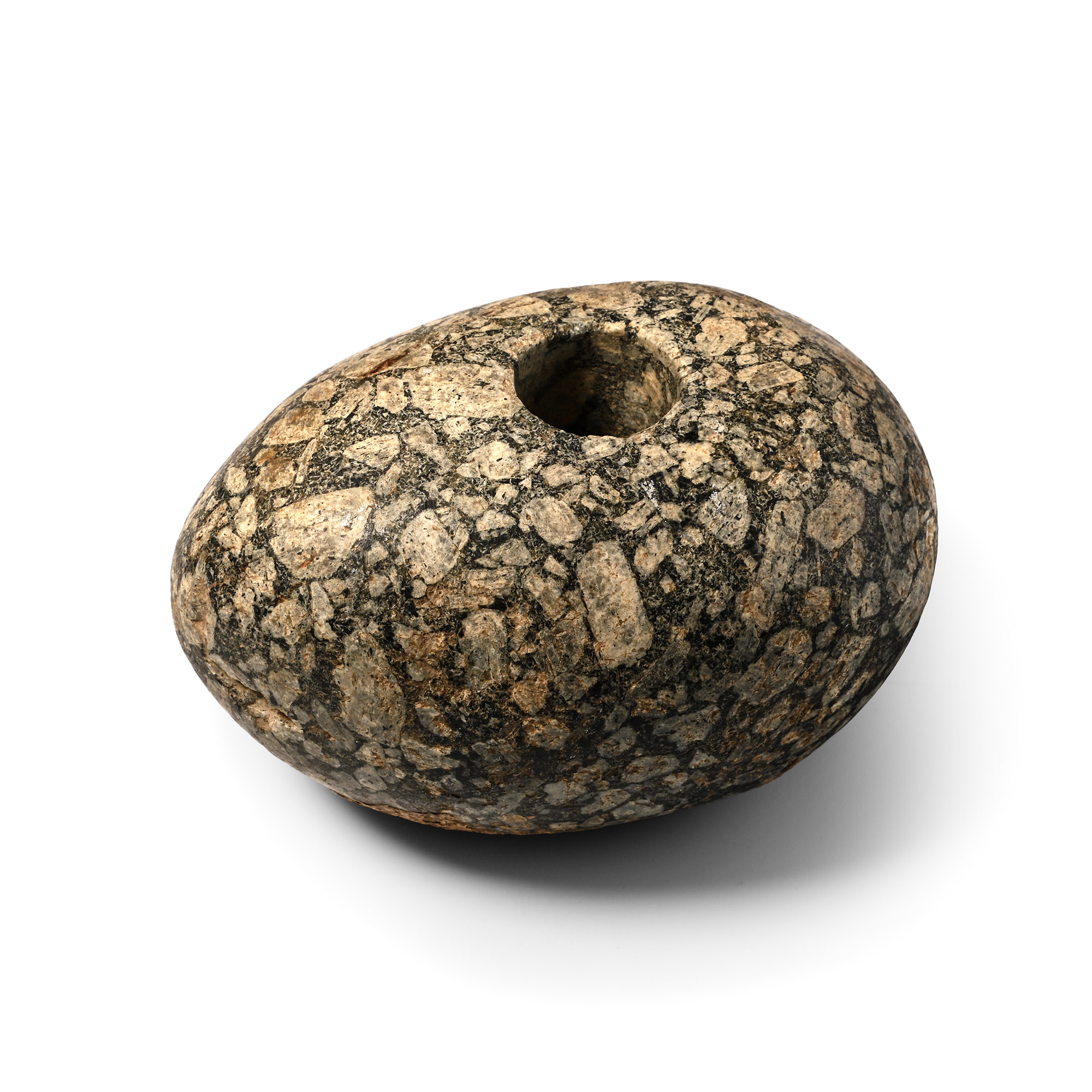
Western Asiatic Stone Macehead
4TH MILLENNIUM B.C.
3 1/8 in. (360 grams, 81 mm).
Oval in plan with a tapering drilled central socket.
ProvenanceEx private collection, Contessa L.G., since the 1980s.
Private collection, acquired in 1999.
Cf. Gorelik, M., Weapons of Ancient East, IV millennium BC-IV century BC, Saint Petersburg, 2003, pl.XXX, no.15, for similar example from Mesopotamia.
FootnotesThe mace was a close-combat weapon consisting of a short handle and a massive striking element—the head, a striking weapon capable of inflicting severe contusions and internal fractures. Although a very archaic and rather primitive weapon, the mace was nevertheless widely used in the ancient East. Its sacred and representative role was particularly significant. Due to its shape, it symbolised the owner's masculinity and was therefore one of the primary insignia of power, symbolising the inseparability of its civil, military, and sacred-magical essences—ensuring the functioning and reproduction of the collective and the conditions for its existence. This is why we so often encounter ‘ceremonial’ maces, especially those made of stone—in this case, undoubtedly a ritual material. However, it must be said that stone, as a material for a mace head, was in no way inferior to metal in terms of combat qualities, while being much more labour-intensive to manufacture, which was precisely what appealed to the ritual, symbolic role of this weapon.
CONDITIONTimeLine Auctions follows a vetting process to ensure the authenticity and legality of all items, reinforcing our commitment to integrity and responsible trading. Each antiquity, antique, and coin lot undergoes thorough examination by a vetting committee of at least ten external specialists, professional trade association members, scientists, and archaeologists: Our Vetting Process
AUCTIONS:
TimeLine is a leading auction house specialising in antiquities, ancient art, collectables, natural history, coins, medals, and books. Our auctions offer museums, collectors, historians, and enthusiasts the opportunity to acquire unique and historically significant pieces.
LOT 1337
Western Asiatic Stone Macehead
Estimate £400 - 600€460 - 700 (for guidance only)$540 - 810 (for guidance only)
-
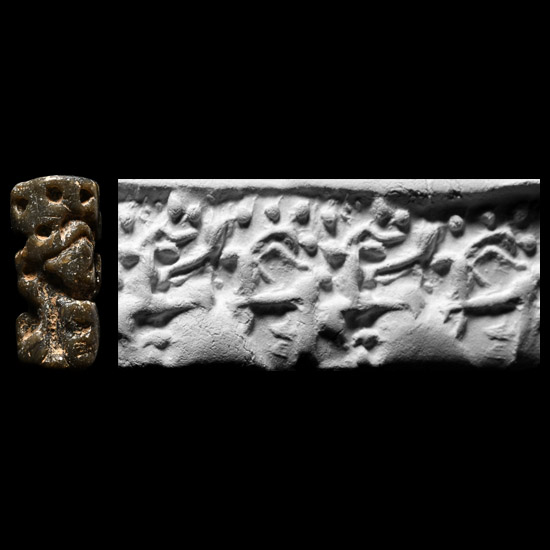
Neo-Assyrian Steatite Cylinder Seal with Capricorns
Circa 800-700 B.C.Sold for (Inc. bp): £52
A small seal with two capricorns and the Pleiades; supplied with a museum-quality impression. 0.85 grams, 14 mm
From the private collection of a European gentleman (1942-2024), formed since the 1970s. Accompanied by a previous typed catalogue slip with collection no.84. -
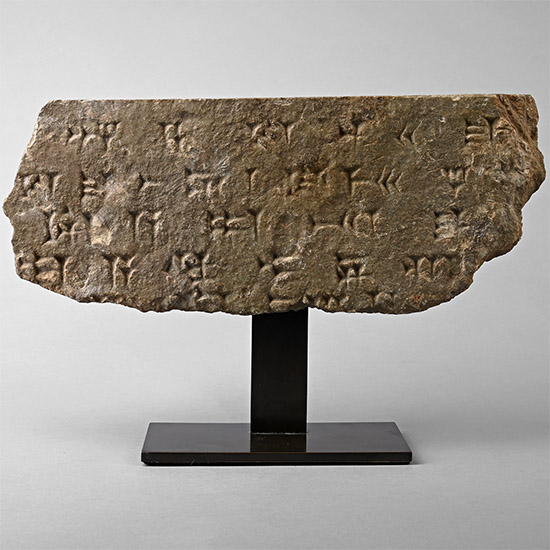
Large Neo-Assyrian Cuneiform Frieze Section with Annals for King Ashurnasirpal II
883-859 B.C.Sold for (Inc. bp): £12,350
A stone frieze with four lines of large cuneiform text accompanied by documentation to support that this a section from the annals of King Ashurnasirpal II: 'Ashurnasirpal (II), great king, mighty king, king of the universe, king of Assyria, son of Tukulti-Ninurta (II), great king, mighty king, king of the universe, king of Assyria, son of Adad-nirari (II), great king, mighty king, king of the universe, king of Assyria, valiant man, who acts with the support of the weapons of Assur, his lord, who has no equal among the princes of the four regions, king who has subdued (the territories extending) from the opposite bank of the Tigris to Mount Lebanon and the Great Sea, the entire land of Laqû, the land of Suhu as far as the city of Rapiqu. He conquered the sources of the Subnat river as far as the land of Nirbu…'; mounted on a custom-made display stand. 2.85 kg total, 36.5 cm wide including stand
Belgian private collection, acquired before 1960, and thence by descent to the collector's widow. with Mrs Drees (?), Brussels, acquired from the widow of the above, 2004. with Pierre Bergé & Associés, Paris, 28 October 2006, lot 219. with Gorny & Mosch, Munich, 12 December 2023, lot 416. This lot has been checked against the Interpol Database of stolen works of art and is accompanied by search certificate number no.13369-258955.
Most of the reliefs and inscriptions of this king are in the British Museum and Louvre. Further holdings are in the New York Historical Society, the Metropolitan Museum of Art and Yale University. They celebrated the glory of the Assyrians at the apogee of their Empire. -
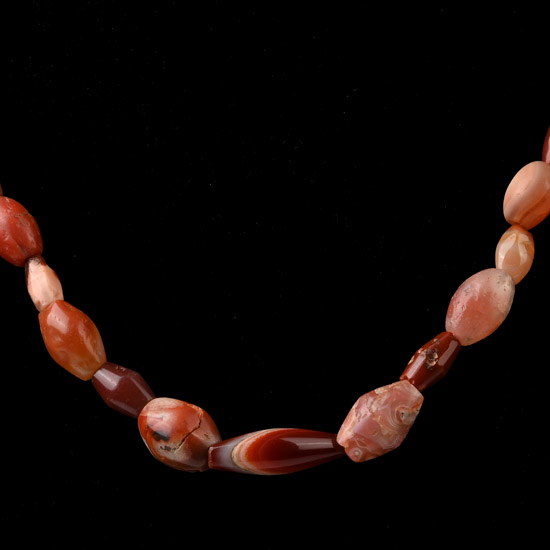
Western Asiatic Carnelian Bead Necklace
Circa 1st millennium B.C.Sold for (Inc. bp): £286
Composed of large biconical and oval carnelian and agate beads, restrung with a modern clasp. 70 grams, 53 cm
Ex London, UK, collection, 1990s. Accompanied by a previously illustrated catalogue card with provenance.
