
Loading, please wait...
_900x900.jpg "Western Asiatic Stone Macehead")
_200x200.jpg "Western Asiatic Stone Macehead")
.jpg "Western Asiatic Stone Macehead")
LOT 1089
Western Asiatic Stone Macehead
3RD MILLENNIUM B.C.
3 1/4 in. (310 grams, 83 mm).
With plain globular body and circular short shaft.
ProvenanceEx London, UK, collection, 1990-2000s.
This lot has been cleared against the Art Loss Register database, and is accompanied by an illustrated lot declaration signed by the Head of the Antiquities Department, Dr Raffaele D'Amato.
See Gorelik, M., Weapons of Ancient East, IV millennium BC-IV century BC, Saint Petersburg, 2003, pl.XXX, no.47, mace of a deity, detail of the image on the “Stela of Kites” Eanatuma, Ngirsu, mid-3rd millennium B.C.
FootnotesThe mace in the Middle East was of great importance, and widely used in fighting activities at the end of the 4th millennium B.C. Many maces of simple spherical or pear-shaped profile have been found there, and they were quickly utilised by the military commanders as symbol of power and rank; limestone maces are still attested in the Marlik culture of 14th-10th century B.C.
CONDITIONTimeLine Auctions follows a vetting process to ensure the authenticity and legality of all items, reinforcing our commitment to integrity and responsible trading. Each antiquity, antique, and coin lot undergoes thorough examination by a vetting committee of at least ten external specialists, professional trade association members, scientists, and archaeologists: Our Vetting Process
AUCTIONS:
TimeLine is a leading auction house specialising in antiquities, ancient art, collectables, natural history, coins, medals, and books. Our auctions offer museums, collectors, historians, and enthusiasts the opportunity to acquire unique and historically significant pieces.
LOT 1089
Western Asiatic Stone Macehead
Estimate £100 - 140€120 - 160 (for guidance only)$140 - 190 (for guidance only)
-
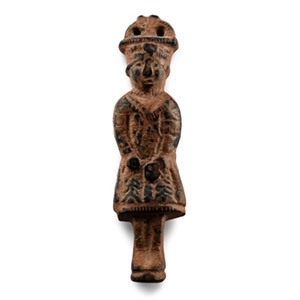
Western Asiatic Bronze Standing Figure Mount
16th-18th century A.D.Sold for (Inc. bp): £234
An appliqué of a female standing wearing a decorated knee-length robe, hands on her thighs holding a purse(?), elaborate pierced headdress; hollow to the reverse. 44 grams, 74 mm
Fine condition.
From a private Belgian collection; previously part of a private collection formed in Germany in the 1990s. From the private collection of John Meredith, acquired since the 1990s; thence by descent. This lot has been cleared against the Art Loss Register database, and is accompanied by an illustrated lot declaration signed by the Head of the Antiquities Department, Dr Raffaele D'Amato. -
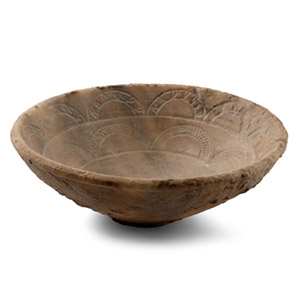
South Arabian Alabaster Bowl with Decorations
5th-3rd century B.C.Sold for (Inc. bp): £260
Shallow in profile with chamfered rim, concentric circles to inner face with arcading in two tiers; marine encrustation to exterior. 217 grams, 12.9 cm
UK private collection before 2000. Acquired on the UK art market. Private collection, London, UK. This lot has been cleared against the Art Loss Register database, and is accompanied by an illustrated lot declaration signed by the Head of the Antiquities Department, Dr Raffaele D'Amato. -
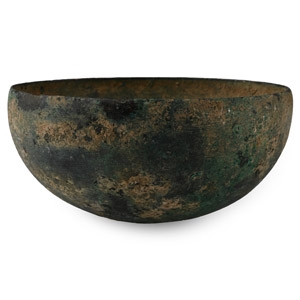
Achaemenid Bronze Vessel
Circa 500-400 B.C.Sold for (Inc. bp): £78
Hemispherical in profile with slightly inturned rim. 116 grams, 10.6 cm
Ex London, UK, collection, 1990-2000. This lot has been cleared against the Art Loss Register database, and is accompanied by an illustrated lot declaration signed by the Head of the Antiquities Department, Dr Raffaele D'Amato.
