
Loading, please wait...
_900x900.jpg "Western Asiatic Stone Macehead")
_200x200.jpg "Western Asiatic Stone Macehead")
.jpg "Western Asiatic Stone Macehead")
LOT 1483
Western Asiatic Stone Macehead
3RD-2ND MILLENNIUM B.C.
3 in. (370 grams, 75 mm).
With plain globular body, circular short shaft expanding to a circular flat base.
ProvenanceEx London, UK, collection, 1990-2000s.
This lot is accompanied by an illustrated lot declaration signed by the Head of the Antiquities Department, Dr Raffaele D'Amato.
See Gorelik, M., Weapons of Ancient East, IV millennium BC-IV century BC, Saint Petersburg, 2003, pl.XXX, no.47.
CONDITIONTimeLine Auctions follows a vetting process to ensure the authenticity and legality of all items, reinforcing our commitment to integrity and responsible trading. Each antiquity, antique, and coin lot undergoes thorough examination by a vetting committee of at least ten external specialists, professional trade association members, scientists, and archaeologists: Our Vetting Process
AUCTIONS:
TimeLine is a leading auction house specialising in antiquities, ancient art, collectables, natural history, coins, medals, and books. Our auctions offer museums, collectors, historians, and enthusiasts the opportunity to acquire unique and historically significant pieces.
-
.jpg)
Western Asiatic Collared Stone Macehead
2nd millennium B.C.Sold for (Inc. bp): £117
Tubular in form with tapering profile and collar above the socket. 396 grams, 88 mm
Ex London, UK, collection, 1990-2000s. This lot is accompanied by an illustrated lot declaration signed by the Head of the Antiquities Department, Dr Raffaele D'Amato. -
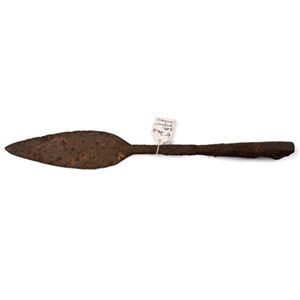
King James II Period Iron Lance Head
Late 17th century A.D.Estimate: £100 - 140 (+bp*)
Opening Bid: £50
Comprising a flat-section leaf-shaped blade with short round-section neck, square-section baluster with hatched surfaces, narrow flared socket with remains of original wooden shaft. 162 grams, 28.5 cm
By repute from the site of the battle of Sedgemoor (6th July 1685), Somerset, UK. Formerly from the collection of gentleman from South London, UK. Property of a private collector, West London, UK. This lot is accompanied by an illustrated lot declaration signed by the Head of the Antiquities Department, Dr Raffaele D'Amato. -
.jpg)
Post Medieval Iron Dagger with Bronze Hilt
17th century A.D.Sold for (Inc. bp): £247
Comprising a triangular two-edged blade with median chamfer, ricasso at the rear, quillons formed as two vertical rings on short arms, wooden grip with most of the hatched mounting ring, rectangular pommel with raised panel to each face. 276 grams, 42.2 cm
Previously acquired at a UK auction in the 1990s. Acquired from an Oxfordshire antiques centre. Property of a Berkshire, UK, collector. This lot is accompanied by an illustrated lot declaration signed by the Head of the Antiquities Department, Dr Raffaele D'Amato.
Swords and daggers with a square pommel became fashionable in the early 16th century, a Central European fashion. The edges of the present weapon do not ever appear to have been sharpened, so this may have been a parade-piece.
