
Loading, please wait...
LOT 1094
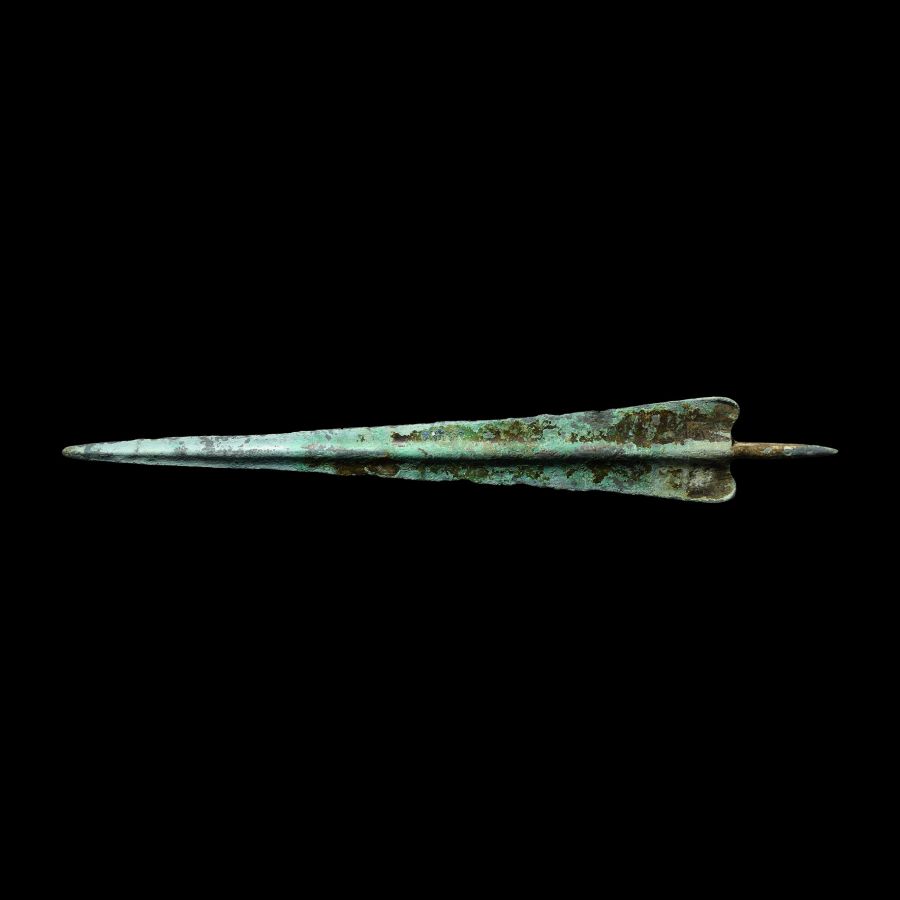
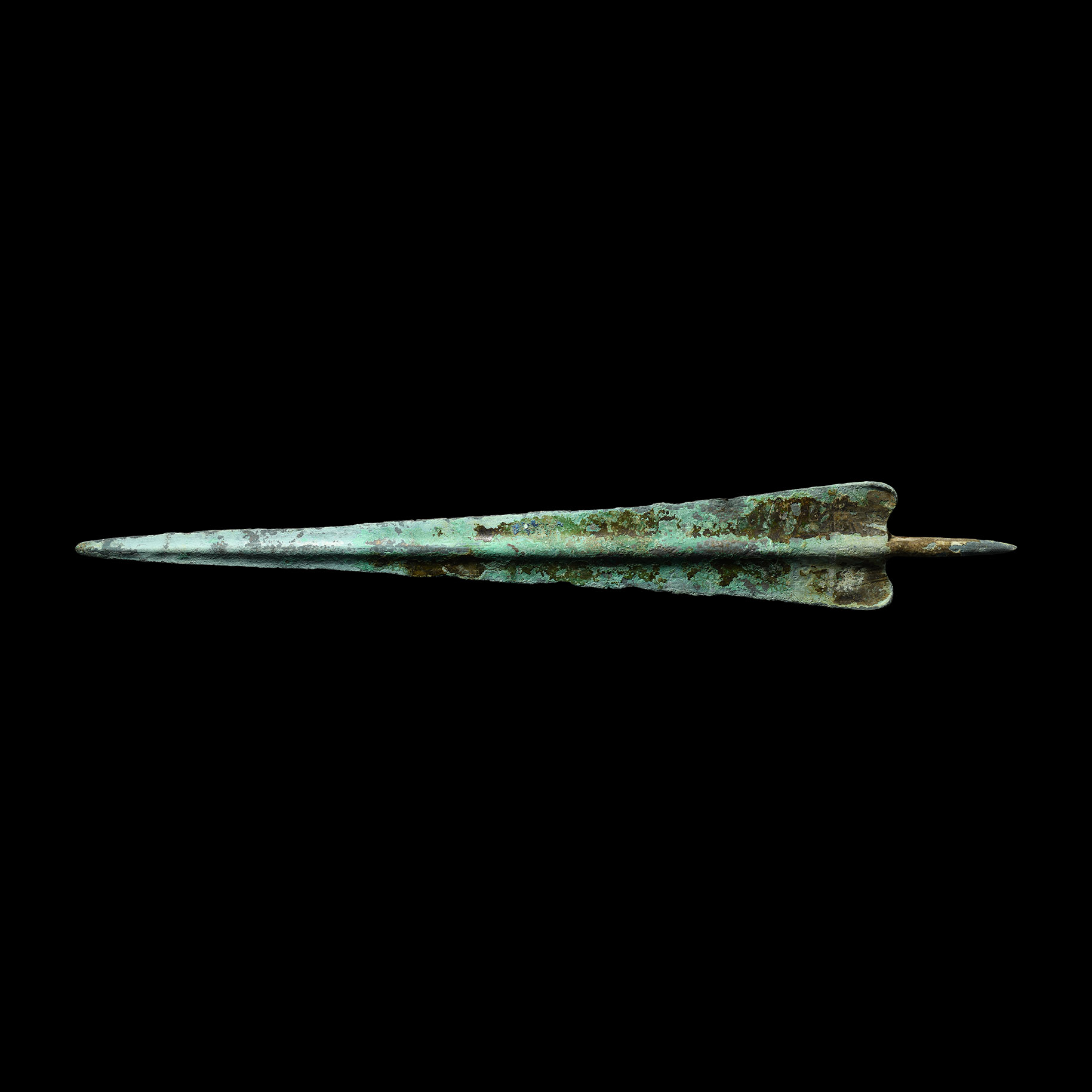
Western Asiatic Spearhead
12TH-10TH CENTURY B.C.
16 1/2 in. (375 grams, 42 cm).
A bronze spearhead tapering from shoulders to rounded tip; the short tang tapering to end for insertion into a shaft.
ProvenanceAbelita family collection, 1980-2015.
LiteratureCf. Khorasani, M.M., Arms and Armour from Iran - The Bronze Age to the End of the Qajar Period, Tübingen, 2006, p.632, cat.283.
FootnotesThis is a type 2 spearhead with a long blade and short tang. The elongated blade had two rivet heads at its base, here effaced by a later restoration. Similar pieces have been excavated in Marlik and Amlash.
CONDITIONTimeLine Auctions follows a vetting process to ensure the authenticity and legality of all items, reinforcing our commitment to integrity and responsible trading. Each antiquity, antique, and coin lot undergoes thorough examination by a vetting committee of at least ten external specialists, professional trade association members, scientists, and archaeologists: Our Vetting Process
AUCTIONS:
TimeLine is a leading auction house specialising in antiquities, ancient art, collectables, natural history, coins, medals, and books. Our auctions offer museums, collectors, historians, and enthusiasts the opportunity to acquire unique and historically significant pieces.
-
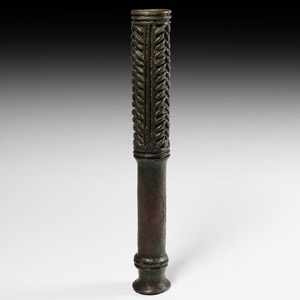
Akkadian Bronze Mace Head
2400-2000 B.C.Sold for (Inc. bp): £390
A bronze cylindrical mace head or cudgel with collared stem and flanged rim, the upper body with alternating vertical ribs and chevrons. 510 grams, 23 cm
Acquired 1980-2015. Ex Abelita family collection. -
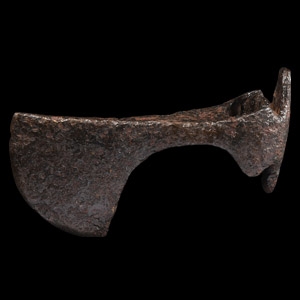
Viking Rus Period Bearded Type Axehead
Circa 11th century A.D.Sold for (Inc. bp): £468
An iron axehead with sturdy neck and slightly curved triangular blade; socket with lateral flanges and long rectangular extension to the rear. 746 grams, 19 cm
Acquired 1971-1972. From the collection of the vendor's father. Property of a London, UK, collector.
The axe seems to be a variation of type III of the Kirpichnikov classification of the Eastern Rus Axes typology - battle axes with downwards blade, two pairs of side wings and an elongated cut-out butt. Paulsen called the related type "Varangian group" of North Baltic axes. -
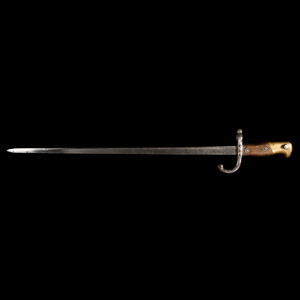
French Gras Model 1874 Rifle Bayonet
Dated 1878 A.D.Sold for (Inc. bp): £49
A Gras bayonet with T-shaped tapering 'epee' blade fitted with steel perforated quillon, rivetted wood grip scales and brass pommel slotted to fit the rifle barrel key; various punchmarks and numbered '54506' to quillon, the back of the blade inscribed 'Mme d'Arennes de Chatrs Avril 1878' in script. 573 grams,64.5 cm
Acquired on the UK antiques market between 1974-1985. Albert Ward collection, Essex, UK.
