
Loading, please wait...
LOT 1093
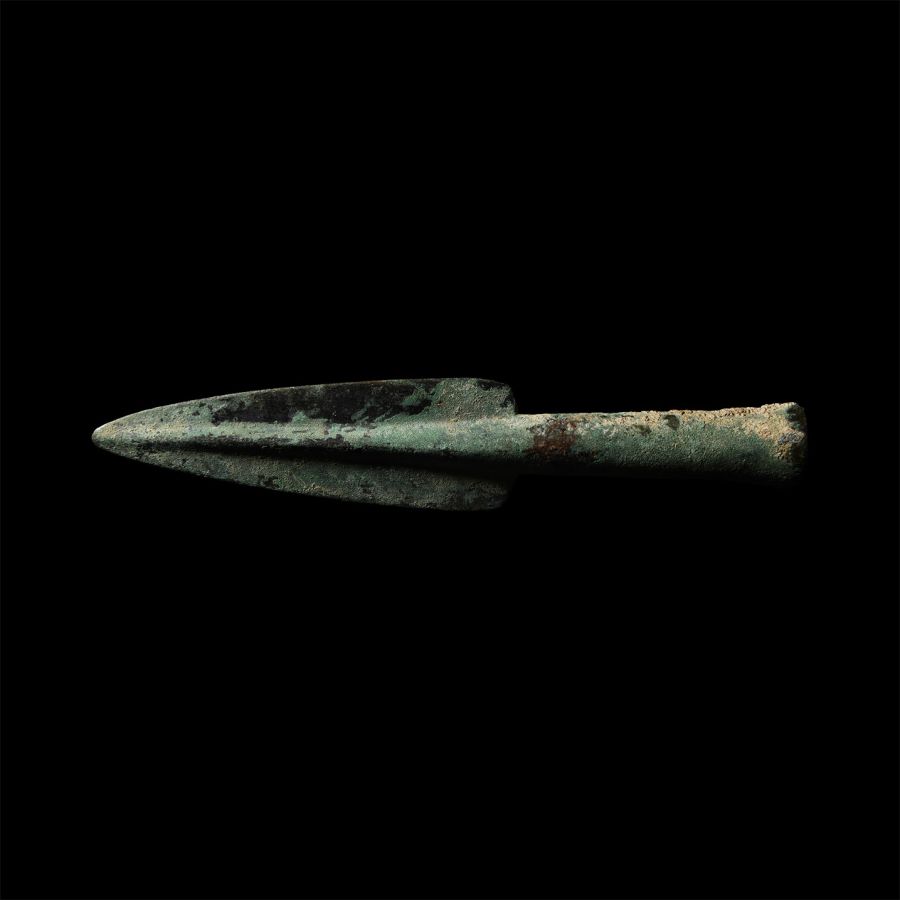
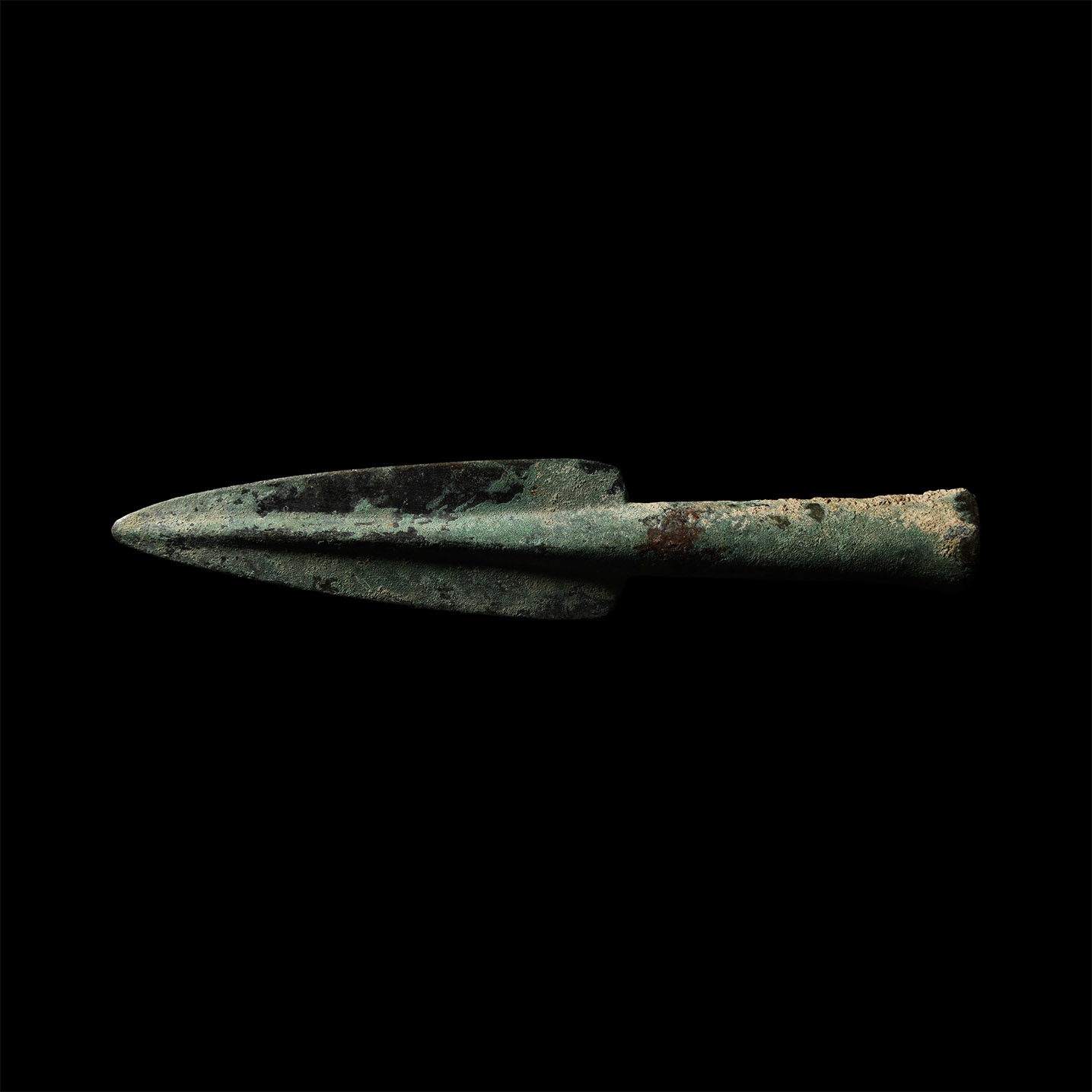
Western Asiatic Socketted Spearhead
9TH-7TH CENTURY B.C.
5 7/8 in. (81 grams, 15 cm long).
A bronze spearhead with short conical socket, triangular-shaped blade with prominent central rib.
ProvenanceEarlier 20th century Cologne collection, Germany.
London Mayfair gallery, UK.
Dr D.G. collection, 1990s-2019.
Accompanied by an old typed catalogue slip with provenance.
Cf. Gernez, G., L’armament en métal au Proche et Moyen-Orient: des origines a 1750 av. J.C., Paris, 2007, fig.2.105, subtype L5.B.b, for the type.
CONDITIONTimeLine Auctions follows a vetting process to ensure the authenticity and legality of all items, reinforcing our commitment to integrity and responsible trading. Each antiquity, antique, and coin lot undergoes thorough examination by a vetting committee of at least ten external specialists, professional trade association members, scientists, and archaeologists: Our Vetting Process
AUCTIONS:
TimeLine is a leading auction house specialising in antiquities, ancient art, collectables, natural history, coins, medals, and books. Our auctions offer museums, collectors, historians, and enthusiasts the opportunity to acquire unique and historically significant pieces.
LOT 1093
Western Asiatic Socketted Spearhead
Estimate £100 - 140€120 - 160 (for guidance only)$140 - 190 (for guidance only)
-
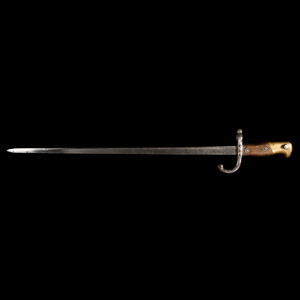
French Gras Model 1874 Rifle Bayonet
Dated 1878 A.D.Sold for (Inc. bp): £49
A Gras bayonet with T-shaped tapering 'epee' blade fitted with steel perforated quillon, rivetted wood grip scales and brass pommel slotted to fit the rifle barrel key; various punchmarks and numbered '54506' to quillon, the back of the blade inscribed 'Mme d'Arennes de Chatrs Avril 1878' in script. 573 grams,64.5 cm
Acquired on the UK antiques market between 1974-1985. Albert Ward collection, Essex, UK. -
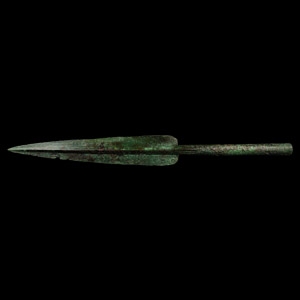
Marlik Decorated Spearhead
14th-10th century B.C.Sold for (Inc. bp): £330
A bronze spearhead with projecting midribs, long folded socket, decorated by concentric horizontal lines at the base and beneath the blade, horizontal triangles and vertical grooves along the shaft; triangular blade with round shoulders, ornamented by vertical lines running parallel to the midrib; pair of holes on the lower part of the shaft for attachment to a wooden haft. 562 grams, 55 cm
Fine condition.
Ex important Japanese collection, 1970s-2010.
The spearhead, cast in one piece, belongs to the type VIII, subtype B (triangular blade) of the Khorasani classification. Similar spearheads were excavated by Dr Negahban in the Marlik necropolis (tomb 1, trench III D) and are preserved in the National Museum of Iran, Teheran. -
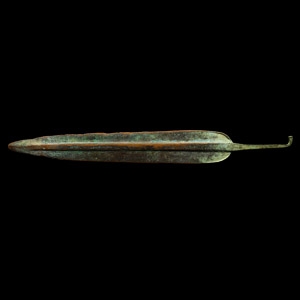
Marlik Spearhead with Pronounced Ridge
14th-10th century B.C.Sold for (Inc. bp): £114
A heavy bronze spearhead comprising an oval blade with gently curved shoulders and strong midrib, flat rectangular-section tang tapering to a curved end. 432 grams, 45.8 cm
Fine condition.
Ex Abelita family collection, 1980-2015.
The spearhead belongs to the type V of the heavy spearheads, similar to the ones excavated by Dr. Negahban in Tomb 47 (Trench XXIIE) of the Marlik necropolis. The heavy spearheads, cast in one piece, usually have an oval blade with rounded gently curved shoulders and a rounded midrib near the tang.
